




01. Edit your form online
Type text, add images, blackout confidential details, add comments, highlights and more.

Type text, add images, blackout confidential details, add comments, highlights and more.

Draw your signature, type it, upload its image, or use your mobile device as a signature pad.

Send it via email, link, or fax. You can also download it, export it or print it out.
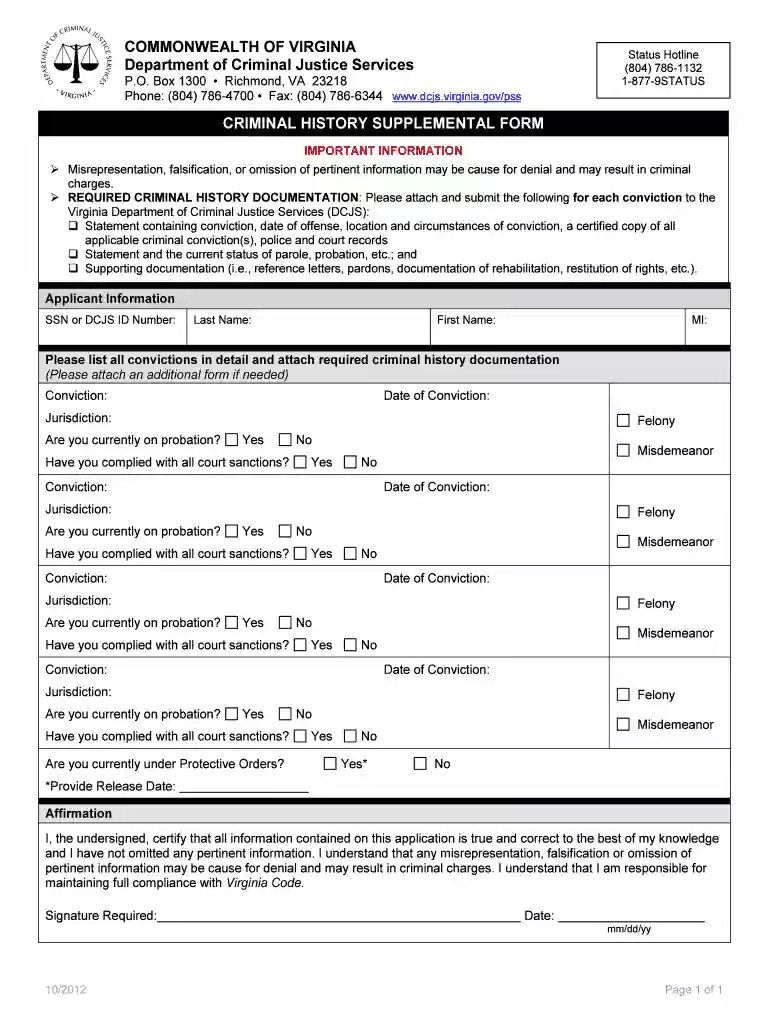
The Criminal History Supplemental Form for the Virginia Department of Criminal Justice Services is a critical document used to provide detailed information about an individual's criminal record. This form is often required as part of job applications or other official processes that necessitate a comprehensive background check. The purpose of this form is to ensure that all relevant details about past convictions, current probation status, and compliance with any court sanctions are transparently disclosed. Accurate completion of this form is essential since misrepresentation can lead to denial of applications or legal consequences.
Individuals seeking the Criminal History Supplemental Form can acquire it directly from the Virginia Department of Criminal Justice Services website. Alternatively, some employers or organizations may provide the form as part of their application process. It is crucial to ensure that you are using the most current version of the form, as regulations and requirements can change over time. Those without internet access may contact the department by phone to request a physical copy or seek assistance with completing the form online.
Read Instructions Carefully: Before you begin filling out the form, read all provided instructions. This ensures you understand what information is required and how it should be presented.
Personal Information: Start by filling in your personal details accurately, including your full name, date of birth, and Social Security number.
Detailing Criminal History: Provide all relevant criminal history information. This includes listing each offense, the date of conviction, and the jurisdiction where the offense occurred. You may need to attach additional sheets if your history is extensive.
Probation and Compliance: If applicable, include details about current probation status and any compliance with court orders or sanctions. Be thorough in your descriptions to avoid any accusations of omission or dishonesty.
Review and Verification: Double-check all information for accuracy. Sign the form to confirm that the information provided is true and correct to the best of your knowledge.
The Criminal History Supplemental Form is significant for both applicants and organizations. For applicants, it represents a formal opportunity to disclose past legal issues in a structured and honest manner. For organizations, the form aids in making informed decisions regarding the suitability of an individual for particular positions or roles, especially those involving security, trust, or sensitive information. It helps create a transparent and trust-based environment between applicants and potential employers.
Legal compliance with the Criminal History Supplemental Form involves understanding both the local and federal laws surrounding privacy and employment. Misrepresentation or failure to disclose full criminal history can lead to legal consequences, ranging from application denial to potential criminal charges. On a broader scope, this form's use is governed by the Fair Credit Reporting Act (FCRA) when used for employment purposes, requiring consent from the individual whose history is being checked.
Non-compliance with the requirements of the Criminal History Supplemental Form can result in serious penalties. These may include being barred from certain positions, facing legal action for misrepresentation, and being subject to fines or other sanctions. Ensuring accurate and honest disclosure not only protects the individual from legal repercussions but also maintains integrity within the hiring or application process.
Both digital and paper versions of the Criminal History Supplemental Form are available, each with unique benefits. Digital forms facilitate faster processing and easier data management. On the other hand, paper versions remain accessible for individuals without reliable internet access or those who prefer traditional submission methods. It’s vital to ensure whichever format is used, the information remains consistent and accurately reflected across different platforms.
Eligibility to submit the Criminal History Supplemental Form typically involves being of legal age and requiring the form for a legitimate purpose, such as a job application or legal proceeding. The specific requirements may vary depending on the context in which the form is required—whether for employment, volunteering, or other individual cases, with each scenario potentially demanding varying levels of detail or supplementary documentation.


We've got more versions of the Criminal History Supplemental Form - Virginia Department of form. Select the right Criminal History Supplemental Form - Virginia Department of version from the list and start editing it straight away!
At DocHub, your data security is our priority. We follow HIPAA, SOC2, GDPR, and other standards, so you can work on your documents with confidence.
Submit to the Department Criminal History Supplemental Form (PSSCHS); you can put up to three (3) criminal convictions on one (1) form.
DEPARTMENT OF CRIMINAL JUSTICE SERVICES Chapter 260. Criminal History Supplemental Form, ORACHS. State regulations are updated quarterly; we currently have


