




01. Edit your form online
Type text, add images, blackout confidential details, add comments, highlights and more.

Type text, add images, blackout confidential details, add comments, highlights and more.

Draw your signature, type it, upload its image, or use your mobile device as a signature pad.

Send it via email, link, or fax. You can also download it, export it or print it out.
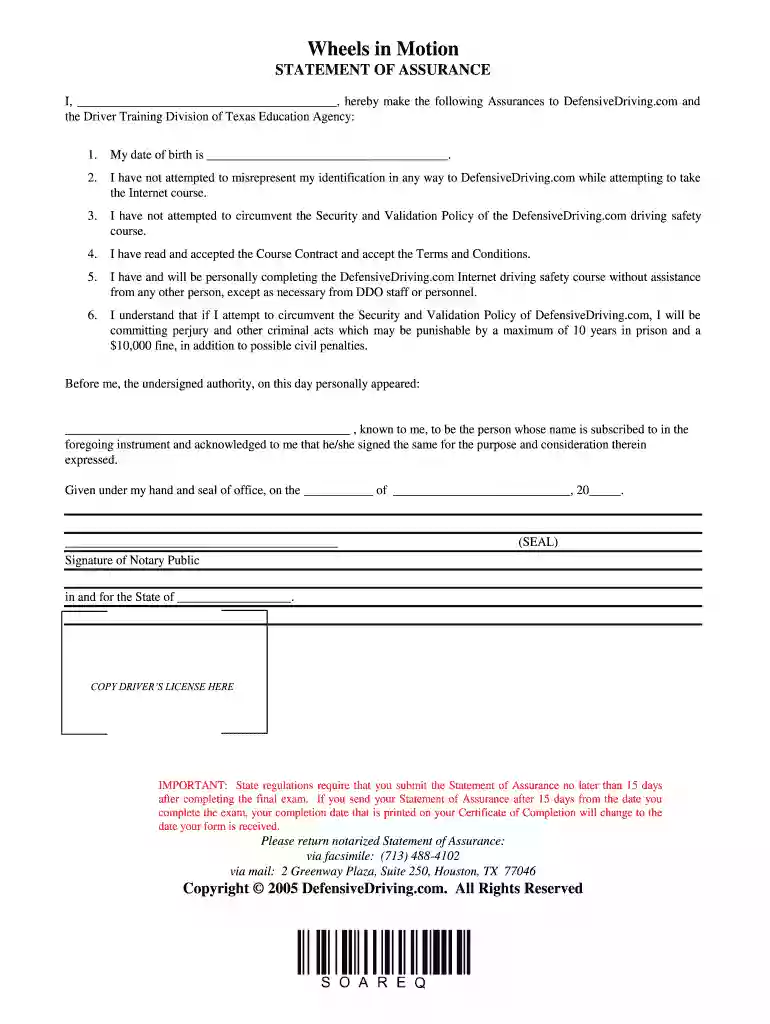
The Statement of Assurance for Defensive Driving is a legal document that participants must complete when enrolling in an online defensive driving course, such as the one offered by DefensiveDriving.com. This form serves to verify the identity of the participant and ensure compliance with the course's security policies. By signing this document, the participant affirms that they will complete the course independently and acknowledge the legal consequences of any misrepresentation. Notably, the document may include a section for notarization and specific instructions for submission within a predefined timeframe. This assurance helps maintain the integrity of the online driving education system by preventing fraud and ensuring that participants genuinely benefit from the course content.
Using the Statement of Assurance effectively involves several key steps. Initially, participants must thoroughly read the document to understand its terms and conditions. It is essential to pay close attention to sections that outline identity verification requirements and compliance with security measures. Participants should then accurately fill out the form, ensuring that all personal information is correct and complete. After completing the form, it must be signed, thereby confirming the participant's agreement to the terms. If a notarization is required, arrangements should be made to have the document signed in the presence of a notary public. Finally, participants need to submit the signed form according to the instructions provided, which may involve online submission or mailing the document to a specified address.
Read the Document: Start by carefully going through the entire document. Ensure you understand all the requirements and consequences outlined.
Fill Out Your Information: Enter your personal details accurately. This typically includes your name, address, course details, and any other requested information.
Identity Verification: Prepare any documents that might be required for identity verification, such as a driver's license or ID card.
Sign the Form: Sign the document, either digitally or in ink, depending on the format required. Ensure your signature matches the one on your official identification documents.
Notarization (if necessary): If the form requires notarization, arrange to meet with a notary public. You will need to provide valid identification during this process.
Submission: Submit the completed form following the specified procedures. This could involve uploading it electronically or sending it through mail.
Several critical elements are integral to the Statement of Assurance:
Identity Verification: The form includes provisions to confirm the participant's identity, which may necessitate presenting a government-issued ID.
Acknowledgment of Terms: Participants must acknowledge that they understand and agree to abide by the terms of the course, emphasizing independent completion.
Legal Compliance: There is typically a section detailing the legal implications of dishonesty or misrepresentation in the completion of the course.
Notarization Clause: For some variants, a notarization clause might be present, requiring authentication by a notary public.
Submission Instructions: Clear guidelines on how and when to submit the form are provided, ensuring seamless processing and validation.
Legally, the Statement of Assurance is used to uphold the integrity and credibility of online defensive driving courses. By affirming their commitment through this document, participants legally bind themselves to complete the course personally, without external assistance. This legal commitment is crucial as it ensures that the participant receives the full educational benefit intended by the course. The document also serves as a protective measure for the course provider, ensuring compliance with state regulations and protecting against fraud. Moreover, by detailing the consequences of non-compliance, it acts as a deterrent against dishonest behavior.
While the Statement of Assurance is generally standardized across different programs, state-specific rules may apply. These rules dictate the acceptable methods of submitting the form and any additional compliance requirements based on individual state legislation. For example, states may have unique notarization laws that require specific procedures for validating the form. Additionally, submission deadlines may vary depending on the jurisdiction, impacting when a course participant must have the document completed and submitted. It is vital for participants to familiarize themselves with these state-specific regulations to ensure full compliance and avoid potential legal repercussions.
Failing to comply with the terms outlined in the Statement of Assurance can lead to several penalties. Foremost among these is the potential for disqualification from the course, meaning the participant would not receive the certification required, such as insurance discounts or removal of points from their driving record. Additionally, fraudulent completion of the form could result in further legal action, including fines or other penalties as dictated by state law. In severe cases, participants might also face revocation of completed course credits or need to retake the course entirely at their expense. Awareness of these penalties ensures that participants understand the importance of full compliance.
Consider a scenario where an individual registered for an online defensive driving course to have points removed from their driving license. They would need to complete the Statement of Assurance to affirm their commitment to undertaking the course personally. Alternatively, a corporate client may enroll a group of employees in defensive driving courses and require each employee to submit a personal Statement of Assurance. These examples highlight how the form acts as a checkpoint for integrity and responsible learning across various contexts, ensuring that all participants engage with the course content authentically and adhere to its educational goals.
We've got more versions of the STATEMENT OF ASSURANCE - Defensive driving form. Select the right STATEMENT OF ASSURANCE - Defensive driving version from the list and start editing it straight away!
| Versions | Form popularity | Fillable & printable |
|---|---|---|
| 2005 | 4.9 Satisfied (60 Votes) |
At DocHub, your data security is our priority. We follow HIPAA, SOC2, GDPR, and other standards, so you can work on your documents with confidence.
The Defensive Driving program helps participants identify and implement successful techniques they can use to become better drivers.Read more
1. What is a Driver Improvement/Defensive Driving Course? 2. What is the difference between Driver Improvement and Defensive Driving? 3. Why would I take aRead more
Defensive driving really means be ready for anything. On city streets, rural roads or freeways, it means always expect the unexpected.


