





Definition and Meaning of the Model Facility Evacuation Agreement
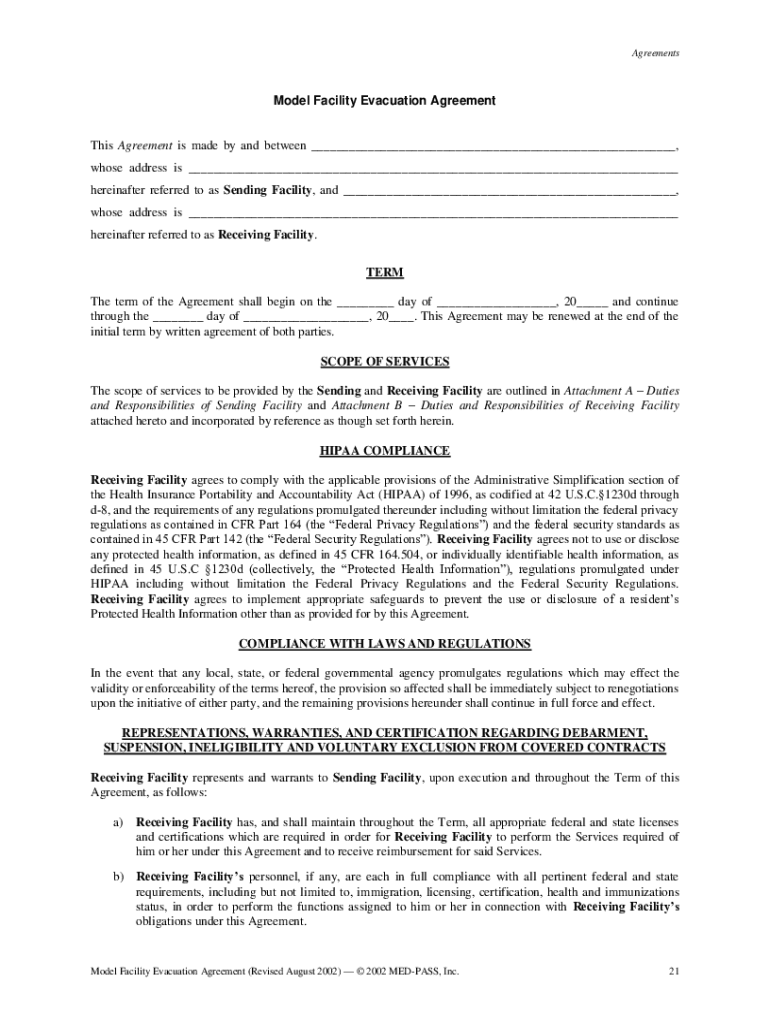
The Model Facility Evacuation Agreement is a formal document used to outline the responsibilities and terms between a Sending Facility and a Receiving Facility during an evacuation process. This agreement is crucial in ensuring that both parties understand their roles, the scope of services involved, and the legal compliance required, particularly in regard to the Health Insurance Portability and Accountability Act (HIPAA). The agreement provides a framework for protecting sensitive information, maintaining confidentiality, and ensuring that patient records are handled appropriately during an evacuation scenario.
How to Use the Model Facility Evacuation Agreement
Using the Model Facility Evacuation Agreement involves several essential steps that both the Sending and Receiving Facilities must follow.
-
Review Agreement Terms: Both parties should thoroughly review the document to understand the obligations and expectations.
-
Customizing the Agreement: Tailor the agreement to fit the specific needs of both facilities. This includes detailing the logistical aspects of how patients will be transferred and what support is necessary.
-
Assigning Responsibilities: Clearly define who is responsible for what aspects of the evacuation process. This can include transportation logistics, patient care during transit, and financial responsibilities.
-
Ensuring Compliance: Verify that the agreement aligns with legal requirements, including HIPAA regulations, to protect health information.
-
Finalization and Signatures: Once both parties are satisfied with the terms, each facility must sign the agreement to make it legally binding.
Key Elements of the Model Facility Evacuation Agreement
Understanding the structure of the Model Facility Evacuation Agreement is important for its effective implementation:
-
Terms and Scope of Services: Defines the duration of the agreement and the services provided during an evacuation.
-
Responsibilities: Clearly outlines the duties of both the Sending and Receiving Facilities, which is critical to avoid misunderstandings.
-
Compliance: Ensures that the agreement complies with HIPAA and other relevant regulations to protect patient privacy.
-
Confidentiality and Record-Keeping: Details how sensitive information is to be handled and stored.
-
Termination Clauses: Conditions under which the agreement can be terminated.
Steps to Complete the Model Facility Evacuation Agreement
Completing the agreement involves strategic steps to ensure clarity and legal compliance:
-
Gather Information: Both facilities need to compile essential data that will be included in the agreement, such as capacity, resources, and personnel availability.
-
Draft Agreement: Develop a draft of the agreement, incorporating necessary legal advice to ensure it meets all regulatory standards.
-
Review and Revise: Both facilities should review the draft and propose any changes to ensure mutual satisfaction with the terms.
-
Finalize and Execute: Once reviewed, the final document should be prepared for signatures from authorized representatives of both facilities.
-
Distribute Copies: Both facilities should keep a signed copy for their records and distribute it to all relevant departments.
Legal Use of the Model Facility Evacuation Agreement
The legal application of this agreement involves ensuring adherence to specific regulations and laws. The primary legal responsibility is complying with HIPAA, which requires that any transfer of patient information or care adheres to strict privacy standards. In addition, the agreement must follow state-specific regulations, which can vary significantly regarding medical facilities and patient care logistics. Legal counsel should be involved in the drafting and revision processes to ensure that the agreement meets all necessary legal criteria and adequately protects both facilities in the event of a dispute.
Importance and Benefits of the Model Facility Evacuation Agreement
The Model Facility Evacuation Agreement is important for several reasons:
-
Streamlined Evacuation Process: By having a pre-defined plan, facilities can ensure that patient evacuations are carried out efficiently and safely.
-
Clear Accountability: Assigns clear roles and responsibilities, minimizing confusion and enhancing coordination during evacuations.
-
Protection of Sensitive Information: Ensures compliance with privacy laws, safeguarding against breaches.
-
Risk Management: Helps anticipate and mitigate potential risks associated with patient transfers.
Examples of Using the Model Facility Evacuation Agreement
Real-world scenarios illustrate the flexibility and necessity of such agreements:
-
Natural Disasters: Facilities located in regions prone to hurricanes or floods use evacuation agreements to prepare for rapid patient relocation.
-
Facility Outages: In cases of power failures or structural damage, the agreement enables a quick and organized transfer of patients to a safe location.
-
Pandemic Responses: Hospitals can use the agreements to manage overcrowding by transferring patients to auxiliary sites.
State-Specific Rules for the Model Facility Evacuation Agreement
States have different regulations governing how facility evacuation agreements should be formulated and executed:
-
California: Requires strict adherence to state-specific health information privacy laws beyond HIPAA, which may necessitate additional confidentiality clauses.
-
Florida: Given its hurricane-prone location, it mandates detailed logistics in evacuation agreements to tackle natural disasters efficiently.
-
Texas: In areas affected by frequent flooding, agreements may need to include specific evacuation routes and processes to ensure safety.
Understanding these variations is crucial for the effective use and legal compliance of the Model Facility Evacuation Agreement across different states.