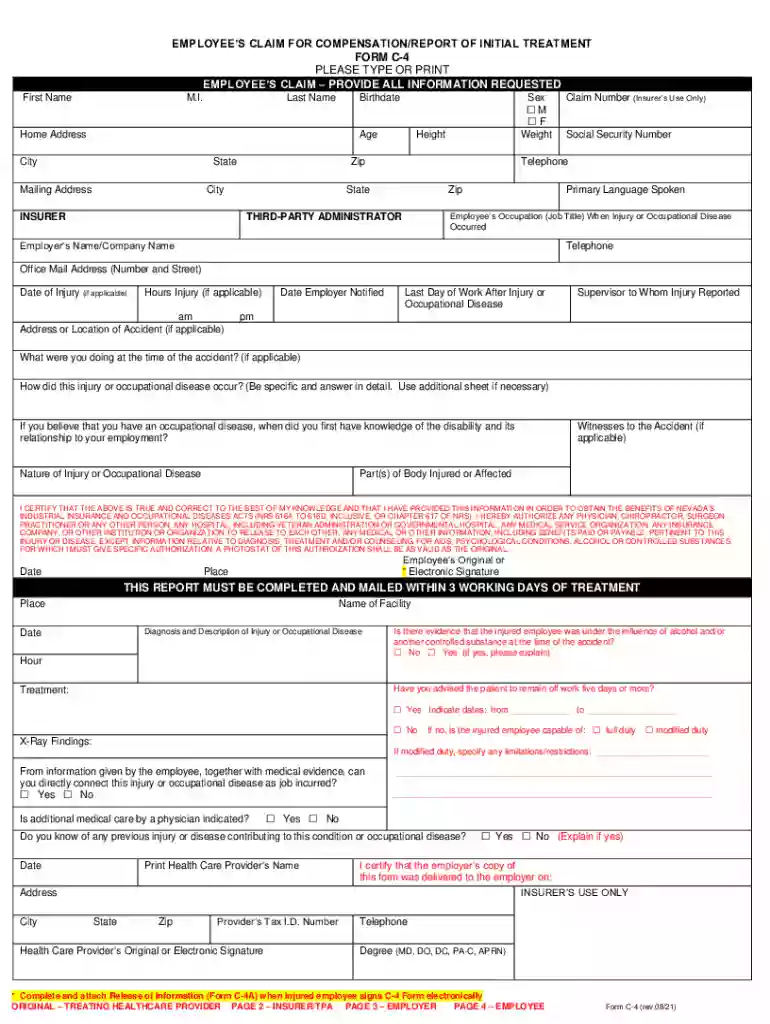
Revised C-4 Form Employee's Claim for Compensation 2026

Get Form
Revised C-4 Form Employee's Claim for Compensation Preview on Page 1

Here's how it works

01. Edit your form online
Type text, add images, blackout confidential details, add comments, highlights and more.

02. Sign it in a few clicks
Draw your signature, type it, upload its image, or use your mobile device as a signature pad.

03. Share your form with others
Send it via email, link, or fax. You can also download it, export it or print it out.

Definition and Meaning

The Revised C-4 Form, officially known as the Employee’s Claim for Compensation, is a document used by employees in the United States to formally report work-related injuries or occupational diseases. This form is crucial in starting the claims process, ensuring that an employee's rights to compensation are protected following a workplace incident. It requires comprehensive personal and medical details to facilitate accurate processing and evaluation by relevant authorities or insurance providers. The form is integral for both the employee and employer in maintaining compliance with labor laws and compensation regulations.

How to Use the Revised C-4 Form

Using the Revised C-4 Form involves several steps aimed at providing detailed information about the work-related injury or illness. Firstly, employees must gather all relevant personal and employment details, along with specifics of the incident. The form requires:

  • Personal information: Employee's name, address, and occupation.
  • Incident specifics: Date, time, and location of the injury or onset of the disease.
  • Medical details: Initial medical treatment or diagnosis.
  • Witness information: Names and contact details of any witnesses to the injury.

Once completed, the form should be submitted to the appropriate authority or the employer's human resources department, ensuring that it is within the prescribed timelines.

Steps to Complete the Revised C-4 Form

Completing the Revised C-4 Form should be done with attention to detail to prevent delays or rejection. The process generally includes:

  1. Access the Revised C-4 Form via the official website or obtain it from your employer.
  2. Fill in your personal details accurately.
  3. Provide a clear account of the incident leading to the injury or illness.
  4. If applicable, input witness information to support your claim.
  5. Ensure all sections related to medical treatment are filled out, often necessitating input from a healthcare provider.
  6. Review the completed form for any errors or omissions before submission.
  7. Submit the form to your employer or the designated state workers' compensation office.

Key Elements of the Revised C-4 Form

Several key elements are critical to the Revised C-4 Form, ensuring comprehensive documentation of the claim. These include:

  • Employee Information: Full name, contact information, and employment details.
  • Injury/Illness Description: Precise description of the events or actions leading to the condition.
  • Medical Assessment: Initial diagnosis, treatment provided, and any ongoing medical needs.
  • Witness Testimony: Details of witnesses, if available, to corroborate the incident circumstances.
  • Certification: Employee and employer signatures to authenticate the claim information.

Filing Deadlines and Important Dates

Deadlines play a vital role in the filing of the Revised C-4 Form to ensure eligibility for compensation. Most states require the form to be submitted within a specific timeframe, typically within three working days after medical treatment. Failure to adhere to these deadlines could jeopardize eligibility for compensation. It's essential to check specific state guidelines to confirm the filing period and any accompanying requirements.

Required Documents

When filing the Revised C-4 Form, supplementary documents can bolster the claim. Required documents typically include medical reports and employer certificates. These can help verify the nature and extent of the injury or illness, supporting the details provided on the form. In some cases, copies of employment contracts or job descriptions may also be requested to further contextualize the claim.

Form Submission Methods

There are multiple avenues to submit the Revised C-4 Form, offering flexibility to accommodate different preferences and capabilities:

  • Online: Utilize the official state website or portal, where electronic submissions are accepted.
  • Mail: Send the completed form and any required documentation via postal mail to the designated address.
  • In-Person: Submit the form directly at a local workers' compensation office or through your employer's human resources department.

Penalties for Non-Compliance

Non-compliance with Revised C-4 Form requirements can result in significant penalties. These consequences may include denial of the compensation claim, leading to the employee bearing medical costs and lost wages. Additionally, persistent non-compliance could lead to legal repercussions or financial penalties against the employer. Therefore, adherence to guidelines on accurate form submission and deadline observance is critical in the compensation process.

be ready to get more

Complete this form in 5 minutes or less

Get form

Got questions?

We have answers to the most popular questions from our customers. If you can't find an answer to your question, please contact us.
Contact us
The Form 43 is to be completed by the respondent (employer/workers compensation insurance carrier) to notify the Administrative Law Judge, the claimant (employee/decedent), and all parties to the claim of its intention to deny the compensability of all or part of the claimants claim to workers compensation benefits.
Complete the Notice of Injury or Occupational Disease, Form C-1. You must fill out this form and turn it in to your employer within one week of your injury. If your work-related injury requires medical treatment, you will need to fill out Form C-4, Employees Compensation Report of Initial Treatment.
C-4.3. Use this form: 1. When rendering an opinion on MMI and/or permanent partial impairment; or 2. In response to a request by the Workers Compensation Board to render a decision on MMI and/or permanent partial impairment.
New York law states that workers have up to two years to file a claim if they are suffering from a work-related illness or injury. For occupational hearing loss, workers have up to three months to report the injury and 90 days to file a workers compensation claim.
ing to the guidelines you have: Two years from the date of the workplace accident that resulted in your injury or. Two years from the time you knew or should have known the occupational disease stemmed from the nature of your job.

Security and compliance

At DocHub, your data security is our priority. We follow HIPAA, SOC2, GDPR, and other standards, so you can work on your documents with confidence.

Learn more
ccpa2
pci-dss
gdpr-compliance
hipaa
soc-compliance

People also ask

C. VOLUNTARY COMPENSATION INSURANCE Bodily Injury by Accident:$100,000-each accident Bodily Injury by Disease: $100,000-each employee Bodily Injury by Disease: $500,000-policy limit
When to File. You must notify your employer within 30 days, but it is best to do so as soon as possible. If 30 days pass and you have not notified your employer, you may lose your rights to workers compensation benefits.
Employees who are eligible for wage replacement benefits pursuant to the Workers Compensation Law receive no wage replacements for the first seven calendar days of disability (which is the Workers Compensation Law initial waiting period), unless the disability extends beyond 14 calendar days.

Related links