




01. Edit your form online
Type text, add images, blackout confidential details, add comments, highlights and more.

Type text, add images, blackout confidential details, add comments, highlights and more.

Draw your signature, type it, upload its image, or use your mobile device as a signature pad.

Send it via email, link, or fax. You can also download it, export it or print it out.
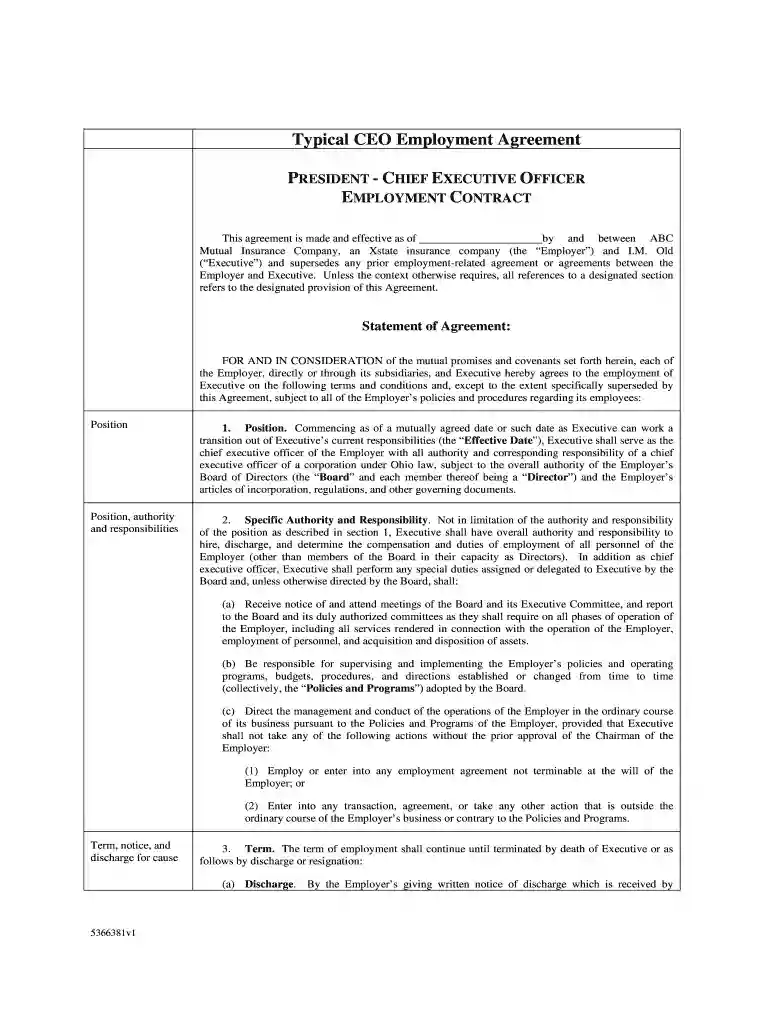
A Typical CEO Employment Agreement outlines the terms and conditions of employment for a Chief Executive Officer (CEO), covering various crucial aspects to ensure a comprehensive understanding between the employer and the executive. This section will dive into the core elements typically included in such agreements to provide clarity and structure.
Responsibilities and Duties: Clearly delineates the specific responsibilities and expected duties of the CEO, ensuring everyone understands what is required for successful job performance.
Compensation and Benefits: Details the base salary, bonuses, stock options, and any additional perks or benefits the CEO is entitled to, reflecting the reward package for the performance.
Termination and Severance: Outlines the conditions under which the employment can be terminated, including voluntary resignation, termination with or without cause, and the severance package if applicable.
Confidentiality and Non-Compete: Discusses clauses preventing the CEO from sharing company secrets and engaging in competitive activities after employment ends, protecting the company's interests.
Understanding the legal context of a CEO Employment Agreement is critical for compliance with applicable laws and regulations. This section addresses how these agreements function within a legal framework.
Governing Law: Specifies which state's law will govern the terms of the agreement, providing a legal backdrop that can influence the contract's interpretation.
Dispute Resolution: Describes the process for resolving any disputes that arise under the agreement, which may include mediation or arbitration as alternative dispute resolution methods.
Compliance with EEOC and Employment Laws: Ensures the agreement adheres to Equal Employment Opportunity Commission (EEOC) guidelines and other federal and state employment laws, avoiding discriminatory practices.
Completing a CEO Employment Agreement involves several key steps, ensuring all necessary provisions are addressed effectively. This guide outlines an effective approach:
Draft the Agreement: Begin with a draft that includes all essential elements like role definition, compensation, and termination conditions.
Review with Legal Counsel: Have the agreement reviewed by legal experts to ensure compliance with applicable laws and that all terms are enforceable.
Negotiate Terms: Engage with the prospective CEO to negotiate terms, making adjustments as necessary to reach a mutually agreeable contract.
Finalize and Execute: Once both parties agree on the terms, finalize the document and have it signed by both the CEO and an authorized representative of the company.
Acquiring a CEO Employment Agreement involves accessing various resources to obtain a template or legal assistance to draft a customized document.
Legal Templates: Many law firms or legal document services provide templates as starting points that can be tailored to meet specific needs.
Legal Consultation: Engaging with legal professionals for a personalized agreement designed to suit the company's unique requirements.
Document Management Platforms: Services like DocHub offer tools to edit, send, and sign electronic versions of such agreements, streamlining the paperwork process.
The utilization of CEO Employment Agreements is prevalent among various business entities seeking to formalize employment with executive leaders.
Corporations: Both public and private companies employ these agreements to define the executive roles crucial to their strategic leadership.
Nonprofits: Even in the nonprofit sector, where executive roles may not include equity incentives, these agreements help clarify the CEO's commitments and expectations.


Understanding specific terminology related to CEO Employment Agreements is crucial for clarity and comprehensive agreement formation. Here are some key terms:
Employment At-Will: A common clause that allows either party to terminate the employment relationship at any time for any reason, or for no reason, with or without notice.
Change of Control Provisions: These specify what happens if the company undergoes a significant change in ownership, often addressing the CEO's position or severance in such events.
Incentive Plans: Refer to bonus, stock, or other performance-based forms of compensation that align CEO interests with company success.
While many provisions of a CEO Employment Agreement are standard, certain aspects may vary depending on state law.
Non-Compete Clauses: State laws differ significantly on the enforceability of non-compete agreements, with states like California having strict limitations against them.
Severance Agreements: States may have specific rules regarding what constitutes fair severance and the tax implications associated with these payouts.
Governing Law Provisions: Companies must select the appropriate state law to govern their contracts, considering the implications of local employment laws.
Providing practical examples helps illustrate how a CEO Employment Agreement is applied in real-world settings, enhancing understanding and applicability.
Case Study in Technology: A large tech firm drafts a CEO agreement that includes specific performance milestones tied to innovative project completions as part of compensation incentives.
Healthcare Organization: A nonprofit hospital system may include restrictive covenants within their CEO contract to protect sensitive data and maintain competitive advantages in the medical sector.
Through these detailed insights into the Typical CEO Employment Agreement, companies can create robust contracts that facilitate clear expectations, protect interests, and foster strong executive relationships.
We've got more versions of the Typical CEO Employment Agreement form. Select the right Typical CEO Employment Agreement version from the list and start editing it straight away!
| Versions | Form popularity | Fillable & printable |
|---|---|---|
| 2012 | 4.5 Satisfied (42 Votes) |
At DocHub, your data security is our priority. We follow HIPAA, SOC2, GDPR, and other standards, so you can work on your documents with confidence.


