




01. Edit your code houston ce 1207 online
Type text, add images, blackout confidential details, add comments, highlights and more.

Type text, add images, blackout confidential details, add comments, highlights and more.

Draw your signature, type it, upload its image, or use your mobile device as a signature pad.

Send houston ce 1207 via email, link, or fax. You can also download it, export it or print it out.
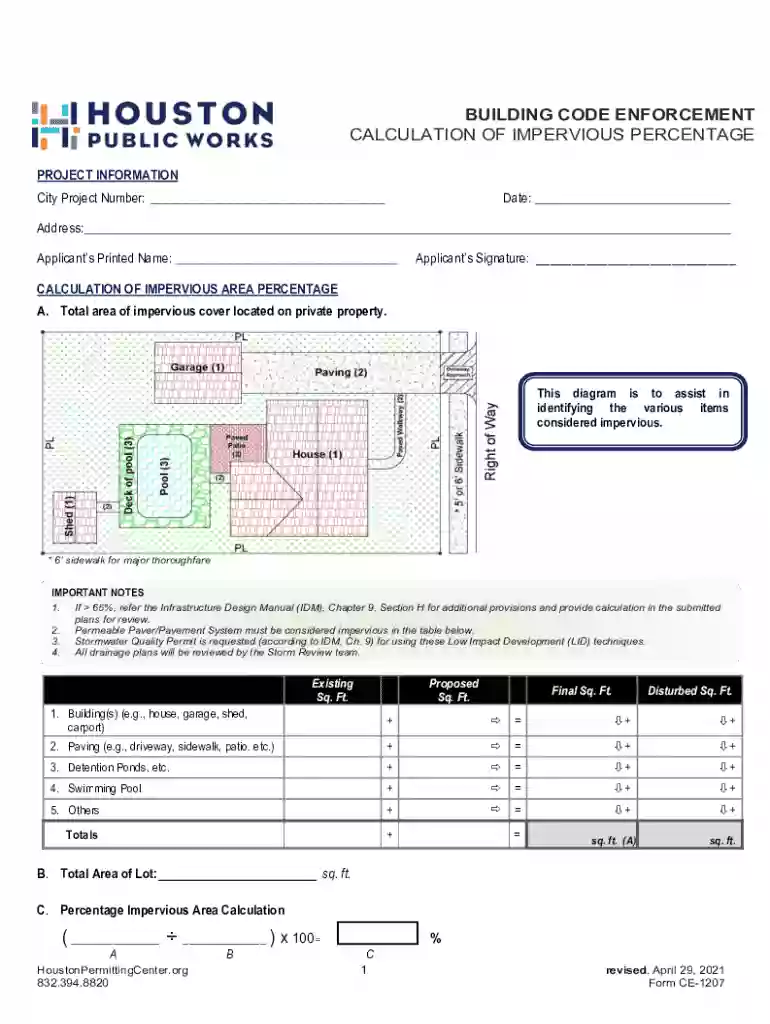
The "mainform-ce-1207-calculation-of-impervious-percentage-city-of-houston-texas" is a specialized document utilized by property owners and developers in the City of Houston. Its primary function is to calculate the impervious surface percentage on a given property, critical for compliance with building codes and stormwater management regulations. Impervious surfaces are non-porous areas that prevent water absorption into the ground, such as rooftops, driveways, and patios. Understanding this percentage helps in managing surface runoff and ensuring adherence to local environmental standards.
The calculation of impervious surfaces plays a crucial role in urban planning and environmental protection. It aids in assessing the impact of development on local water bodies and drainage systems. In the City of Houston, adhering to these calculations ensures that new developments do not exacerbate flooding risks or violate environmental guidelines. By completing the form accurately, applicants contribute to sustainable urban development.
Filling out the "mainform-ce-1207-calculation-of-impervious-percentage-city-of-houston-texas" requires attention to detail and accuracy in reporting. Here is a step-by-step guide:
Collect Property Information: Begin by gathering essential details about the property, including its address, legal description, and total area in square feet.
Identify Existing Impervious Areas: List all existing impervious surfaces on the property, such as buildings, sidewalks, and driveways. Measure each area in square feet.
Document Proposed Impervious Surfaces: For new projects, add details of any additional impervious surfaces planned, including measurements.
Calculate Total Impervious Area: Sum up the area of both existing and proposed impervious surfaces.
Determine Impervious Percentage: Divide the total impervious area by the total property area, then multiply by 100 to get the impervious percentage.
Review Compliance Notes: Ensure that the calculations align with local stormwater management regulations outlined in the form.
Acquiring the "mainform-ce-1207-calculation-of-impervious-percentage-city-of-houston-texas" can be done through various means:
Understanding the components of the form is vital for accurate completion. The main sections include:
The impervious percentage calculation holds legal significance under the City of Houston's building and environmental codes. Accurate reporting is imperative to avoid:
This form is predominantly used by:


Understanding real-world applications of the form assists in grasping its practical importance:
While the form is tailored specifically for the City of Houston, it operates under broader Texas state regulations that prioritize flood prevention and environmental conservation. Local ordinances may further dictate specific limits on acceptable impervious percentages based on a property's zoning classification and location within flood-prone areas.
We've got more versions of the code houston ce 1207 form. Select the right code houston ce 1207 version from the list and start editing it straight away!
At DocHub, your data security is our priority. We follow HIPAA, SOC2, GDPR, and other standards, so you can work on your documents with confidence.
We represent 1325 6th Street Owner, LLC (the Applicant) in connection with their proposal for a new market rate density bonus residential multi-family
Sep 28, 2018 INTERNATIONAL CONFERENCE COMMITTEE Conference. Manoa University of Houston University of. Technological, Organizational and Cultural


