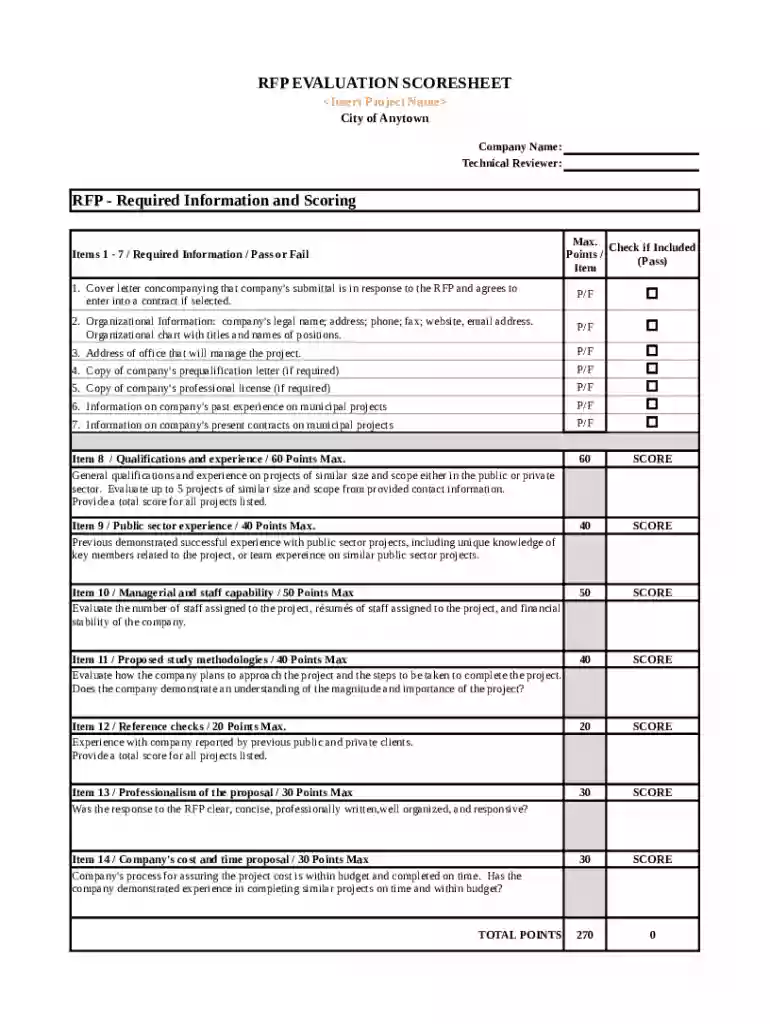
RFP evaluation score sheet RFP evaluation score sheet 2026

Get Form
rfp scoring template Preview on Page 1

Here's how it works

01. Edit your rfp scoring template online
Type text, add images, blackout confidential details, add comments, highlights and more.

02. Sign it in a few clicks
Draw your signature, type it, upload its image, or use your mobile device as a signature pad.

03. Share your form with others
Send it via email, link, or fax. You can also download it, export it or print it out.

Definition and Meaning of the RFP Evaluation Score Sheet

The RFP Evaluation Score Sheet is a structured document used to assess proposals submitted in response to a Request for Proposal (RFP). It serves as a systematic mechanism to evaluate and rank submissions based on predefined criteria. Key aspects include the proposer’s qualifications, experience, managerial capacity, proposed methodologies, and overall proposal professionalism. Each category in the score sheet is assigned a maximum point value, contributing to a comprehensive evaluation.

  • Qualifications: Focuses on the expertise and credentials of the proposing entity.
  • Public Sector Experience: Evaluates past interactions and successful projects with governmental or public entities.
  • Managerial Capability: Assesses the leadership, organization, and project management skills.
  • Proposed Methodologies: Looks at the strategies and methods suggested to achieve the desired results.
  • Professionalism: Considers the clarity, organization, and presentation of the proposal.
  • Cost and Time Proposals: Reviews the financial aspects and project timelines for feasibility and value.

How to Use the RFP Evaluation Score Sheet

Utilizing the RFP Evaluation Score Sheet requires a clear understanding of its categories and score allocations. Here's a step-by-step guide to efficiently use the score sheet:

  1. Preparation: Familiarize yourself with the RFP document and the evaluation criteria.
  2. Review Proposals: Carefully examine each submitted proposal, noting its strengths and weaknesses.
  3. Rate Each Criterion: Assign scores based on the evaluation categories. Use the provided point range to reflect the proposer's competence in each area.
  4. Comments and Notes: Record observations or justifications for each score to facilitate discussions or reviews later.
  5. Rank Proposals: Summarize scores to compare all proposals, helping to identify the most suitable candidate for the project.

Best Practices

  • Emphasize objective analysis over subjective opinions.
  • Cross-reference proposals with the RFP’s goals and requirements.
  • Engage multiple evaluators to ensure balanced scoring.

Who Typically Uses the RFP Evaluation Score Sheet

The RFP Evaluation Score Sheet is predominantly used by procurement officials, project managers, and committee members within organizations that issue RFPs. These individuals are responsible for ensuring that the selection process is fair, transparent, and aligns with organizational objectives.


  • Procurement Officials: Tasked with acquiring services or products while maintaining value for public funds.
  • Project Managers: Ensure that the selected vendor meets specific project needs and timelines.
  • Committee Members: Provide diverse perspectives to mitigate bias and improve decision-making.
decoration image ratings of Dochub

Examples

  • Municipalities: Use score sheets when selecting vendors for public works projects.
  • Educational Institutions: Evaluate third-party service providers for software or infrastructure enhancements.
  • Healthcare Organizations: Assess vendors for medical equipment procurement.

Key Elements of the RFP Evaluation Score Sheet

The key elements of an RFP Evaluation Score Sheet are designed to provide clarity and consistency in the evaluation process:

  • Evaluation Criteria: Detailed parameters that define what aspects of the proposals will be assessed.
  • Scoring System: A numerical framework that offers a standardized approach to rating each proposal.
  • Weighting: Assigns value to different criteria, emphasizing aspects most crucial to the project.
  • Comments Sections: Allows evaluators to include additional insights or observations that support given scores.

Tips

  • Ensure all evaluators understand the weighing principles before scoring.
  • Regularly update the score sheet to reflect any changes in evaluation priorities.

Steps to Complete the RFP Evaluation Score Sheet

Completing the RFP Evaluation Score Sheet with accuracy and consistency involves several steps:

  1. Orientation: Begin with an orientation session to ensure all evaluators understand the score sheet layout and categories.
  2. Plan the Review Session: Schedule sufficient time for detailed analysis and discussions among evaluators.
  3. Compile Individual Scores: Each evaluator independently reviews and scores the proposals.
  4. Conduct Group Discussion: Organize a meeting to discuss scores and rationalize any discrepancies.
  5. Finalize Scores: Agree on final scores and document the overall evaluation outcome.

Considerations

  • Schedule ample time for group discussions to allow comprehensive analysis.
  • Encourage evaluators to provide written justifications for scores to enhance transparency.

Software Compatibility for RFP Evaluation Score Sheet

The RFP Evaluation Score Sheet can be used and managed effectively with various software tools, streamlining the evaluation process:

  • Microsoft Excel: Offers extensive functionality for creating dynamic sheets with automated calculations.
  • Google Sheets: Allows for real-time collaboration and sharing among evaluators.
  • DocHub: Provides tools to edit, annotate, and sign documents, adding digital efficiency to the evaluation process.

Benefits

  • Collaboration: Facilitates seamless interaction between multiple evaluators.
  • Automation: Minimizes manual calculations, reducing errors.
  • Portability: Enables usage across different platforms and devices.

Important Terms Related to the RFP Evaluation Score Sheet

Understanding specific terminology associated with the RFP Evaluation Score Sheet ensures clarity and better communication among evaluators:

  • Request for Proposal (RFP): A formal document requesting proposals from potential vendors to provide specific services or products.
  • Evaluator: An individual responsible for reviewing and scoring proposals.
  • Criteria Weighting: Assigning different levels of importance to various evaluation categories.
  • Scorecard: Another name for the evaluation score sheet used to collate and summarize scores.

Legal Use of the RFP Evaluation Score Sheet

The legal use of the RFP Evaluation Score Sheet is vital to ensure compliance with procurement laws and regulations:

  • Transparency: Score sheets should be used to maintain fairness and transparency in the selection process.
  • Documentation: Retain score sheets as part of the official RFP documentation to reference in audits.
  • Non-Discrimination: Ensure all proposals are evaluated based solely on stipulated criteria, preventing bias or unfair treatment.

Guidelines

  • Keep detailed records of each evaluation phase.
  • Regularly audit score sheets to align with evolving legal standards and best practices.
be ready to get more

Complete this form in 5 minutes or less

Get form

Got questions?

We have answers to the most popular questions from our customers. If you can't find an answer to your question, please contact us.
Contact us
Request for proposal (RFP) scoring, sometimes called proposal scoring, is the process of assigning numerical values to the RFP responses provided in a vendors proposal.
A Requirements Matrix is simply a listing of every SINGLE requirement in the RFP including page and paragraph number. The process of developing the Requirements Matrix is actually quite simple. The first step is to have each of the RFP response team members read the RFP individually.
Here are five RFP process steps to ensure you find the right vendor for your needs. Step 1: Identify stakeholders. Step 2: Create a project plan and scope. Step 3: Prepare your RFP document. Step 4: Review and evaluate RFP responses. Step 5: Contract negotiation.
Some examples of evaluation criteria include: Organization qualifications and experience, Approach/Philosophy, Location of Office where work will be performed, Qualifications of Staff, References/Depth of Client Base and Pricing, etc.
An RFP scoring matrix is a systematic evaluation tool used by organizations to assess and compare proposals from various vendors or suppliers. Its a structured approach that helps decision-makers objectively evaluate each submission based on predetermined criteria.

Security and compliance

At DocHub, your data security is our priority. We follow HIPAA, SOC2, GDPR, and other standards, so you can work on your documents with confidence.

Learn more
ccpa2
pci-dss
gdpr-compliance
hipaa
soc-compliance

People also ask

A proposal compliance matrix is a tool used in government contracting to ensure that all requirements of the Request for Proposal (RFP) are met in the proposal. It outlines each RFP requirement and cross-references it with the corresponding section in the proposal.
RFP weighted scoring The weighted scoring approach breaks down your RFP evaluation criteria and assigns a value to each question or section. For example, your RFP criteria may consider questions of technical expertise, capabilities, data security, HR policies and diversity and sustainability.
Interview matrix scoring is an interviewing system in which employers use a specific structure to record a candidates interview performance. Matrices can differ depending on employer needs and interviewing guidelines .

Related links