







Definition & Meaning
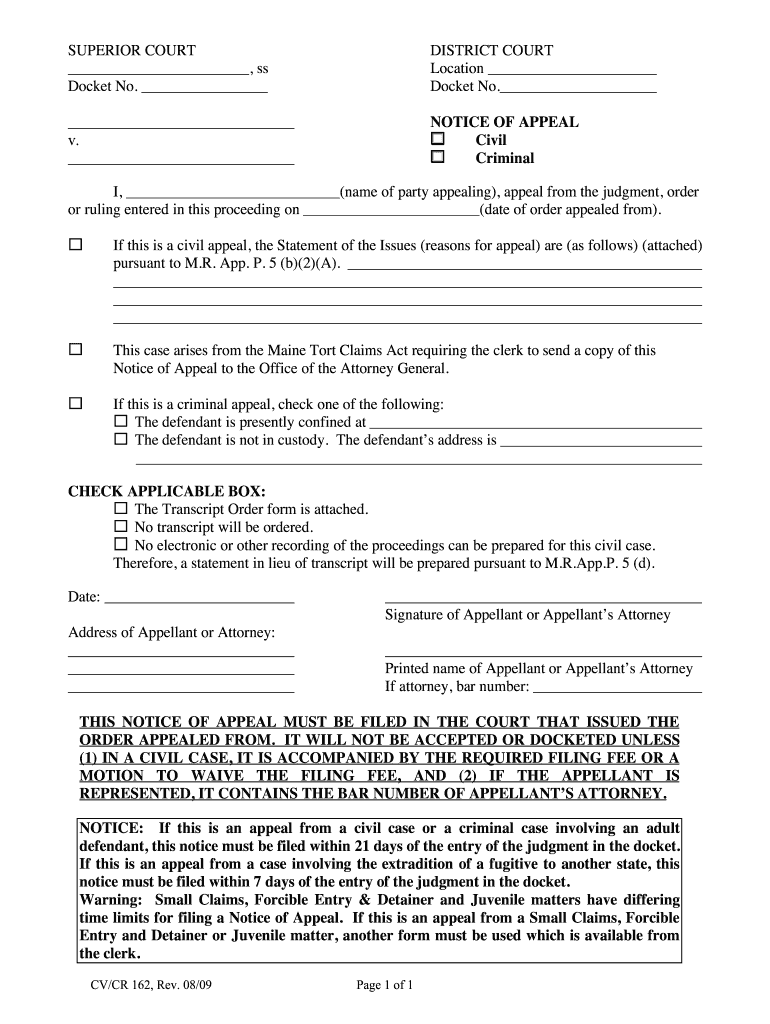
The CV-R-162, Notice of Appeal Rev 08-09, is an official legal document used within the State of Maine's District Court system to initiate an appeal against a court's judgment or order. This form serves as the formal method by which a party indicates their intention to contest the decision of a trial court, citing specific grievances concerning the original ruling. The document requires detailed information about the case, including whether it pertains to civil or criminal matters, and outlines the procedural framework for advancing the appeal. By utilizing this form, appellants ensure their appeal is recognized and reviewed by the appellate court, adhering to established state legal protocols.
How to Use the CV-R-162, Notice of Appeal Rev 08-09
Using the CV-R-162 effectively requires understanding its structure and the information it mandates. Begin by ensuring all relevant sections are aptly completed. This includes listing the case number and title, court name, and a concise description of the order being appealed. Additionally, appellants should provide a Statement of Issues, clearly identifying the legal errors believed to have occurred. Submitting this accurately completed form, along with any required supporting documents and filing fees, is crucial to successfully initiating an appeal. Familiarity with these steps can streamline the process and increase the prospects of a favorable review by the appellate court.
Steps to Complete the CV-R-162, Notice of Appeal Rev 08-09
-
Gather Necessary Information: Before filling out the form, collect all pertinent case details, including court documentation and the specific judgment or order you wish to appeal.
-
Complete the Appellant Information: Enter the appellant's personal and contact information accurately to ensure proper communication throughout the appeal process.
-
Describe the Case: Clearly record the case number, court of origin, and names of all parties involved. This identifies the case as it moves through the appellate process.
-
Statement of Issues: Provide a well-detailed statement of the specific issues being appealed. Articulate any perceived legal missteps in the original trial that merit reconsideration.
-
Attach Required Documents: Include all necessary supporting documents such as copies of the judgment and relevant case materials, adhering to the court's documentation requirements.
-
Submit the Form: File the completed form with the court that issued the original order. Ensure it is accompanied by any mandated filing fees and that deadlines for submission are met.
-
Await Confirmation: After submission, monitor communications from the court for confirmation of receipt and any additional instructions or clarification requests.
Key Elements of the CV-R-162, Notice of Appeal Rev 08-09
- Appellant Details: Essential contact and identity information for the person or entity filing the appeal.
- Case Identification: Includes case number, the full title of the case, and court of origin.
- Statement of Issues: A critical section where the appellant specifies the legal points of error in the original judgment.
- Supporting Documentation: Copies of relevant court orders and documents supporting the appeal.
- Filing Fee Information: Guidance on payment for submitting the notice of appeal, as failure to include this can result in delays.
- Submission Instructions: Detailed filing procedures, including deadlines and requisite court locations.
State-Specific Rules for the CV-R-162, Notice of Appeal Rev 08-09
In Maine, specific rules govern the use and submission of the CV-R-162 form. One must adhere to the state's appellate procedural guidelines, which detail timelines for submissions, particular formatting standards, and required documentation. For instance, certain appeals may necessitate additional filings, such as a docketing statement or transcript requests. Familiarity with these rules is crucial to ensure compliance and avoid dismissal for procedural technicalities. Furthermore, Maine's courts stipulate that any amendments to the Notice of Appeal must be filed promptly, ensuring that changes are duly recorded and acknowledged by the judicial system.
Filing Deadlines / Important Dates
The timing for filing a CV-R-162, Notice of Appeal Rev 08-09, is of utmost importance. In Maine, appellants generally have thirty days from the date of the original judgment or order to file their notice. This period is strict, and missing this deadline typically results in losing the right to appeal. Additionally, knowing the deadlines for submitting accompanying documents, such as the Statement of Issues, is crucial. The court may have set schedules for when the appellate record must be prepared and transmitted to the higher court, highlighting the need for diligence in monitoring these dates to preserve the integrity of the appeal process.
Form Submission Methods (Online / Mail / In-Person)
The CV-R-162 can be submitted via several methods depending on the appellant's preference and the court's facilities. Forms may be mailed directly to the court, ensuring they arrive before the filing deadline. For those seeking a more immediate acknowledgment, in-person filing at the court's clerk office is an alternative, providing a receipt of submission. Some courts offer online filing systems, allowing appellants to submit forms electronically, streamlining the submission process and offering the benefit of instant confirmation. It is essential to verify which methods are available and preferred by the court to prevent any delays in the appeal process.
Legal Use of the CV-R-162, Notice of Appeal Rev 08-09
The legal standing of the CV-R-162 rests in its role as the official document formalizing an appeal request in the state of Maine. Its proper use adheres to the appellate procedure set by state law, ensuring that appeals are made uniformly and reviewed according to the judicial standards. The document must clearly articulate the grounds for appeal, supported by applicable legal theories and case references. Its submission is a crucial step in seeking judicial review and ensuring that all avenues for legal redress are pursued within the structured confines of the legal system.




