




01. Edit your form online
Type text, add images, blackout confidential details, add comments, highlights and more.

Type text, add images, blackout confidential details, add comments, highlights and more.

Draw your signature, type it, upload its image, or use your mobile device as a signature pad.

Send it via email, link, or fax. You can also download it, export it or print it out.
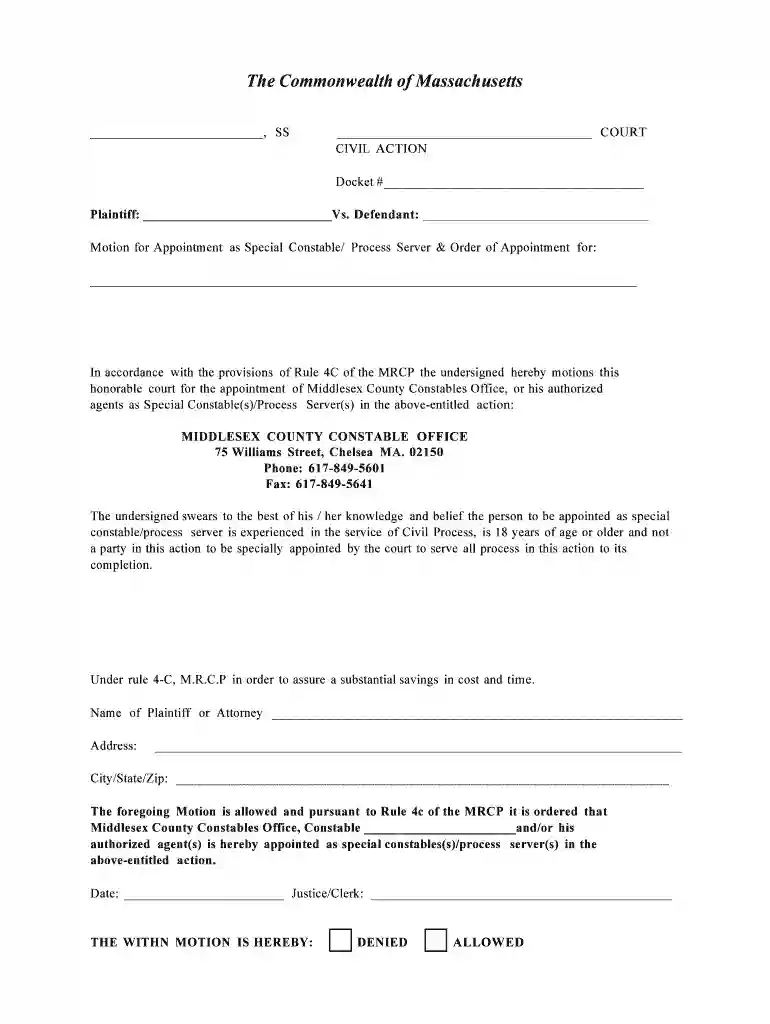
The "MA-Rule-4c-Motion doc" refers to a legal motion within Massachusetts courts that seeks the appointment of the Middlesex County Constables Office as special constables or process servers for a civil action. This motion is governed by Rule 4C of the Massachusetts Rules of Civil Procedure and is crucial for ensuring efficient service of process.
Utilizing the MA-Rule-4c-Motion doc requires a clear understanding of its purpose within a court procedure.
Consider a civil case where timely delivery of documents is critical. Filing this motion ensures that assigned officers handle deliveries, thus safeguarding the process's legitimacy and punctuality.
Filling out this form involves the following steps:
Ensure all sections are filled with precise and correct information to avoid delays. It may be beneficial to attach supporting documents verifying the qualifications of the proposed officers.
This document is generally utilized by legal professionals and parties involved in civil actions who require the structured service of legal documents. Common users include:


Essential components of the motion include:
The motion may also require affidavits or declarations from the constables, verifying qualifications and readiness to serve.
The document is legally significant due to its role in ensuring compliance with procedural rules.
This motion aligns with Massachusetts' commitment to fair and efficient legal proceedings, facilitating proper notification and involvement of all parties.
Massachusetts has unique guidelines that define the usage of this motion.
Unlike some states that may have broader criteria for process servers, Massachusetts requires court approval for special assignments, reflecting a stringent approach to legal processes.
Real-world application scenarios for this document include:
In a multi-party lawsuit, failure to appoint qualified constables led to service delays and added complexity. Using the MA-Rule-4c-Motion resolved these issues by streamlining document delivery.
By providing comprehensive insights and detailed steps, this structured guide enables users to effectively navigate the intricacies of the "MA-Rule-4c-Motion doc," ensuring optimal utilization in Massachusetts's legal processes.
We've got more versions of the MA-Rule-4c-Motion doc form. Select the right MA-Rule-4c-Motion doc version from the list and start editing it straight away!
| Versions | Form popularity | Fillable & printable |
|---|---|---|
| 2012 | 4.2 Satisfied (41 Votes) |
At DocHub, your data security is our priority. We follow HIPAA, SOC2, GDPR, and other standards, so you can work on your documents with confidence.
It explicitly allows the plaintiff or the attorney to obtain the blank summons form in advance. Rule 4(c) permits special court appointment of process servers.Read more
(c) Motion and Proceedings Thereon. The motion shall be served at least ten days before the time fixed for the , although there is a genuine issue as to the


