




01. Edit your rbt voluntary inactive status form online
Type text, add images, blackout confidential details, add comments, highlights and more.

Type text, add images, blackout confidential details, add comments, highlights and more.

Draw your signature, type it, upload its image, or use your mobile device as a signature pad.

Send it via email, link, or fax. You can also download it, export it or print it out.
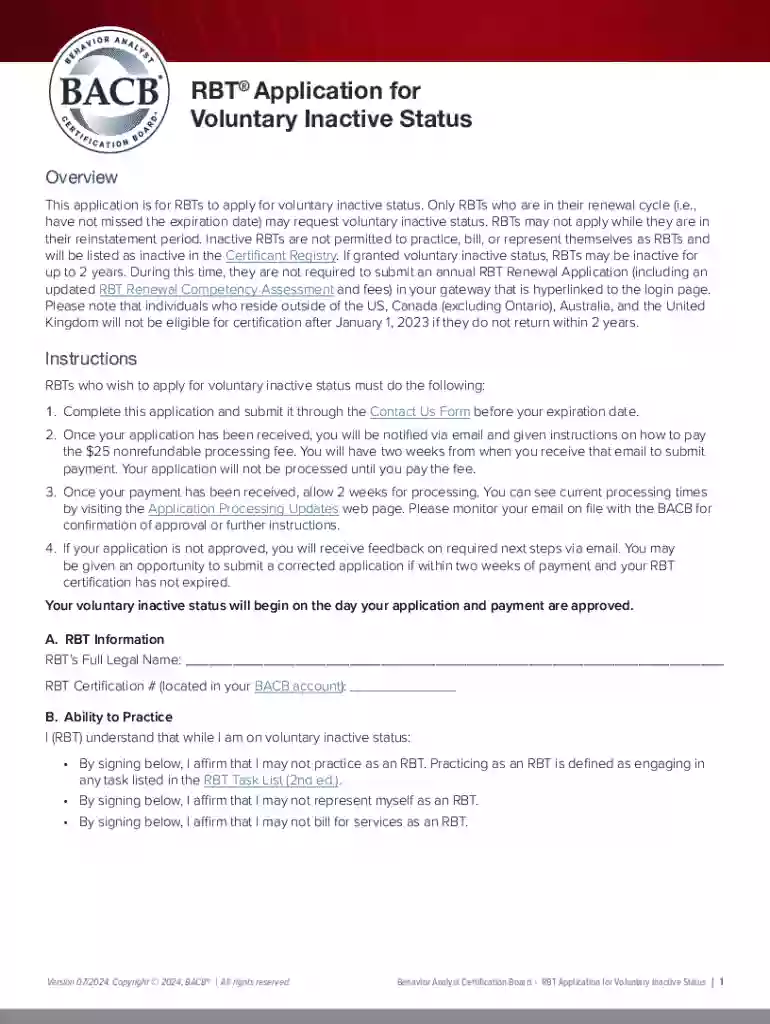
The "Rbt Voluntary Inactive Status Form" is specifically designed for Registered Behavior Technicians (RBTs) who wish to declare a voluntary inactive status with the Behavioral Analyst Certification Board (BACB). This form facilitates a temporary halt in their active certification status while maintaining the potential to reactivate it within a specified period. Entering voluntary inactive status allows RBTs to pause practice without surrendering their credentials, typically in cases such as personal leave, career changes, or further education pursuits.
Inactive Status vs. Active Practice: While inactive, RBTs cannot engage in providing behavior-analytic services or bill for such services under their certification.
Certification Preservation: Going inactive helps maintain the certification without needing to undergo the full re-certification process upon re-entry into practice.
Time Frame: Inactivity can generally last up to two years, offering flexibility for professionals to address personal or professional needs that require stepping away from active practice.
Utilizing this form effectively involves a strategic understanding of personal career goals and certification requirements. Considerations include ensuring that this transition aligns with career breaks and long-term objectives.
Assess Eligibility: Confirm eligibility by reviewing the specific requirements set by the BACB for entering inactive status.
Decision Making: Evaluate professional objectives and decide if entering inactive status supports them, considering potential impacts on practice and career trajectory.
Completion: Fill out the form precisely, ensuring all sections related to personal details, certification ID, and reasons for seeking inactive status are correctly supplied.
Submission: Submit the form according to BACB guidelines, which typically includes online submission channels for efficient processing.
Confirmation: Await confirmation of the status change from BACB, which indicates the start of the inactive period.
Eligibility for the voluntary inactive status demands adherence to specific requirements outlined by BACB, ensuring consistency in maintaining the quality and standards of professional behavior-analytic practice.


Completing the form thoroughly and accurately is essential to ensure a smooth transition into inactive status.
Gather Information: Include personal identification details, current certification information, and precise reasons for the inactive request.
Form Filling: Follow each section of the form with careful attention to detail, ensuring accuracy and completeness.
Review: Double-check all entered data to avoid common errors or omissions that may delay processing.
Submit: Finalize by sending the form through recommended submission channels, keeping a copy for personal records.
Follow-up: Contact BACB if confirmation is not received within the expected timeline to ensure processing completion.
RBTs must strictly comply with the laws and regulations surrounding the use of the inactive status form to avoid any legal infractions associated with practice rights and certification statuses.
Practice Restrictions: Acknowledge the prohibition against practicing under the RBT certification while on inactive status.
Reporting Duties: Inform BACB about any changes in personal or professional circumstances that may affect the inactive status.
Reactivation: Understand the requirements to reactivate and return to an active certification status as needed.
The form comprises several critical components, each serving a distinct function in the application process.
Personal Information Section: Where candidates provide their personal and professional identifiers.
Certification Details: Encompassing certification number, issue and expiry dates, and any other relevant certification attributes.
Reason for Inactivity: Clearly defined reasons for seeking voluntary inactive status, supporting the application rationale.
Completing the Rbt Voluntary Inactive Status Form necessitates supporting documentation to validate the request and ensure compliance.
Current Certification Proof: Such as a copy of the RBT certificate or official notice.
Supporting Letters: If applicable, documents supporting reasons for inactive status, such as medical notes or employment verification.
Identification Documents: May include a government-issued ID to confirm identity legitimacy.
The application process for voluntary inactive status is straightforward yet requires attention to detail for successful navigation.
Form Preparation: Collect necessary information and documents as outlined in the requirements.
Submission: Use the designated submission method for BACB, often conducted digitally to expedite processing.
Processing Time: Approval time varies; typically, processed within several weeks depending on BACB’s evaluation and workload.
We've got more versions of the rbt voluntary inactive status form form. Select the right rbt voluntary inactive status form version from the list and start editing it straight away!
At DocHub, your data security is our priority. We follow HIPAA, SOC2, GDPR, and other standards, so you can work on your documents with confidence.
Return an Inactive License to Active Status. The Inactive to Active application is for licenses that are currently in a Current Inactive status. If you wantRead more
If you wish to request voluntary inactive status, you must complete the BCBA Application for Voluntary Inactive Status and pay a one-time, inactive-request fee


