




01. Edit your use fuel user tax report form oregon online
Type text, add images, blackout confidential details, add comments, highlights and more.

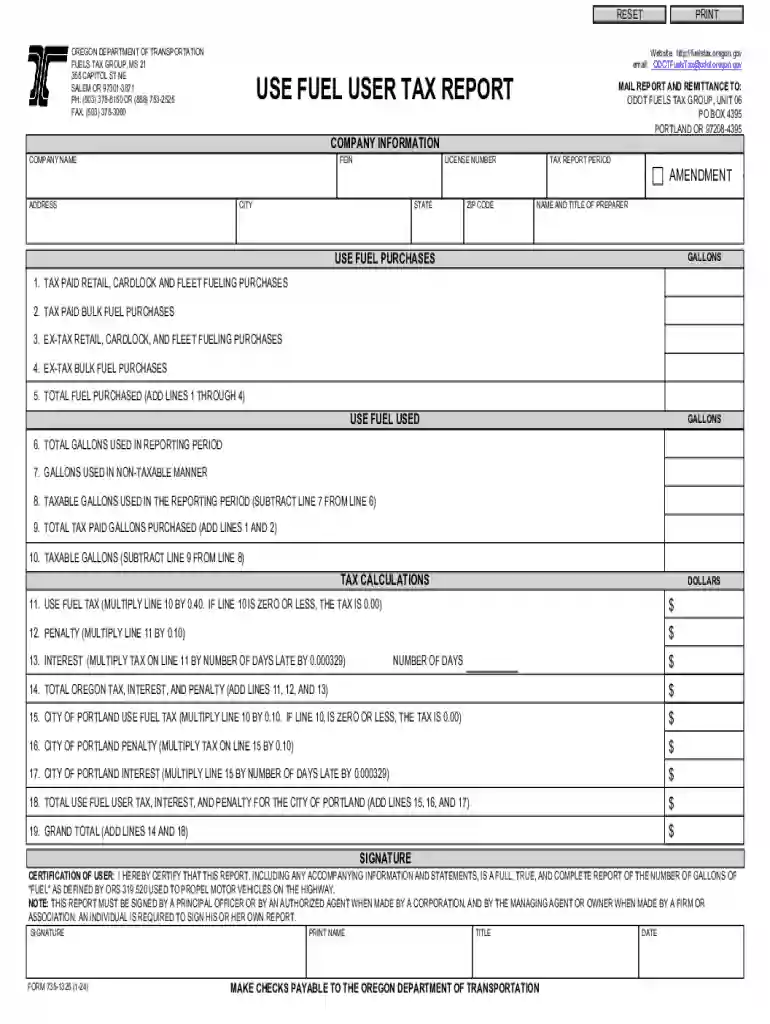
Type text, add images, blackout confidential details, add comments, highlights and more.

Draw your signature, type it, upload its image, or use your mobile device as a signature pad.

Send odot fuel tax forms 735 1325 via email, link, or fax. You can also download it, export it or print it out.
Taxable Distribution Reports: Fuels Tax in the State of Oregon is a mandatory reporting form for businesses involved in the distribution or sale of fuels within Oregon. This form is primarily used to meet state taxation requirements for fuel sales, ensuring businesses report the volume and type of fuels distributed. It includes calculations for taxes owed based on current Oregon fuel tax rates. Understanding the purpose of this form is crucial for compliance with state tax laws.
Completing the Taxable Distribution Reports involves several detailed steps. Businesses must ensure accuracy in data entry to avoid compliance issues.
The Taxable Distribution Reports are vital for businesses engaged in the fuel supply chain in Oregon.


Oregon has specific regulations and rates that apply to fuel taxation, requiring precise adherence when completing the form.
Several documents are needed to support the information provided in the Taxable Distribution Reports.
Failure to submit the Taxable Distribution Reports accurately and on time can result in penalties.
Oregon provides various methods to submit the Taxable Distribution Reports, accommodating different preferences and capabilities.
Compatibility with various software solutions can streamline the reporting process for the Taxable Distribution Reports.
Understanding the core components of the Taxable Distribution Reports is critical for correct completion and submission.
Certain business entities benefit significantly from properly engaging with the Taxable Distribution Reports.
We've got more versions of the use fuel user tax report form oregon form. Select the right use fuel user tax report form oregon version from the list and start editing it straight away!
At DocHub, your data security is our priority. We follow HIPAA, SOC2, GDPR, and other standards, so you can work on your documents with confidence.
(1) Motor vehicle fuel or aircraft fuel lost by a carrier or other person in this state must be included in the taxable distribution section of the monthly taxRead more
Taxable distribution reports in Oregon are public record. The Fuels Tax Group publishes taxable distribution reports for all jurisdictions, per local ordinance.Read more


