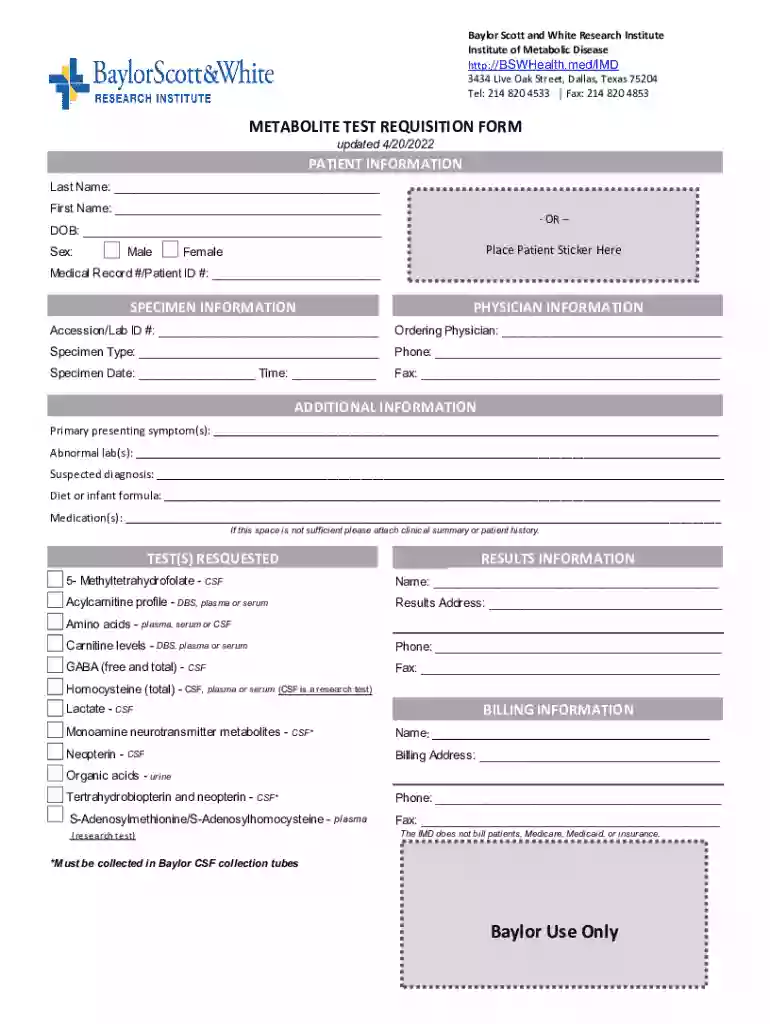
Research DNA Test requisit form 2026

Get Form
Research DNA Test requisit form Preview on Page 1

Here's how it works

01. Edit your form online
Type text, add images, blackout confidential details, add comments, highlights and more.

02. Sign it in a few clicks
Draw your signature, type it, upload its image, or use your mobile device as a signature pad.

03. Share your form with others
Send it via email, link, or fax. You can also download it, export it or print it out.

Definition and Meaning of the Research DNA Test Requisition Form

A Research DNA Test Requisition Form is an essential instrument in clinical and genetic testing. It serves as a detailed application form to request DNA testing services, especially in research contexts. This form ensures that the requesting party provides all necessary information, such as patient details, specific tests needed, and any pertinent medical background. The goal is to facilitate a precise and efficient testing process. This form is most often used in clinical research settings, where comprehensive genetic data collection is needed for studies on hereditary conditions, genetic mutations, or personalized medicine applications.

Practical Examples

  • Clinical Trials: Used to collect DNA samples from participants to analyze genetic markers relevant to the study.
  • Genetic Research Studies: Supports collections in research projects that examine hereditary diseases.
  • Healthcare: Facilitates personalized medicine by providing necessary genetic information.

How to Use the Research DNA Test Requisition Form

Using this form correctly is fundamental to gathering accurate genetic information.

  1. Obtain the Form: Available through institutions or laboratories conducting the DNA analysis.
  2. Fill in Patient Information: Include full name, date of birth, and contact information.
  3. Specify the Tests Required: Clearly mark which DNA tests or panels are needed.
  4. Provide Medical History: Note any existing medical conditions or relevant family history.
  5. Healthcare Provider Details: Include the requesting provider’s contact information and official stamp.
  6. Signatures and Consent: Obtain necessary signatures for patient consent.

Step-by-Step Instructions

  • Carefully read each section before filling it out.
  • Double-check the spelling of names and accuracy of test codes.
  • Review the completed form with a healthcare provider to ensure nothing is missed.

How to Obtain the Research DNA Test Requisition Form

Access to the form is generally straightforward:

  • Healthcare Institutions: Typically provided by clinics conducting DNA testing.
  • Research Facilities: Available at institutions conducting genetic research.
  • Online Resources: Some laboratories may offer downloadable versions through their websites.

Alternative Methods

  • Contacting the healthcare provider directly to request the form.
  • Visiting a research facility or laboratory to obtain a copy.

Steps to Complete the Research DNA Test Requisition Form

Completing the form accurately is vital to ensure that the correct tests are conducted without delays.

  1. Gather Required Information: Ensure you have all patient records and necessary documentation.
  2. Fill Out Personal Details: Start with patient’s personal and contact information.
  3. Select the Required Tests: Mark the appropriate tests; consult with a healthcare provider if unsure.
  4. Include Medical Background: Document any medical history pertinent to the tests.
  5. Review with a Healthcare Provider: Double-check for completeness and accuracy.
  6. Secure Required Signatures: Obtain the necessary consents and authorization.
  7. Submit the Form: Follow the submission guidelines, whether by mail, fax, or online portal.

Recommended Practices

  • Always use legible handwriting or type the information.
  • Ensure all information is up-to-date and verified.

Who Typically Uses the Research DNA Test Requisition Form

The main users of this form include:

  • Researchers: Conducting studies on genetic disorders or DNA-based research.
  • Healthcare Professionals: Ordering genetic tests for diagnostic or treatment purposes.
  • Laboratories: Processing DNA tests require this form to ensure compliance and accuracy.
  • Patients and Families: To consent to testing and facilitate personalized medical care.
decoration image ratings of Dochub

Key Elements of the Research DNA Test Requisition Form

Understanding the core components of the form helps ensure it is filled out correctly.

  • Personal Information Section: Patient demographics and contact information.
  • Test Selection Area: Lists the available DNA tests and panels.
  • Medical History and Background: Allows for documentation of relevant health information.
  • Provider Information and Authorization: Details of the requesting healthcare professional.
  • Consent and Signature Fields: Essential for legal compliance and ethical considerations.

Detailed Breakdown

  • Patient Details: Accuracy is critical to match test results to the right individual.
  • Test Codes or Names: Ensure clarity to avoid misinterpretation in the lab.
  • Healthcare Provider Sign-off: Confirms professional oversight of the test request.

Legal Use of the Research DNA Test Requisition Form

The form acts not only as a test request but also as a legal and ethical document.

  • Consent Compliance: Ensures the patient's authorization is documented.
  • Data Privacy: Adheres to HIPAA regulations, safeguarding patient information.
  • Testing Authorization: Confirms the legitimacy of the test request from a certified provider.

State-Specific Rules for the Research DNA Test Requisition Form

Different states in the U.S. could have variations in the form's requirements.

  • Consent Laws: States have differing requirements on genetic testing consent.
  • Data Handling Regulations: Variances exist regarding genetic information protection.

Examples of State-Specific Considerations

  • Some states may require additional consent forms for minors.
  • Specific regulations might exist in states such as California, which has strict genetic privacy laws.

Understanding these regional differences can prevent delays or legal issues when submitting the form.

be ready to get more

Complete this form in 5 minutes or less

Get form

Got questions?

We have answers to the most popular questions from our customers. If you can't find an answer to your question, please contact us.
Contact us
Note to the Ordering Health Care Provider: Some states require that patients (or their authorized representatives) provide their written informed consent prior to receiving genetic testing, and that the ordering health care provider maintain documentation of the informed consent in the patients medical record.
Consent Proper consent is an essential requirement for a Paternity DNA test. All participants whose DNA sample will be used must give consent. For children under the age of 18, their legal guardian must provide consent. Documentation Basic information will also be collected such as the name of the participants.
The most common way is through a swab of the inside of the cheek, which collects cells that can be used for DNA testing. This is usually done by rubbing a cotton swab on the inside of the cheek for a few seconds and then placing it in a sterile container. Another way to collect DNA samples is through a blood test.
There is no penalty for choosing not to give consent or for withdrawing from 23andMe Research. You will not lose any benefits you receive by being a 23andMe customer, including access to your Genetic Information and to the Personal Genetic Service.
Be Honest and Open: Share your feelings and reasons for wanting the DNA test. Whether its for peace of mind, health reasons, or family history, being transparent can help foster understanding. Listen to Their Concerns: Be prepared for questions or concerns from your fianc.

Security and compliance

At DocHub, your data security is our priority. We follow HIPAA, SOC2, GDPR, and other standards, so you can work on your documents with confidence.

Learn more
ccpa2
pci-dss
gdpr-compliance
hipaa
soc-compliance
be ready to get more

Complete this form in 5 minutes or less

Get form

People also ask

Each person being tested is required to bring along an identification document (ID, passport, drivers licence, birth certificate or photo) and will also be required to sign informed consent for the test. A sample will then be collected from the biological mother, alleged father and child.
At the appointment, you will provide a swab and identification. The AABB collection site or clinic must submit the DNA sample and copies of proof of identification to the lab for testing. You must ask the lab to forward test results to the U.S. embassy or consulate, or passport agency or center.
You cannot directly receive DNA test kits. The AABB-accredited lab will tell you where to go. At the appointment, you will provide a swab and identification. The AABB collection site or clinic must submit the DNA sample and copies of proof of identification to the lab for testing.

Related links