




01. Edit your form online
Type text, add images, blackout confidential details, add comments, highlights and more.

Type text, add images, blackout confidential details, add comments, highlights and more.

Draw your signature, type it, upload its image, or use your mobile device as a signature pad.

Send it via email, link, or fax. You can also download it, export it or print it out.
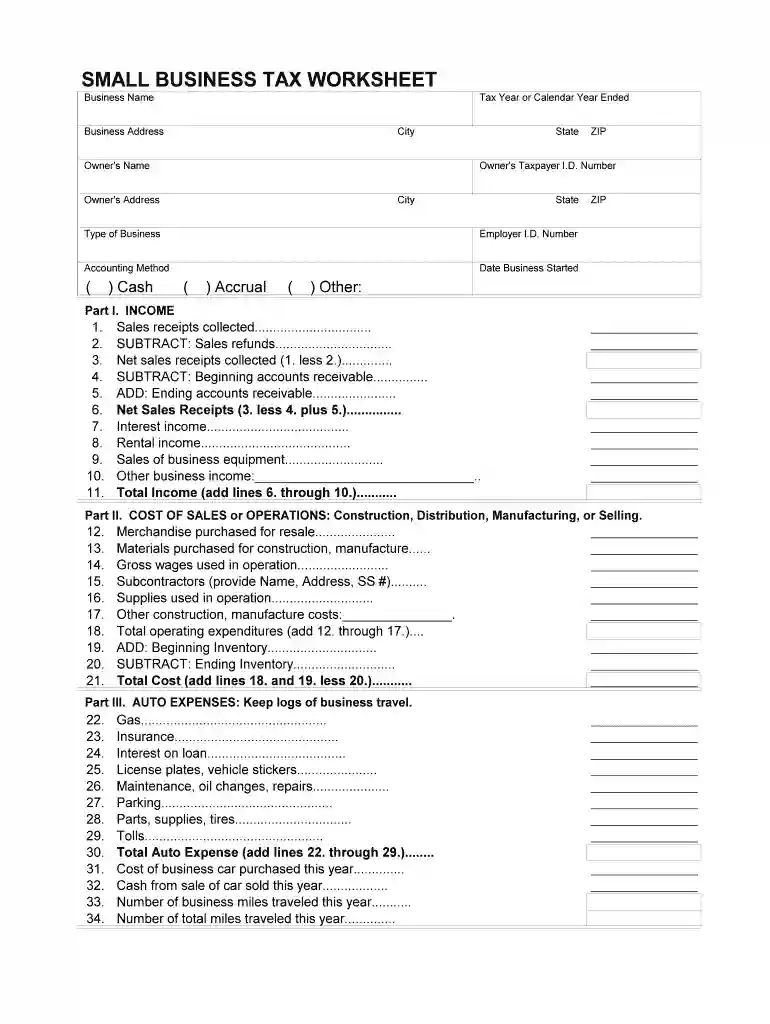
The Small Business Tax Worksheet is an essential tool designed to aid business owners in structuring and calculating their finances for tax reporting. It encompasses several components, including:
Sales Receipts: Record all income generated within a financial period, including sales and service fees.
Cost of Goods Sold: Document costs directly associated with the production of goods sold by the business.
Operating Expenses: Include expenses necessary for running daily business operations, such as rent, utilities, and office supplies.
Auto Expenses: List any vehicle-related expenses incurred for business purposes, including mileage and maintenance.
Miscellaneous Expenses: Capture any other expenditures not classified under the primary categories, ensuring a comprehensive financial summary.
Summary Totals: Compile total revenues, expenses, and net profit for ready submission in tax records.
To effectively utilize the Small Business Tax Worksheet, follow these steps:
Gather Financial Records: Collect all necessary financial documents, such as bank statements, receipts, and invoices.
Input Data: Enter the gathered information into respective sections of the worksheet, ensuring accuracy and completeness.
Review Entries: Regularly review the inputs for potential errors or omissions, which could impact the accuracy of the resulting financial summaries.
Calculate Totals: Use the worksheet to automatically calculate total revenues, expenses, and net profit to understand your financial standing.
Compile Tax Records: Utilize the summarized information to compile and prepare your tax records for submission.
Completing the Small Business Tax Worksheet requires a systematic approach to ensure accuracy:
Start with Income Documentation: List all streams of income, ensuring every sale is recorded.
Detail Cost of Goods Sold: Document inventory purchases and manufacturing costs as necessary.
List Operating Expenses: Include all expenses required for day-to-day business operations.
Document Auto-related Expenses: Record expenses associated with the use of vehicles for business activities.
Add Miscellaneous Expenses: Capture any additional expenses unique to your business model.
Verify All Data: Double-check entries for accuracy before calculating totals.
Summarize Financial Information: Finalize the worksheet by calculating and recording the summary totals.
The worksheet serves as a vital tool for legal compliance in financial reporting:
Understanding key terms is crucial for effective use:
Here are some scenarios illustrating its practical use:
Retail Business: A shop owner uses the worksheet to track inventory costs and compare them against sales revenue.
Freelancer: An independent contractor records their client payments and work-related expenses.
Service Provider: A catering business logs their earnings from events alongside necessary expenses such as ingredient costs.
The IRS outlines several guidelines associated with preparing tax documents:
Accurate Reporting: Ensure all income and expenses are accurately reported to avoid penalties.
Record Retention: Maintain copies of all financial records and worksheets for at least three years.
Understanding Deductions: Utilize deductions correctly to optimize taxable income.
To successfully complete the worksheet, maintain the following documents:
These elements provide a comprehensive guide to understanding and using the Small Business Tax Worksheet effectively, ensuring accuracy and compliance in tax preparation.
We've got more versions of the SMALL BUSINESS TAX WORKSHEET - Independent Accountants form. Select the right SMALL BUSINESS TAX WORKSHEET - Independent Accountants version from the list and start editing it straight away!
| Versions | Form popularity | Fillable & printable |
|---|---|---|
| 2008 | 4.5 Satisfied (67 Votes) |
At DocHub, your data security is our priority. We follow HIPAA, SOC2, GDPR, and other standards, so you can work on your documents with confidence.
Mar 26, 2024 If your small business works with independent contractors, you must file Form 1099-NEC for each non-employee whom you have paid at least $600
You must report income, gain, or loss from all taxable transactions involving virtual currency on your federal income tax return for the taxable year of the


