




01. Edit your affidavit of non military service online
Type text, add images, blackout confidential details, add comments, highlights and more.

Type text, add images, blackout confidential details, add comments, highlights and more.

Draw your signature, type it, upload its image, or use your mobile device as a signature pad.

Send it via email, link, or fax. You can also download it, export it or print it out.
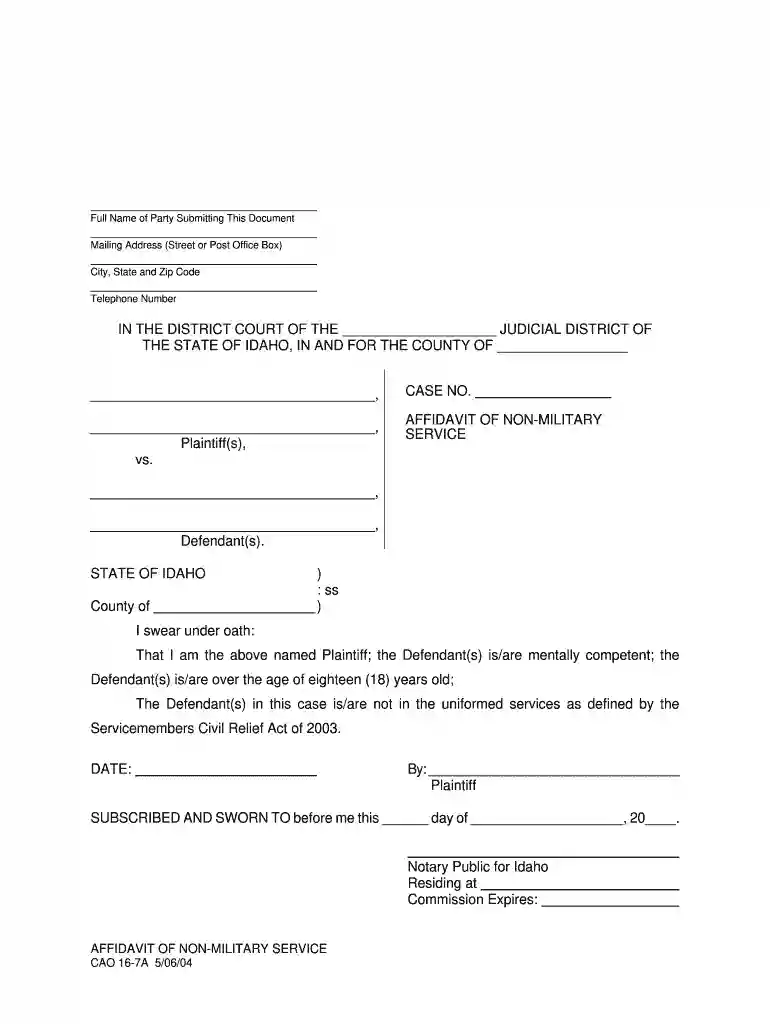
An "Affidavit of Non-Military Service" is a sworn statement used primarily in legal settings to confirm that certain individuals are not serving in the military at the time the document is executed. This form is crucial when legal proceedings involve defendants whose military status could impact court decisions, particularly due to the protections offered under the Servicemembers Civil Relief Act (SCRA) of 2003. By asserting that a defendant is not in military service, the form helps ensure that legal proceedings do not unfairly prejudice service members, offering a necessary layer of legal protection.
When using the affidavit, the declarant must ensure that the information provided is complete and accurate. Typically, this involves identifying the defendant in question and confirming their non-military status. The affidavit is then signed in the presence of a notary public, adding legal weight to the document. It is often filed in court to support a motion or legal filing where military status is a factor. This ensures all parties involved have a clear understanding of the defendant's military obligations, or lack thereof, ensuring fair legal process under the SCRA.
This form can be obtained through legal sources, such as a court clerk's office or an attorney familiar with civil procedure. Many legal websites also offer downloadable templates. Given its legal importance, obtaining the most current and jurisdiction-specific version is critical. When securing the form, ensure the template aligns with local court requirements to prevent any filing issues. Consultation with legal professionals can also provide guidance on how best to complete and file this document based on specific needs and jurisdictions.
Accurate completion of each step is essential, as any errors could delay legal proceedings or invalidate the affidavit.
This affidavit is frequently utilized by legal professionals, like attorneys or paralegals, representing clients in civil lawsuits to assure courts that military service will not affect the proceedings. It is also commonly used by creditors in default proceedings to certify that the individual owing a debt is not in military service, which otherwise might grant the debtor certain protections from legal actions under the SCRA. The form serves as an essential document to ensure legal processes respect the unique obligations of military service members and protect their rights.


Each component is critical for the affidavit's legal effectiveness, assuring all necessary information is provided to respect both the declarant and defendant's rights under the law.
In a legal context, the affidavit is used to facilitate smooth court proceedings by removing uncertainties about a defendant’s military status. It plays a vital role in cases involving defaults, evictions, foreclosures, or similar actions where knowledge of military status is legally required to prevent unjust judgements. Courts rely on the affidavit to enforce the SCRA appropriately, ensuring no unintentional harm comes to service members actively fulfilling their duties, respecting both legal fairness and military obligations.
Throughout the United States, variations exist in how each state may require this form to be formatted or filed. It is imperative to check with local court systems to understand specific state regulations. For example, some states may insist on additional documentation to substantiate military status claims, while others may have different requirements for notarization. Legal counsel can provide state-specific insights to ensure compliance, helping to navigate any unique procedural steps that are essential for validity within local jurisdictions.
An example of this affidavit's utility is in eviction cases where landlords must confirm that tenants are not military members to proceed with eviction processes without additional legal hindrance. In debt collection scenarios, creditors can submit the affidavit to highlight non-applicability of SCRA protections when seeking judgments or other actions in court. These scenarios exhibit the pivotal role this document holds in responsibly navigating the intersections of civil law and military service requirements, preventing misapplication of legal measures.
We've got more versions of the affidavit of non military service form. Select the right affidavit of non military service version from the list and start editing it straight away!
| Versions | Form popularity | Fillable & printable |
|---|---|---|
| 2004 | 4 Satisfied (40 Votes) |
At DocHub, your data security is our priority. We follow HIPAA, SOC2, GDPR, and other standards, so you can work on your documents with confidence.
Use these forms for Fall 2025, Spring 2026 and Summer 2026 terms. 2023 Parent Non-Filer Form 2023 Spouse Non-Filer Form 2023 Student Non-Filer Form 2025-Read more
This declaration is made for the purpose of obtaining a default judgment against the above named defendant/respondent.


