Medical malpractice 2026

Get Form
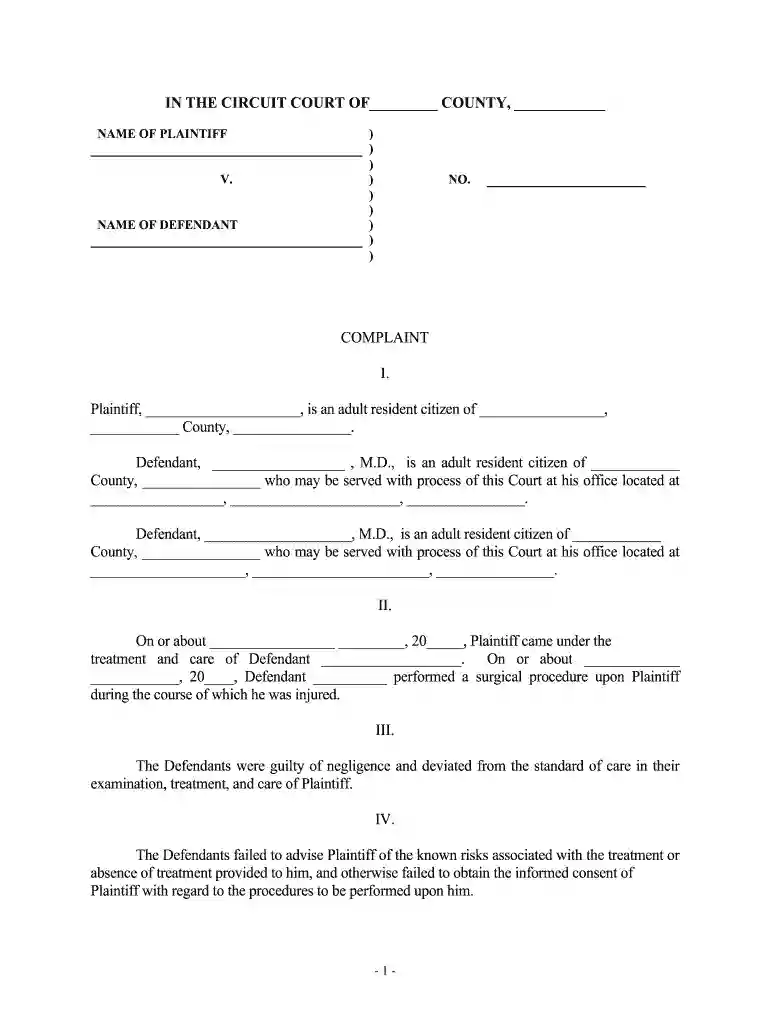
changing a pt medical record and malpractice Preview on Page 1

Here's how it works

01. Edit your changing a pt medical record and malpractice online
Type text, add images, blackout confidential details, add comments, highlights and more.

02. Sign it in a few clicks
Draw your signature, type it, upload its image, or use your mobile device as a signature pad.

03. Share your form with others
Send example of medical malpractice complaint via email, link, or fax. You can also download it, export it or print it out.

Definition and Meaning of Medical Malpractice

Medical malpractice occurs when a healthcare professional or institution fails to provide the standard of care that is expected in the medical community, resulting in harm to the patient. This could involve an incorrect diagnosis, a prescription error, surgical mistakes, or a failure to take appropriate medical action. The pivotal aspect of medical malpractice is the breach of standard care, which implies that the actions of the medical personnel fell below what would be reasonably expected under similar circumstances.

Key Components of Medical Malpractice

  • Duty of Care: The obligation of healthcare providers to adhere to a standard practice accepted by the medical community.
  • Breach of Duty: Occurs when a healthcare professional's actions deviate from the accepted medical standard of care.
  • Causation: A direct connection needs to be established between the breach of duty and the injury sustained by the patient.
  • Damages: The patient must have suffered harm as a result of the breach, which can include physical injuries, emotional distress, and financial burdens.

How to Use the Medical Malpractice Form

The medical malpractice form is primarily used to file a claim against medical professionals or institutions alleging negligence. Filing this form involves supplying detailed information about the incident, including details of the standard of care, how it was breached, and the impact on the patient.

Steps Involved

  1. Gather Evidence: Collect all relevant medical records, expert opinions, and any other documentation supporting the claim.
  2. Complete the Form: Fill out the form with precise and factual details, ensuring no omissions or errors.
  3. Submit the Form: Depending on jurisdictional rules, submit the form to the appropriate legal entity, usually a court or legal office specializing in malpractice cases.

Steps to Complete the Medical Malpractice Form

Filing a medical malpractice claim requires careful attention to detail and substantial evidence to support the claim. Here's a step-by-step guide to completing the form:

  1. Patient Information: Accurately fill out personal details, including contact information and patient identification.
  2. Incident Details: Provide a thorough description of the event, including dates, times, and specific actions taken by the healthcare provider.
  3. Healthcare Professional/Institution Information: Note the names, addresses, and contact information of the providers involved.
  4. Statement of Allegations: Clearly state the basis of the claim and outline how the standard of care was breached.
  5. Supporting Evidence: Attach copies of medical records, witness statements, and any other documentation that substantiates the claim.
  6. Legal Representation: If applicable, include contact information for legal representation handling the case.

Key Elements of Medical Malpractice Cases

Understanding what constitutes a medical malpractice claim is crucial for both plaintiffs and defendants. The essential elements that must be proven include:

  • Standard of Care: Demonstrate what a competent doctor would have done under similar circumstances.
  • Breach of Standard: Evidence must show that the care provided was not aligned with the expected standard.
  • Injury and Damages: The patient must have endured an injury or damages as a result of the breach.
  • Causation: It should be clear that the breach of care caused the injury or damage directly.

State-Specific Rules for Medical Malpractice

Medical malpractice laws can vary significantly from one state to another, affecting the procedure for filing cases, the statute of limitations, and available damages.

Examples of Variations

  • Statute of Limitations: Time limits on when a claim can be filed range from one to three years, depending on the state.
  • Caps on Damages: Some states impose limits on the amount of damages that can be awarded for non-economic harm, such as pain and suffering.
  • Mandatory Mediation: Certain states require mediation before proceeding to court, aiming to settle the case amicably.

Examples of Medical Malpractice

Various real-world scenarios exemplify the different types of medical malpractice cases:

  • Surgical Errors: Improper surgical techniques resulting in injury, or surgical tools left inside a patient.
  • Misdiagnosis or Delayed Diagnosis: A failure to diagnose a serious condition, leading to delayed treatment and poor outcomes.
  • Medication Errors: Prescribing the wrong medication or dose that results in adverse reactions.
  • Birth Injuries: Negligence during childbirth that causes harm to the mother or infant.

Digital vs. Paper Version of Malpractice Forms

The choice between digital and paper forms depends on the efficiency and accessibility requirements of the filer.

Advantages of Digital Forms

  • Ease of Access: Forms can be filled out online and submitted electronically, reducing the need for physical presence or mailing.
  • Efficient Record-Keeping: Digital submissions allow for easier tracking and storage of records.
  • Environmental Impact: Reduces paper use and associated waste.

Advantages of Paper Forms

  • Accessibility: Some individuals may prefer or require physical forms if they lack internet access or digital skills.
  • Tangible Records: Provides a physical paper trail, which some individuals may find more reliable.

Required Documents for Filing a Claim

To pursue a medical malpractice case effectively, specific documents are typically necessary to substantiate the claim:

  1. Medical Records: Comprehensive records from all healthcare providers involved.
  2. Expert Testimonies: Opinions from medical experts supporting the breach of standard care claim.
  3. Billing Information: Documentation of all related medical expenses.
  4. Personal Statements: Detailed accounts from the patient and witnesses regarding the negligence.

Understanding these critical elements and the proper procedures for filing a medical malpractice claim can significantly affect the outcome of a case. Providing accurate, detailed information and ensuring compliance with state-specific rules are vital steps in presenting a compelling claim.

be ready to get more

Complete this form in 5 minutes or less

Get form

Got questions?

We have answers to the most popular questions from our customers. If you can't find an answer to your question, please contact us.
Contact us
Medical malpractice cases are brought when there is the presence of intent, whether obvious or discreet. Medical negligence cases are brought when there is no intent, but the act that caused harm is a mistake.
Medical malpractice is a complex issue, but understanding and implementing the 4 CsCompassion, Communication, Competence, and Chartingcan help healthcare professionals mitigate risks and improve patient outcomes.
Proving Negligence in Medical Malpractice Lawsuits These are: Negligence: The defendant was negligent; AND, Harm: The plaintiff was harmed; AND, Substantial Factor: The defendants negligence was a substantial factor in causing the plaintiffs harm.
Medical malpractice is defined as any act or omission by a physician during treatment of a patient that deviates from accepted norms of practice in the medical community and causes an injury to the patient.
Common Types of Claims Diagnostic Errors: Misdiagnosis is one of the most common types of malpractice. Conditions like cancer, infections, and vascular events are often misdiagnosed. Medication Errors: Prescription errors are also prevalent, with and morphine being the two most error-prone medications.

Security and compliance

At DocHub, your data security is our priority. We follow HIPAA, SOC2, GDPR, and other standards, so you can work on your documents with confidence.

Learn more
ccpa2
pci-dss
gdpr-compliance
hipaa
soc-compliance
be ready to get more

Complete this form in 5 minutes or less

Get form

People also ask

What Are the Four Elements of Medical Malpractice? Duty: The duty of care owed to patients. Dereliction: Or bdocHub of this duty of care. Direct cause: Establishing that the bdocHub caused injury to a patient. Damages: The economic and noneconomic losses suffered by the patient as a result of their injury or illness.
Medical malpractice happens when a doctors actions, or failure to act, during patient care do not meet accepted medical standards and cause harm to the patient.

medical malpractice cases 2016