




01. Edit your form online
Type text, add images, blackout confidential details, add comments, highlights and more.

Type text, add images, blackout confidential details, add comments, highlights and more.

Draw your signature, type it, upload its image, or use your mobile device as a signature pad.

Send it via email, link, or fax. You can also download it, export it or print it out.
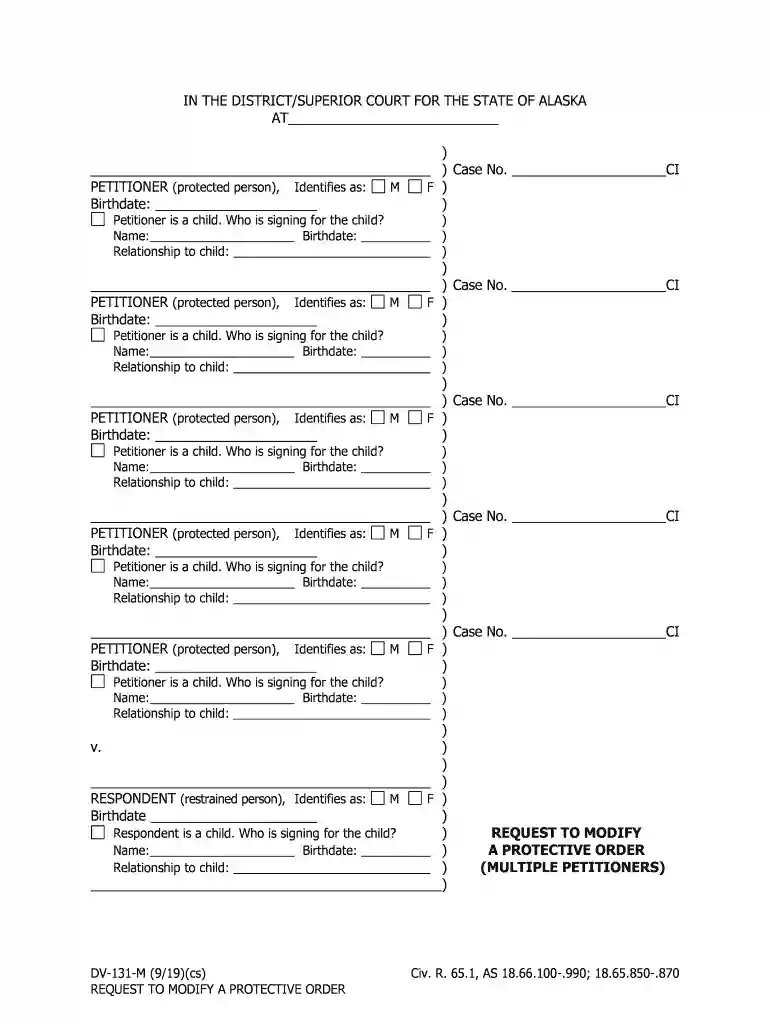
The "DV-131-M Request to Modify Protective Order" is a legal document used within the District/Superior Court for the State of Alaska. This form is specifically employed to request changes to existing protective orders, usually issued in cases involving domestic violence, sexual assault, or stalking. These protective orders are legal obligations safeguarding individuals from harm or threat by another party. The form allows individuals, known as petitioners, to formally propose amendments, additions, or deletions to the terms of a protective order initially granted by the court. The modifications sought might pertain to changes in the conditions of contact, residing arrangements, or duration of the order. It is vital to note that any proposed changes do not take effect until sanctioned by a judge, ensuring all parties maintain compliance with legal standards.
To effectively use the DV-131-M Request to Modify Protective Order form, individuals must first clearly identify the modifications they seek within the protective order. The process begins with accessing the form through the District/Superior Court website or a physical court location. Petitioners must meticulously document the justification for requesting these modifications, detailing any new circumstances or evidence supporting the changes. The form requires comprehensive information about both petitioners and respondents, including their identities and the nature of their relationship.
After completing the form, it should be submitted to the court for review. Petitioners need to ensure all fields are accurately filled to prevent delays. After submission, the court evaluates the request, potentially holding a hearing where both parties can present their arguments. Understanding this process is crucial for petitioners to effectively utilize the form and its intended purpose.
Access the Form: Obtain the DV-131-M form from the Alaska District/Superior Court website or a physical location.
Identify Modifications: Determine the specific changes needed in the protective order. This could include alterations to contact restrictions, residence requirements, or timeframes.
Fill Out Personal Information: Complete the sections requesting detailed information about the petitioner and respondent, including contact details and relationship status.
State Reasons for Modification: Clearly articulate the reasons for seeking changes to the order. Include any new evidence or circumstances that justify the modification.
Submit to Court: Submit the fully completed form to the appropriate court, either online if available, by mail, or in person.
Attend Court Hearing: Be prepared to attend a court hearing if the judge deems it necessary to discuss the requested modifications.
The primary users of the DV-131-M form are individuals directly impacted by a protective order's terms. These individuals, known as petitioners, seek to amend the conditions of an existing order for various reasons, such as changes in personal circumstances or new developments warranting a modification. Additionally, legal representatives acting on behalf of individuals involved in protective orders frequently use this form to ensure their clients’ rights and safety are adequately addressed. Respondents, the parties against whom the protective order is directed, may also use this form to request modifications, particularly if they believe the existing conditions are too restrictive or no longer applicable.


In legal contexts, the DV-131-M form plays a crucial role in modifying protective orders under specific legal criteria. It's used exclusively within the court system of Alaska and serves as a formal mechanism for individuals to legally request adjustments based on changing needs or circumstances. The court reviews each submitted form judiciously to ensure any modifications align with legal standards and adequately protect the concerned parties. Effective use requires an understanding of family law as it pertains to protective orders, soliciting legal counsel where necessary to navigate complex modifications.
The DV-131-M form is governed by state-specific rules unique to Alaska. These rules ensure that modifications to protective orders are conducted transparently and judiciously. For instance, the form must be filed within the jurisdiction where the original order was issued. The court considers the safety and well-being of the petitioner paramount, balancing these concerns against new information provided by the petitioner. Furthermore, Alaska statutes may set forth specific timelines and requirements for filing these requests, necessitating compliance with local legal provisions to avoid delays or rejections.
Submissions of the DV-131-M form can occur through several methods:
Each method requires careful attention to detail, ensuring all sections of the form are complete and correct to facilitate processing without unnecessary delays.
We've got more versions of the DV-131-M Request to Modify Protective Order form. Select the right DV-131-M Request to Modify Protective Order version from the list and start editing it straight away!
At DocHub, your data security is our priority. We follow HIPAA, SOC2, GDPR, and other standards, so you can work on your documents with confidence.


