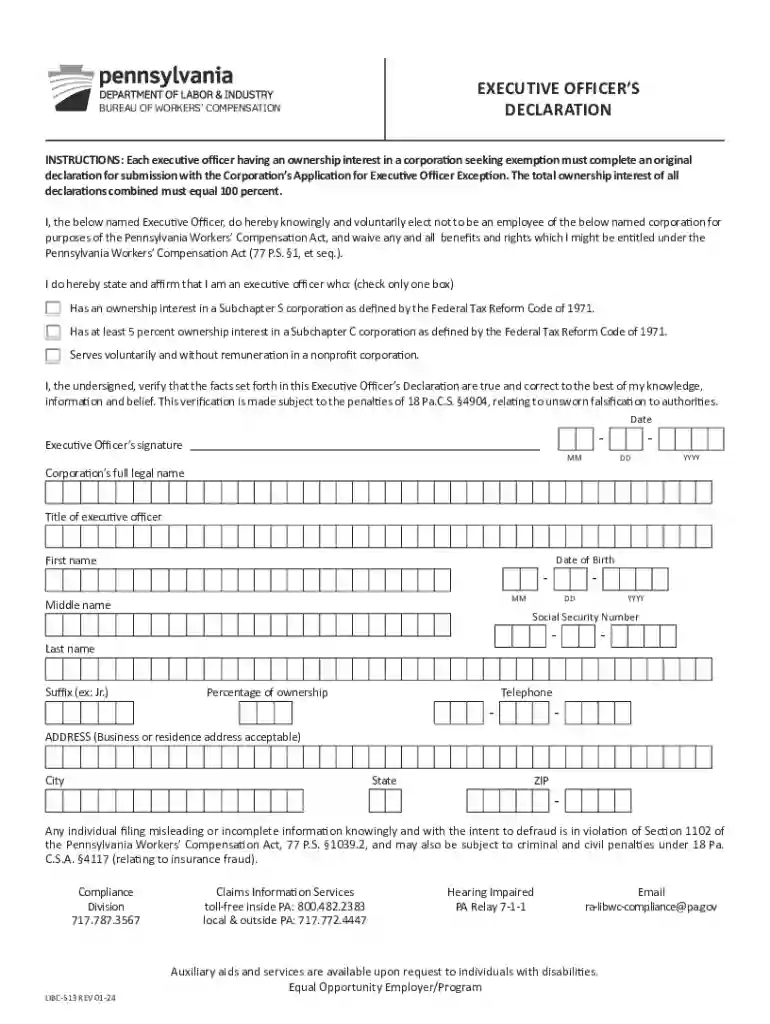
NOTICE TO CORPORATIONS WITH ONE OR TWO 2026

Get Form
pa 513 Preview on Page 1

Here's how it works

01. Edit your pa 513 online
Type text, add images, blackout confidential details, add comments, highlights and more.

02. Sign it in a few clicks
Draw your signature, type it, upload its image, or use your mobile device as a signature pad.

03. Share your form with others
Send libc 513 via email, link, or fax. You can also download it, export it or print it out.

Definition & Meaning

The "NOTICE TO CORPORATIONS WITH ONE OR TWO" is a formal declaration primarily used by corporations having a low number of executive officers, typically one or two. It is often applied in legal and tax contexts to outline specific requirements or exemptions applicable to these businesses. Typically, this form helps determine if such corporations can be exempt from certain mandates, like state workers' compensation insurance, because of their ownership structure. Its completion certifies that companies meet predefined criteria, protecting them from unforeseen liabilities or penalties.

Detailed Breakdown of Purpose

  • Clarification of Status: Ensures the classification of a corporation based on the number of executive officers.
  • Eligibility for Exemptions: Identifies if the corporation qualifies for certain statutory exemptions, such as being excluded from automatic employee status under workers' compensation laws.
  • Formal Declaration: Acts as an official record for internal or external auditing purposes, especially in legal or financial reviews.

Practical Scenario

Imagine a corporation in Pennsylvania that has two executive officers, each with a significant ownership stake. Using the "NOTICE TO CORPORATIONS WITH ONE OR TWO," the company can establish its eligibility to opt-out from certain requirements, such as being included under the state's workers’ compensation policies.

Steps to Complete the NOTICE TO CORPORATIONS WITH ONE OR TWO

Proper completion of the form involves several critical steps to ensure accuracy and compliance. These steps guide corporations through the process of filling in necessary information and submitting the form as required.

  1. Gather Necessary Information:

    • Collect details of the executive officers, including ownership percentages, personal identification details, and official titles.
    • Verify the corporation's formal registration details, including the legal name and business address.
  2. Fill Out Personal and Company Details:

    • Enter personal information for each executive officer.
    • Provide specific details about the corporation, aligning with registration data.
  3. Declare Intentions and Exemptions:

    • Clearly state the officers’ intent regarding their employment status under relevant state laws.
    • Document any claims for exemptions, supported by ownership data.
  4. Review for Accuracy:

    • Cross-check all entries for errors or omissions to prevent potential legal complications.
    • Ensure that the details align with existing corporate documentation.
  5. Submit Form:

    • Choose the appropriate submission method (e.g., mail, online portal, in-person).
    • Keep copies of the completed form for corporate records.

Important Considerations

  • State Variability: Specific requirements might differ based on state laws. Pennsylvania, for example, has specific provisions under its workers' compensation act.
  • Legal Advice: Consulting legal counsel to review the form before submission can prevent misinterpretation of the requirements.

Who Typically Uses the NOTICE TO CORPORATIONS WITH ONE OR TWO

This form is primarily designed for small corporations with up to two executive officers, often used in sectors where ownership and executive roles are limited to a few key individuals.


decoration image ratings of Dochub

Business Scenarios

  • Family-Owned Businesses: Where the business is managed by one or two owners who also serve as executive officers.
  • Startups: New ventures that mainly include founders as the primary managers and have not yet expanded their executive team.

Eligibility and Use Cases

  • Corporations seeking exemptions under state-specific laws.
  • Entities looking to clarify their executive and ownership structure for tax purposes.

Legal Use of the NOTICE TO CORPORATIONS WITH ONE OR TWO

The form establishes a legal basis for certain exemptions or declarations. It provides assurance under the law about the corporation's classification concerning labor and insurance mandates.

Compliance Role

  • Documentation: Provides written evidence of compliance or eligibility for specific legal provisions.
  • Protection Against Claims: Offers defense against incorrect classifications by state agencies that could lead to fines or penalties.

Legal Advice

  • Corporations should consult legal professionals to understand the implications fully and align the form with broader corporate compliance strategies.

Key Elements of the NOTICE TO CORPORATIONS WITH ONE OR TWO

Understanding the components of this form helps accurately complete it and ensures all relevant information is recorded.

Core Components

  • Executive Officer Details: Information on roles, ownership interest, and contact information.
  • Corporate Information: Name, address, and tax identification number.

Submission Details

  • Dates: Ensure all information is up-to-date at the time of submission.
  • Signatures: Authorized signatories must validate the form to confirm its authenticity.

Important Terms Related to NOTICE TO CORPORATIONS WITH ONE OR TWO

Having a clear understanding of terms ensures accurate completion and legal compliance.

Key Terminologies

  • Ownership Interest: Percentage of the corporation owned by the executive officers filling the form.
  • Designation as Non-Employee: The specific declaration that executives should not be counted as employees under workers' compensation.

Contextual Definitions

  • Each term aligns with specific legal definitions under state law, which vary. It is crucial to refer to these carefully to meet compliance criteria.

Penalties for Non-Compliance

Failure to properly complete and submit this form can lead to significant issues for corporations.

Potential Consequences

  • Fines: Financial penalties for failing to meet submission requirements.
  • Legal Challenges: Increased risk of audits or legal action if misclassification of employment status occurs.

Preventive Measures

  • Timely Submission: Ensures forms are filed in accordance with state deadlines to avoid penalties.
  • Accurate Completion: Properly engaging legal services to review forms before submission.

State-Specific Rules for the NOTICE TO CORPORATIONS WITH ONE OR TWO

Rules and compliance requirements may differ depending on the state in which the corporation is registered.

Focus on Pennsylvania

  • Workers' Compensation Requirements: Pennsylvania has clear statutes that define when corporate officers can claim exemption from workers’ compensation under the Pennsylvania Workers' Compensation Act.

General Guidance for Multi-State Corporations

  • Research Statutory Requirements: Corporations operating in multiple states should understand each jurisdiction’s specific requirements to ensure comprehensive compliance.
be ready to get more

Complete this form in 5 minutes or less

Get form

Got questions?

We have answers to the most popular questions from our customers. If you can't find an answer to your question, please contact us.
Contact us
Yes, a Single Owner Business Can Be a Corporation In a traditional corporation, many shareholders may own a percentage of the company based on their shares. However, in the case of a single-owner business, the owner can be the sole shareholder, controlling 100% of the corporations stock.
Business name (sole proprietorship) is a business structure operated and owned by one person. The owner is the sole decision maker in the business and is liable for all the losses and returns of the business. In most cases it is usually a business structure for small and medium sized enterprises (SMEs).
Unlike sole proprietorships, a corporation can be owned by multiple people. A shareholder is a part owner of a corporation. A majority shareholder holds more than 50% of the companys shares. A director manages the corporation and may also hold shares.
Shareholders, if they perform work for the business, are also considered employees and must earn a salary. As a result, most S corporations need a reliable payroll system, even if they only have one shareholder or employee. You run the business.
A California GP must have two or more persons engaged in a business for profit.

Security and compliance

At DocHub, your data security is our priority. We follow HIPAA, SOC2, GDPR, and other standards, so you can work on your documents with confidence.

Learn more
ccpa2
pci-dss
gdpr-compliance
hipaa
soc-compliance

People also ask

A company limited by shares must have at least one shareholder, who can be a director. If youre the only shareholder, youll own 100% of the company.

Related links