Definition and Meaning of FIN594 - Application for Residency Change to Texas
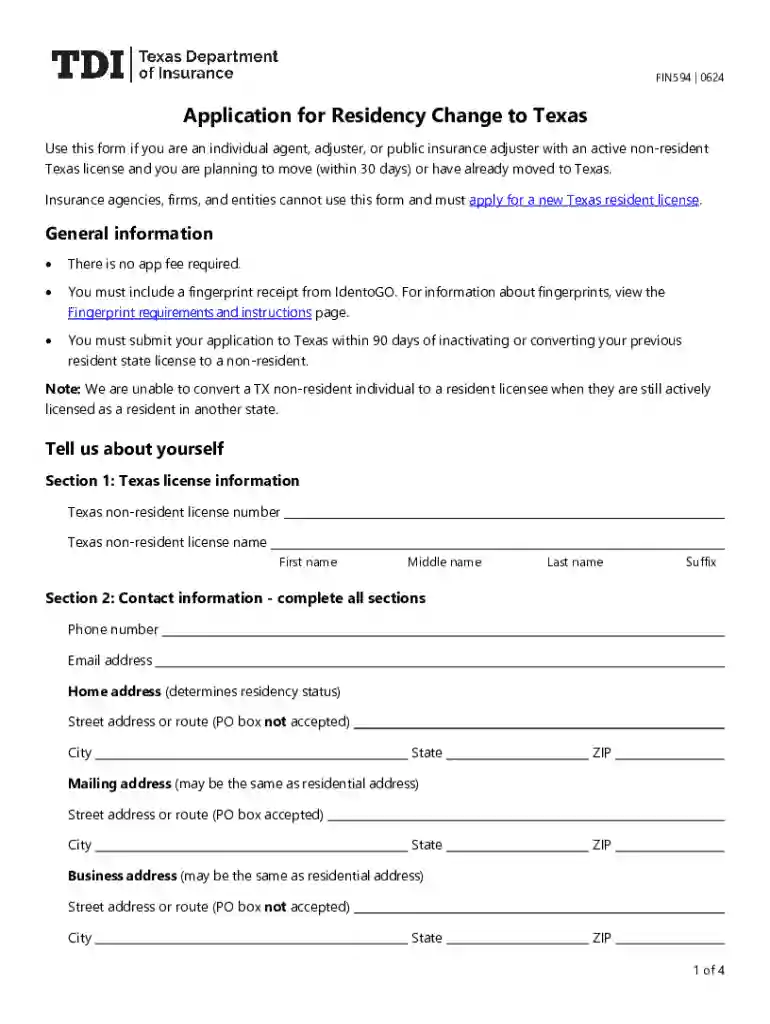
The FIN594 is a formal application form designed for individuals holding a non-resident Texas insurance license who wish to change their residency status to Texas. The primary function of this form is to facilitate the update of resident status with the Texas Department of Insurance and ensure compliance with Texas state requirements for insurance professionals. This process includes notifying applicable parties about a change in residency status and maintaining up-to-date credentials for conducting insurance operations within the state of Texas.
How to Use FIN594 - Application for Residency Change to Texas
Utilizing the FIN594 form involves several critical steps to ensure accuracy and compliance. Upon deciding to change residency to Texas, individuals must:
- Review all sections of the form to understand the requirements and conditions.
- Gather necessary documentation, including proof of prior residency and evidence of intended Texas residency.
- Complete the form attentively, providing detailed information about former and current residency.
- Ensure all required signatures are provided on the form.
- Prepare supportive documents, such as fingerprint receipts and background disclosures, as these are crucial for the application process.
How to Obtain FIN594 - Application for Residency Change to Texas
Individuals seeking the FIN594 form can acquire it from the Texas Department of Insurance's website. Here are the steps to download and access the form:
- Visit the Texas Department of Insurance official website.
- Navigate to the licensing section and search for residency change resources.
- Download the FIN594 form in the preferred file format, such as PDF or DOCX.
- Print the form if a hard copy is necessary, otherwise complete it digitally using document management platforms like DocHub to ensure all fields are properly filled.
Steps to Complete FIN594 - Application for Residency Change to Texas
Completing the FIN594 successfully involves following meticulous steps:
- Personal Information: Begin by entering your full legal name, current non-resident license number, and contact details.
- Residency Details: Provide a complete history of your residential addresses and the date of the intended move to Texas.
- License Information: Include all existing insurance licenses and the states in which they are active.
- Fingerprint and Background Check: Attach receipts for fingerprint submissions and provide necessary background information.
- Continuing Education Compliance: Confirm completion of Texas education requirements for maintaining an insurance license.
- Submission and Review: Double-check all entries for accuracy and completeness before submitting the form either online or via mail as directed.
Required Documents for FIN594 - Application for Residency Change to Texas
A variety of supporting documents must accompany the FIN594 application to substantiate the change of residence:
- Proof of former non-resident status.
- Fingerprint receipt for Texas submission.
- Completion certificates for Texas insurance continuing education credits.
- Disclosure of any past regulatory actions or legal proceedings related to professional conduct.
- Proof of new Texas residency, such as a lease agreement or utility bill.
Key Elements of the FIN594 - Application for Residency Change to Texas
The FIN594 form comprises several critical elements that require attention:
- Identification Section: Captures applicant's personal and professional information.
- Residency Verification: Establishes applicant's new residency in Texas.
- Compliance Assessment: Ensures adherence to state insurance laws, including educational mandates.
- Signature and Certification: Legal acknowledgment by the applicant confirming the accuracy of provided information.
Form Submission Methods for FIN594 - Application for Residency Change to Texas
Applicants have multiple submission options for the FIN594 form:
- Online Submission: Preferred for immediate processing. Users can fill out and upload documents via the Texas Department of Insurance secure portal.
- Mail: Sent to the department's postal address. Ensure all documents are enclosed and correctly addressed.
- In-Person: Directly handed to the Texas Department of Insurance's office. This might expedite processing for complex applications where additional clarification is needed.
Legal Use of FIN594 - Application for Residency Change to Texas
Applying for a residency change through the FIN594 form ensures compliance with Texas's legislative requirements for insurance professionals. Legal adherence involves:
- Accurately reporting residence changes to avoid infractions or penalties.
- Updating all professional credentials and contact information with the Texas Department of Insurance to support lawful business operations.
- Maintaining records of all submitted information and correspondence related to the residency change.
Penalties for Non-Compliance with FIN594 - Application for Residency Change to Texas
Failure to comply with filing requirements for the FIN594 form can lead to significant consequences:
- License Suspension: Temporary or permanent loss of the right to practice insurance services in Texas.
- Fines: Monetary penalties may be imposed for incomplete submissions or misrepresentations.
- Legal Action: Severe cases of non-compliance might result in legal proceedings, affecting future professional conduct and reputation.
By following detailed instructions and ensuring comprehensive submissions, applicants can facilitate a smooth transition in residency and continued compliance with Texas insurance regulations.