




01. Edit your form online
Type text, add images, blackout confidential details, add comments, highlights and more.

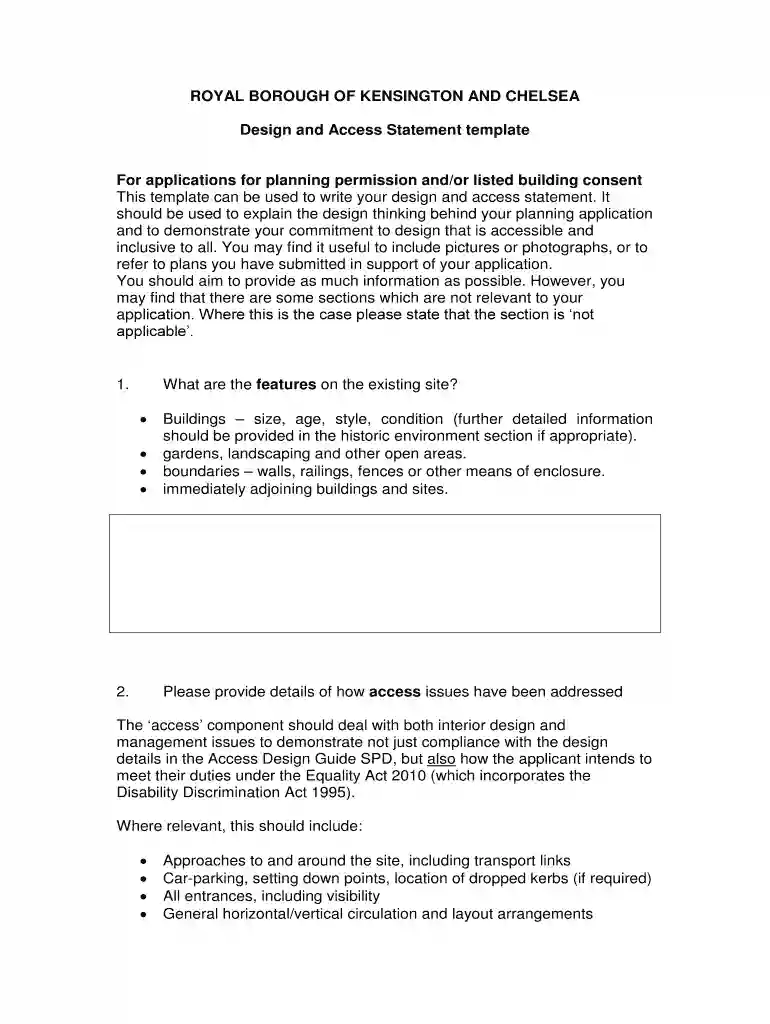
Type text, add images, blackout confidential details, add comments, highlights and more.

Draw your signature, type it, upload its image, or use your mobile device as a signature pad.

Send it via email, link, or fax. You can also download it, export it or print it out.
The "Design and Access Statement" template is a crucial document used in planning applications. It serves as a comprehensive outline that provides details about the design process, access considerations, and the justification for proposals related to new developments or alterations to existing structures. Primarily used within the context of the Royal Borough of Kensington and Chelsea, this template ensures that the proposed design is not only aesthetically pleasing but also accessible and inclusive according to regulatory standards. By incorporating key elements, the statement demonstrates a thorough understanding of site-specific characteristics and regulatory requirements.
Site Analysis: Begin by conducting a detailed analysis of the site. This includes noting features such as topography, existing structures, and surrounding landscape. Understanding these elements helps tailor the development to fit seamlessly into its environment.
Design Proposals: Clearly outline the proposed development layouts. Include details on the scale, appearance, and functionality of the structures to show how they align with both aesthetic goals and practical usage needs.
Access Considerations: Define how the design promotes accessibility. Describe pathways, entrances, and exits, as well as considerations for individuals with disabilities. Ensure compliance with accessibility standards to support inclusive use.
Impact Assessment: Evaluate how the proposed development will affect heritage assets, if applicable. Consider detailing any measures taken to preserve or enhance existing cultural or historical elements.
Justification of Design Choices: Provide a narrative explaining the rationale behind design choices. This section should tie together functional, aesthetic, and social aspects of the proposal, showing how they benefit the community.
Site Features: Include physical, historical, and contextual aspects that any new development must consider to achieve harmony with existing environments.
Access Considerations: Detail ways to promote easy access for all, ensuring compliance with legal standards for disability access.
Proposed Development Layout: Present diagrams or schematics outlining the intended layout of the development, emphasizing practical and visual aspects.
Scale and Appearance: Discuss the size and look of the development in relation to the existing environment. This may include rendering images or architectural sketches.
Landscaping Details: Considerations for external features such as gardens, pathways, and public spaces, which contribute to the development’s environmental integration and aesthetic appeal.
Heritage Asset Impacts: For locations with historical significance, assess how the development might affect these assets and provide strategies for mitigation.
Designers, architects, and planners who are involved in creating or modifying buildings and landscapes within regulated areas frequently use this template. Developers submitting planning applications to local authorities, particularly those involved in projects requiring Heritage Asset considerations, also find this document crucial. Beyond professionals, local government officials may use this document to evaluate whether proposals align with community standards and regulations.


The Design and Access Statement template is intended for use in the formal planning process, specifically for acquiring planning permission or listed building consent. It outlines the proposal's compliance with legal frameworks, emphasizing accessibility and thoughtful design. The legal implications include meeting national and local planning policies and demonstrating a commitment to sustainability and inclusivity.
Planning Permission: A legal authorization required for new developments or changes to existing buildings.
Listed Building: Structures recognized for their historical or architectural importance, which are legally protected from alterations that might affect their character.
Accessibility: The design aspect that ensures equitable access to spaces and facilities for all individuals, including those with disabilities.
Heritage Assets: Buildings, landscapes, or items of historical, architectural, or cultural significance.
An architect working on a new community center must create a Design and Access Statement to accompany their planning application. The document would detail the center’s compliance with accessibility standards, its environmental impact, and how it complements the existing neighborhood. In another case, a developer proposing alterations to a historical building within Kensington might use the template to carefully outline the planned work, emphasizing the preservation of important architectural features while enhancing accessibility.
While the core features of a Design and Access Statement are widely applicable, specific requirements can vary by state or locality. For instance, in the United States, each state might have distinct historical protection statutes or building codes that influence the content and focus of the statement. Professionals must familiarize themselves with local planning regulations to ensure compliance. In areas with stringent heritage protection, additional emphasis on integrating the project with the site's historical context may be necessary.
While the Design and Access Statement is a well-established part of planning applications in many jurisdictions, alternative documents might be used in other regions depending on local regulatory requirements. These can include Environmental Impact Assessments, which focus more on ecological issues, or Cultural Heritage Impact Statements, specifically addressing the influence on cultural assets. It is crucial to choose the right document type that aligns with project goals and regulatory expectations.
We've got more versions of the Design and Access Statement template form. Select the right Design and Access Statement template version from the list and start editing it straight away!
| Versions | Form popularity | Fillable & printable |
|---|---|---|
| 2025 | 4.3 Satisfied (54 Votes) | |
| 2025 | 4.3 Satisfied (49 Votes) | |
| 2024 | 4.6 Satisfied (39 Votes) | |
| 2022 | 4.1 Satisfied (31 Votes) | |
| 2022 | 4.8 Satisfied (116 Votes) | |
| 2022 | 4.1 Satisfied (60 Votes) | |
| 2022 | 4.8 Satisfied (112 Votes) | |
| 2022 | 4.5 Satisfied (52 Votes) | |
| 2021 | 4.5 Satisfied (41 Votes) | |
| 2021 | 4.9 Satisfied (26 Votes) | |
| 2021 | 4.8 Satisfied (66 Votes) | |
| 2021 | 4.9 Satisfied (40 Votes) | |
| 2021 | 4.8 Satisfied (179 Votes) | |
| 2021 | 4.5 Satisfied (55 Votes) | |
| 2021 | 4.8 Satisfied (36 Votes) |
At DocHub, your data security is our priority. We follow HIPAA, SOC2, GDPR, and other standards, so you can work on your documents with confidence.
Using Conditionals. One of the easiest and most powerful things you can do in your templates is leverage conditional statements to control content. For example,Read more
Texas state agencies are encouraged to publish an accessibility statement on their website. The template below can be adapted with your agencys information.
May 15, 2024 An accessibility statement shows your commitment to accessibility. It lets users know you care about them and their access to your digitalRead more


