Final Decree of Divorce Set A - No Children Divorce - (Set A) No children 2026

Get Form
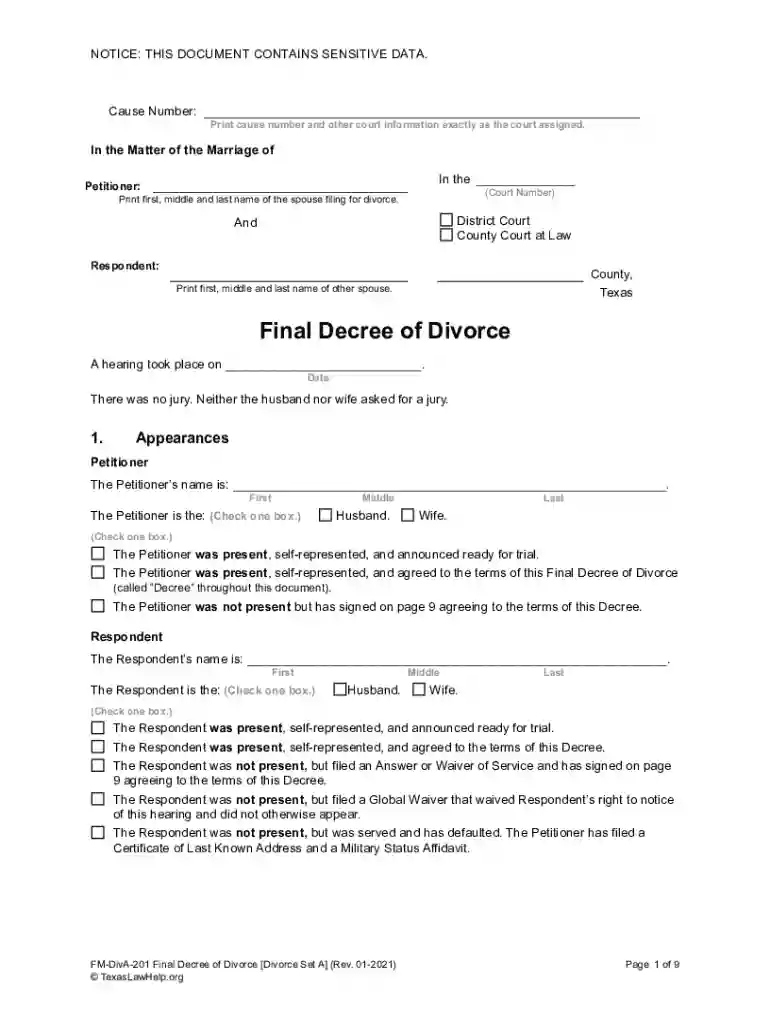
Final Decree of Divorce Set A - No Children Divorce - (Set A) No children Preview on Page 1

Here's how it works

01. Edit your form online
Type text, add images, blackout confidential details, add comments, highlights and more.

02. Sign it in a few clicks
Draw your signature, type it, upload its image, or use your mobile device as a signature pad.

03. Share your form with others
Send it via email, link, or fax. You can also download it, export it or print it out.

Definition & Meaning

The "Final Decree of Divorce Set A - No Children Divorce - (Set A) No children" is a legal document issued by a court in Texas that formally finalizes a divorce between two parties. This document outlines the specifics of the divorce, including the division of assets and liabilities, and confirms the legal dissolution of the marriage. The decree is intended for cases where there are no children involved, simplifying the process by focusing on aspects like property division and spousal agreements without the complexities of child support or custody.

Key Elements of the Final Decree of Divorce Set A - No Children Divorce - (Set A) No children

  • Petitioner and Respondent Identification: Clearly identifies both parties involved in the divorce process, essential for legal and formal recognition.
  • Jurisdiction Details: Specifies the court's legal authority to issue the decree in the state of Texas.
  • Division of Property and Debts: Outlines the specific distribution of marital assets and responsibilities for debts, ensuring an equitable division is finalized.
  • Name Changes: Provides the option for either party to revert to a previous legal name, if desired.
  • Court Costs and Fees: Details which party is responsible for the financial obligations related to court proceedings.

Steps to Complete the Final Decree of Divorce Set A - No Children Divorce - (Set A) No children

  1. Gather Required Information: Collect all necessary information related to property ownership, debts, and personal identification for both parties.
  2. Complete the Divorce Petition: Fill out initial divorce paperwork including the petition, ensuring accuracy and completeness in all sections.
  3. File the Petition with the Court: Submit the completed forms to the appropriate Texas court to initiate the legal process.
  4. Attend Court Hearings: Participate in any required court appearances, providing testimony or additional documentation as necessary.
  5. Finalize the Decree: Once the court has reviewed the case, the finalized decree will be issued, concluding the divorce proceedings.

How to Use the Final Decree of Divorce Set A - No Children Divorce - (Set A) No children

The decree serves as the official record of the divorce settlement. Both parties should keep a copy for their records and refer to it for details on property division and other relevant legal agreements. It acts as proof of divorce for any future legal or financial transactions, such as changing one's legal name or updating marital status with governmental and financial institutions.

Who Typically Uses the Final Decree of Divorce Set A - No Children Divorce - (Set A) No children

This decree is typically used by individuals in Texas undergoing a divorce where no children are involved. It is relevant for those who need a straightforward resolution of marital matters like asset division without the additional complexity of child custody agreements. Legal professionals, such as attorneys specializing in family law, frequently work with this form to aid their clients through the divorce process.


decoration image ratings of Dochub

Legal Use of the Final Decree of Divorce Set A - No Children Divorce - (Set A) No children

The legal use of this form includes finalizing the dissolution of marriage and ensuring compliance with the agreed terms of asset division and other related settlements. It serves as a binding legal document enforceable by law, protecting the rights and responsibilities of each party post-divorce.

State-Specific Rules for the Final Decree of Divorce Set A - No Children Divorce - (Set A) No children

In Texas, divorces fall under state jurisdiction, with particular rules governing the process. For instance, there is a mandatory 60-day waiting period from the filing of the petition to the decree's finalization. Texas, being a community property state, also has specific guidelines concerning the division of property that must be followed in the decree.

Examples of Using the Final Decree of Divorce Set A - No Children Divorce - (Set A) No children

Consider a couple in Texas with no children deciding to divorce. They jointly own a home and have shared debt, such as credit cards and loans. The Final Decree of Divorce specifies how they divide these assets and liabilities, such as granting full ownership of the home to one party while equally dividing the debt responsibilities.

Required Documents

To complete the Final Decree of Divorce, parties will need documents including proof of identification, financial records for property and debts, the initial divorce petition, and any agreements made regarding the division of assets. Supporting documentation such as real estate titles and loan statements should also be presented to substantiate claims.

Form Submission Methods (Online / Mail / In-Person)

The form can be submitted in-person at the court clerk’s office, typically where the divorce petition was filed. Certain Texas jurisdictions may offer online submission options through their electronic filing systems, but parties should verify specific court procedures. All filings must comply with court guidelines to be accepted for processing.

be ready to get more

Complete this form in 5 minutes or less

Get form

Got questions?

We have answers to the most popular questions from our customers. If you can't find an answer to your question, please contact us.
Contact us
See why moving out is the biggest mistake in a divorce. You May Give a Divorce Judge the Impression Youve Abandoned Your Spouse. You Could Affect the Decisions a Divorce Judge Makes Regarding Child Custody. You Will Negatively Impact Your Financial Situation and the Equitable Distribution of Marital Assets.
In Texas, there needs to be a final divorce decree filed and signed by a judge in order for your divorce to be final. It is important to note that a divorce cannot be finalized until 60 days from the filing of the Original Petition for Divorce is filed and accepted by the court.
5 Women Share The Biggest Regrets About Their Divorce I wish Id been kinder to myself I wish I hadnt moved on to someone else so quickly I hate the fact that we threw away a strong friendship I shouldve ended things sooner I wish Id been more civil--and protected my assets Relationships
(1)Any marriage solemnised, whether before or after the commencement of this Act, may, on a petition presented by either the husband or the wife, be dissolved by a decree of divorce on the ground that the other party (i)has, after the solemnisation of the marriage, had voluntary sexual intercourse with any person
FINAL ORDER Following a conditional order, you have to wait 43 days (i.e. 6 weeks and 1 day) before you can apply for a final order. The final order legally ends your marriage and is the point at which you will go from being married to being divorced.

Security and compliance

At DocHub, your data security is our priority. We follow HIPAA, SOC2, GDPR, and other standards, so you can work on your documents with confidence.

Learn more
ccpa2
pci-dss
gdpr-compliance
hipaa
soc-compliance

People also ask

Research shows that divorce hits women far harder financially than it does men. The United States Government Accountability Offices Special Report to the Senate released a study showing that a womans household income plummets by an average of 41% after a divorce.
Accepting the end of a marriage on a deep psychological level is one of the most difficult aspects of divorce. While you may go through the motions of acknowledging the situation, emotionally, it can be challenging to truly comprehend that the relationship has come to an end.
Second thoughts after divorce also depend on who left first. Various data suggest that the spouse who decided to call it quits regrets divorce more often than the other party.

Related links