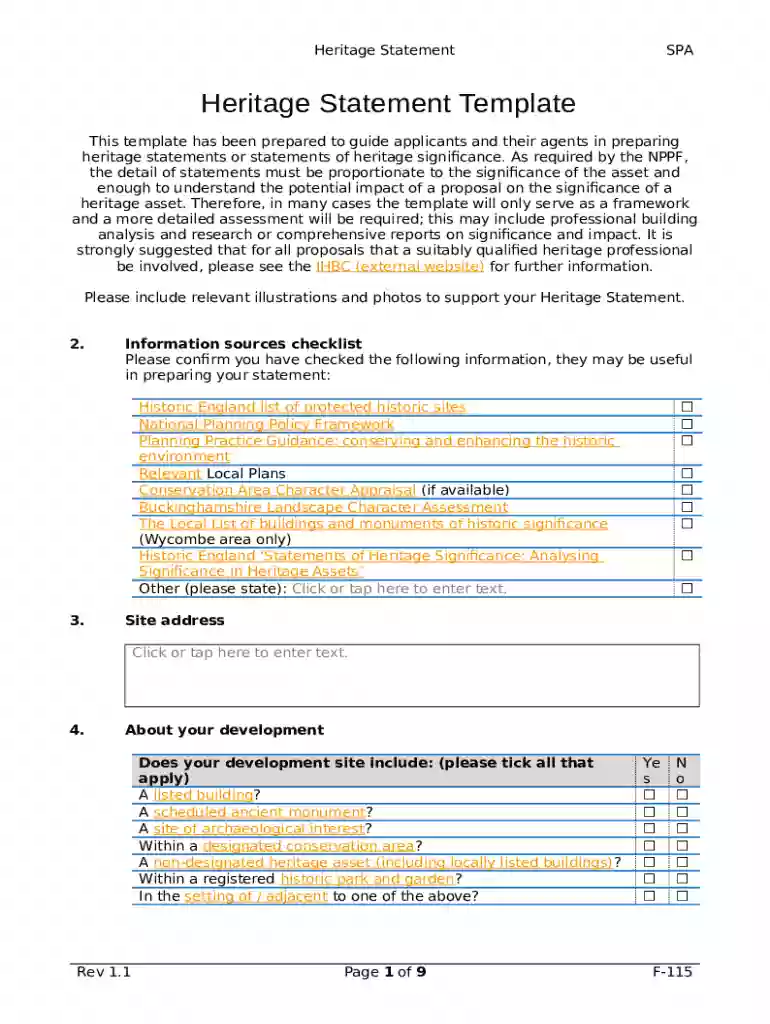
Heritage Statement Template 2026

Get Form
Heritage Statement Template Preview on Page 1

Here's how it works

01. Edit your form online
Type text, add images, blackout confidential details, add comments, highlights and more.

02. Sign it in a few clicks
Draw your signature, type it, upload its image, or use your mobile device as a signature pad.

03. Share your form with others
Send it via email, link, or fax. You can also download it, export it or print it out.

Definition & Meaning

The Heritage Statement Template is a structured document used to assess and report the significance of heritage assets in the context of proposed developments. It is a pre-requisite under the National Planning Policy Framework (NPPF) in the United States. The template is designed to ensure a thorough evaluation of heritage sites, documenting their importance, the impact of potential development, and strategies for preservation or enhancement.

Key Aspects of Heritage Assets

  • Historical Significance: Evaluates past events, people, or trends related to the site.
  • Social Value: Considers the community’s attachment to the site and its importance in social functions.
  • Aesthetic Value: Assesses design, materials, and any artistic elements.
  • Architectural Merit: Reviews structures' design, age, and rarity within a historical context.

Importance of Heritage Statements

Heritage Statements play a crucial role in informed decision-making, ensuring that developments respect and integrate with historical environments. They offer a foundation for stakeholders to understand heritage aspects fully, mitigate potential adverse impacts, and support legal compliance.

Key Elements of the Heritage Statement Template

The Heritage Statement Template includes several critical components that guide applicants in preparing comprehensive assessments of heritage sites.

Components of the Template

  1. Description of the Asset: Detailed description of the heritage asset, including its historical and cultural background.
  2. Significance Assessment: An evaluation of the asset’s importance and the attributes contributing to its significance.
  3. Development Proposal: Overview of the proposed changes, including plans, sketches, and intended materials.
  4. Impact Analysis: Estimation of how the proposed developments might affect the heritage asset and the surrounding area.
  5. Preservation Strategies: Recommendations for mitigating negative impacts and suggestions for enhancements.

Supporting Sections

  • Planning History: Any previous planning applications and decisions related to the asset.
  • Source Checklist: A list of documents, maps, and references used in compiling the statement.

Steps to Complete the Heritage Statement Template

Completing a Heritage Statement involves a systematic approach that ensures thorough documentation and analysis.

Step-by-Step Process

  1. Initial Research: Gather all relevant historical, architectural, and archaeological information about the site.
  2. Field Survey: Conduct on-site inspections to validate existing records and gather new data.
  3. Significance Evaluation: Analyze the gathered data to assess the heritage asset's value.
  4. Develop Proposed Plans: Create detailed development plans respecting cultural and historical contexts.
  5. Impact Assessment: Identify potential negative effects of the proposed work and document these with justifications.

Finalization

  • Consultation with Experts: Engage with historians, archaeologists, and architects to validate your findings.
  • Review and Revise: Ensure accuracy and compliance with the NPPF guidelines before submission.

Legal Use of the Heritage Statement Template

Using a Heritage Statement is essential for legal compliance, particularly when developments could impact protected sites.

Legislation and Regulation

  • NPPF Compliance: Ensure that all assessments align with the policies outlined in the National Planning Policy Framework.
  • Local Legislation: Adhere to state or county-specific heritage and planning laws.

Legal Implications

Failure to submit a Heritage Statement when required can result in delays, potential legal challenges, and additional costs. Proper documentation can also serve as legal evidence to defend proposed developments.

Examples of Using the Heritage Statement Template

Real-world scenarios provide clarity on practical applications and outcomes related to heritage assessments.

Practical Applications

  • Urban Redevelopment: Assess the impact of new construction in historic districts and propose adaptive re-use of heritage buildings.
  • Infrastructure Projects: Evaluate the implications of road or rail projects near protected sites and suggest appropriate mitigation.

Case Study

A recent development in a historic neighborhood required the use of a Heritage Statement to retain the original façade of a building while allowing modern interiors to support business needs. This balanced the preservation of heritage with contemporary requirements.

Who Typically Uses the Heritage Statement Template

The Heritage Statement Template is a versatile tool employed by various stakeholders involved in property development and heritage preservation.


decoration image ratings of Dochub

Primary Users

  • Architects and Planners: Utilize the template to ensure aesthetic and functional alignment in historical contexts.
  • Construction Companies: Integrate heritage assessments into project planning to meet regulatory requirements.
  • Government Agencies: Oversee compliance and enforce preservation laws based on comprehensive heritage evaluations.

Extended Stakeholders

  • Communities and Advocacy Groups: Leverage the template to argue for or against specific developments affecting heritage sites.

State-Specific Rules for the Heritage Statement Template

State rules may offer additional or different directives guiding the preparation and submission of Heritage Statements.

Variations by State

  • California: Emphasizes seismic compliance in heritage buildings, necessitating structural evaluations.
  • New York: Requires detailed archaeological assessments in addition to architectural evaluations.

State Agencies and Resources

  • Each state may have a designated heritage or cultural resource office that can provide guidelines, resources, and approvals needed during heritage assessments.

How to Obtain the Heritage Statement Template

Accessing the Heritage Statement Template is an essential initial step in preparing an effective document.

Sources for the Template

  1. Local Planning Authority Websites: Many offer downloadable templates or guidance documents.
  2. Heritage Organizations: May provide templates and resources for preparing comprehensive statements.
  3. Professional Services: Consulting firms specializing in planning and heritage services often supply tailored templates.

Additional Tips

  • Ensure the template version aligns with the latest local, state, and federal requirements.
  • Consider professional assistance if customization is required to meet specific project needs.
be ready to get more

Complete this form in 5 minutes or less

Get form

Got questions?

We have answers to the most popular questions from our customers. If you can't find an answer to your question, please contact us.
Contact us
Heritage Statements. As Heritage Statements constitute our most common enquiry, wed like to make our offer as transparent as possible from the outset. Detailed information on the nature of the document and the process is provided below. Prices start at just 500 for a desk-based assessment.
However, in some cases the scale of the proposed development, or the nature and importance of the heritage asset(s) may require the Heritage Statement to be compiled by a suitably qualified professional consultant or contractor, with the necessary skills to assess the effects.
A Heritage Statement incorporating an Assessment of Significance is required as part of the information which should be submitted with applications for listed building consent and/or planning permission affecting heritage assets.
A statement of heritage impact (SOHI) is a document that sets out the impact a development will have on the heritage values of an item, place or conservation area. It outlines: why the item or area has heritage significance.
We recommend the use of a heritage specialist to prepare the Heritage Statement on your behalf. A Glossary of Terms can be found in the National Planning Policy Framework (NPPF) and in the Appendix at the end of this document, along with sources of further advice and information.

Security and compliance

At DocHub, your data security is our priority. We follow HIPAA, SOC2, GDPR, and other standards, so you can work on your documents with confidence.

Learn more
ccpa2
pci-dss
gdpr-compliance
hipaa
soc-compliance

People also ask

Get Started Register your eligible accounts for eStatements now in our Mobile Banking App via the Settings menu. You can also login to Heritage Online on a desktop or mobile browser and register for eStatements via the Services menu. Once registered well send you an email each time your statement is ready to view.
The format of a heritage statement background to the application, what its about. the list description. a brief history of the building in so far as it is known, including planning history. key elements of the building which contribute to its significance. the statement of significance.

Related links