






Definition & Meaning
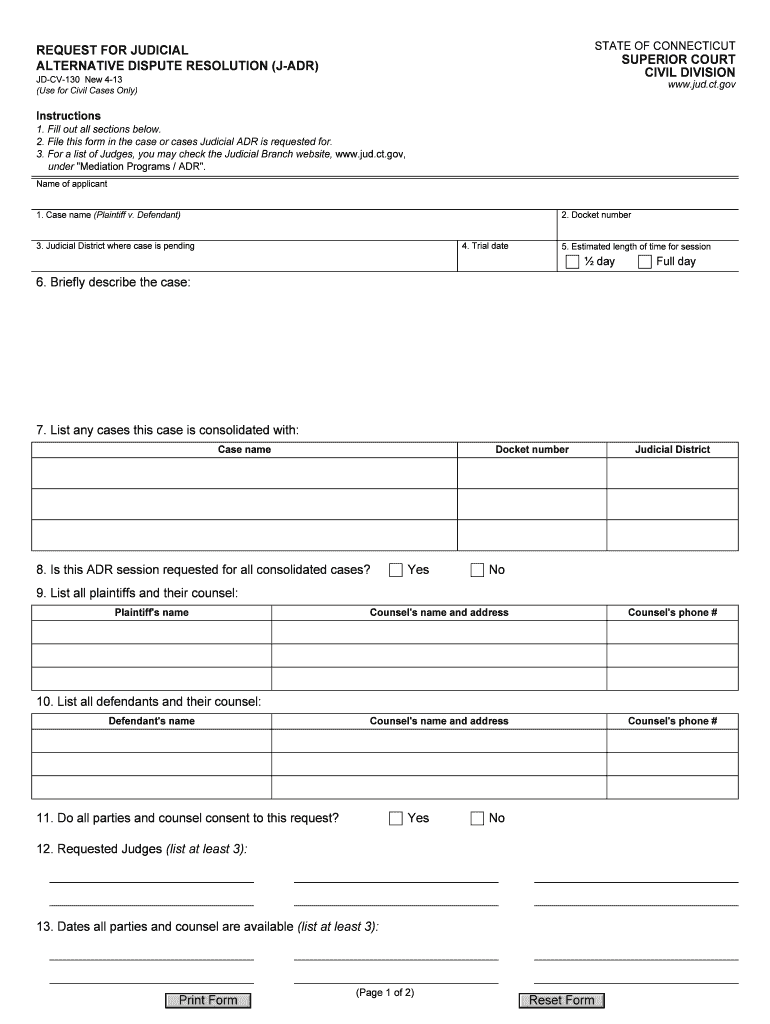
The "jd cv omdex form" is associated with the Judicial Alternative Dispute Resolution (J-ADR) process in the Connecticut Superior Court's Civil Division. It serves as a formal request for parties involved in a civil dispute to engage in an alternative resolution method outside the standard court proceedings. This form is designed to streamline the process of entering into J-ADR, ensuring that all necessary details about the case and the participating parties are captured accurately. The emphasis is on promoting a voluntary and confidential approach to dispute resolution, thereby potentially saving time and resources for all parties.
How to Obtain the JD CV Omdex Form
Acquiring the JD CV Omdex form is a straightforward process. It can be obtained directly from the Connecticut Superior Court's official website under the Civil Division forms section. This ensures that you are accessing the most up-to-date and official version of the form. Additionally, individuals may request a copy from the court clerk's office in person if they prefer a paper version. Many legal professionals involved in civil disputes may also have the form readily available for their clients. It's important to ensure that you have the correct version, specifically tailored to the Connecticut judicial system.
Key Elements of the JD CV Omdex Form
The JD CV Omdex form comprises several essential sections designed to gather comprehensive information for the J-ADR process:
-
Case Information: Details about the case, including docket number, case type, and parties involved.
-
Party Consent: Confirmation that all parties consent to participate in the J-ADR process, emphasizing its voluntary nature.
-
Confidentiality Clauses: Assurance that all proceedings will be confidential, aligning with the core principles of J-ADR.
-
Alternative Resolution Details: Information about the chosen ADR method, mediator, and any scheduled dates.
This structured approach ensures that both the court and participating parties have a clear record of the mutual agreement to resolve the dispute outside the conventional courtroom setting.
Steps to Complete the JD CV Omdex Form
Completing the JD CV Omdex form requires attention to detail to ensure all sections are accurately filled out:
-
Gather Case Details: Start by collecting all relevant information about the case, including the docket number and the involved parties’ contact details.
-
Consult with a Legal Advisor: Discuss the possibility of J-ADR with a legal professional to understand the implications and gain advice on filling out the form correctly.
-
Collect Signatures: Ensure that all parties provide their written consent, verifying their agreement to the J-ADR process.
-
Fill Out the Form: Carefully complete each section of the form with the gathered information and signatures.
-
Submit the Form: Once completed, submit the form to the appropriate court division, either online or in person, as dictated by the submission guidelines.
Legal Use of the JD CV Omdex Form
The JD CV Omdex form is legally binding, serving as an official document within the Connecticut Superior Court system. Its primary legal use is to facilitate the J-ADR process, a court-endorsed method of dispute resolution. By opting for this form, parties agree to engage in mediation or arbitration, led by a neutral third party. This decision is documented and approved within the legal framework, offering an alternative to traditional litigation. The confidentiality and voluntary components are particularly endorsed by legal standards, ensuring that the process remains within the desired judicial criteria.
Who Typically Uses the JD CV Omdex Form
The JD CV Omdex form is primarily utilized by parties involved in civil disputes within Connecticut who seek an alternative resolution to their conflict. This includes:
-
Individuals or Groups in Civil Litigation: Parties wishing to resolve disputes involving contracts, property, or personal grievances outside of traditional court proceedings.
-
Legal Professionals: Attorneys advising clients to consider J-ADR as a viable resolution method to save time and reduce the stress of litigation.
-
Court Officials: Judges and court clerks who facilitate the transition of suitable cases from litigation to ADR processes.
This form is especially beneficial for those seeking a more expedient resolution to their legal conflicts.


State-Specific Rules for the JD CV Omdex Form
The JD CV Omdex form and its associated processes are governed by Connecticut's state-specific rules. These rules outline the acceptable forms of ADR, confidentiality requirements, and the legal implications of entering into such agreements. Connecticut law requires that both parties voluntarily agree to the J-ADR process and adhere to the mutual respect of the decided outcome, provided it is fair and just. It's vital to understand that these rules may vary significantly from practices in other states, highlighting the importance of localized legal guidance.
Important Terms Related to JD CV Omdex Form
Understanding certain key terms is crucial for effectively using the JD CV Omdex form:
-
J-ADR: Judicial Alternative Dispute Resolution, a program offered as an alternative to traditional litigation.
-
Mediator: A neutral third party engaged in guiding the ADR process without offering a binding decision.
-
Confidentiality: A fundamental principle ensuring that all discussions and agreements made during ADR are not disclosed externally.
These terms and their definitions form the foundation of understanding the scope and functions of the J-ADR process facilitated by the JD CV Omdex form.