Family with service needs - Connecticut Judicial Branch - CT - jud ct 2026

Get Form
Family with service needs - Connecticut Judicial Branch - CT - jud ct Preview on Page 1

Here's how it works

01. Edit your form online
Type text, add images, blackout confidential details, add comments, highlights and more.

02. Sign it in a few clicks
Draw your signature, type it, upload its image, or use your mobile device as a signature pad.

03. Share your form with others
Send it via email, link, or fax. You can also download it, export it or print it out.

Definition & Meaning

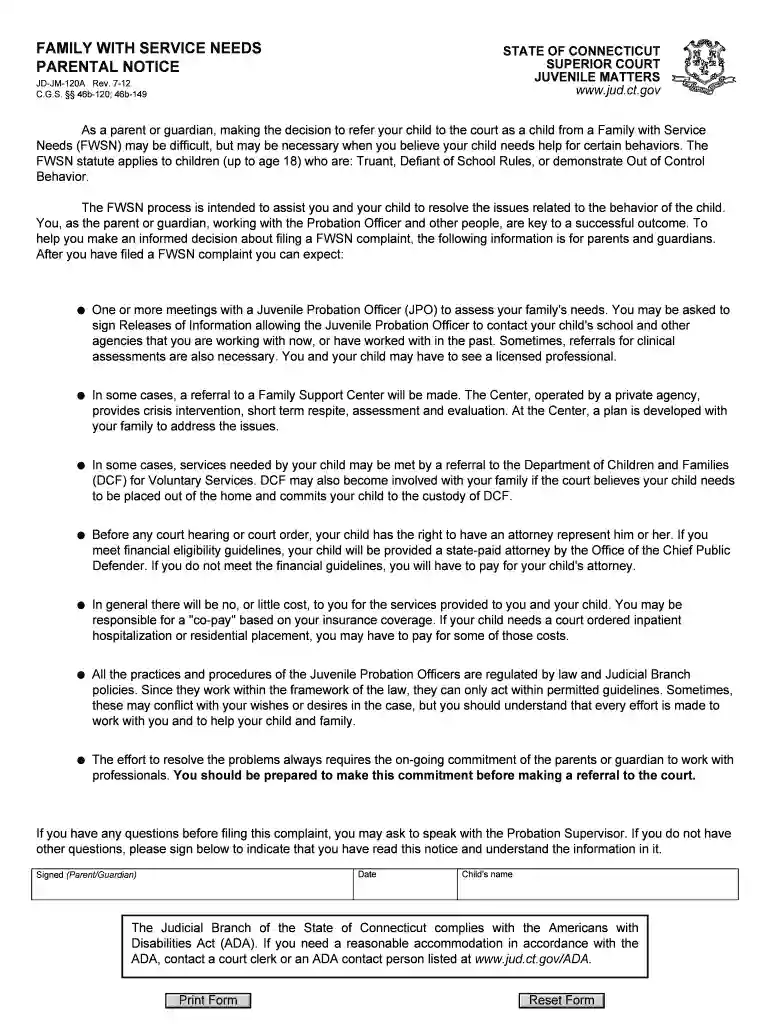
The term "Family with Service Needs" (FWSN) refers to a specific Connecticut legal framework designed to address situations where a family requires court intervention due to the behavior of a child. This includes problems such as truancy, defiance of school rules, or running away. Under this process, the Connecticut Judicial Branch aims to provide families with support mechanisms to address these challenges effectively. The FWSN process involves various stages aiming to divert children from entering the juvenile justice system unnecessarily.

Practical Examples

  • A teenager frequently skips school, prompting their parents to file an FWSN petition in an effort to obtain a formal intervention.
  • A child repeatedly defies school authority, and the family seeks the court's involvement to connect them with counseling services.

How to Use the Family with Service Needs Form

Families intending to use the FWSN form begin by downloading or obtaining it from the Connecticut Judicial Branch. The form requires detailed information about the child's behaviors, personal identification, and circumstances prompting the referral. It is crucial to complete each section accurately to ensure proper handling by the juvenile court system.

Steps for Form Completion

  1. Collect Necessary Information: Gather details about the child's behavior, school records, and any prior interventions.
  2. Complete the Form: Fill out each section precisely, ensuring all required fields are covered.
  3. Submit the Form: Depending on preference, submit via mail or in person at the designated local judicial office.

How to Obtain the Family with Service Needs Form

The FWSN form can be acquired through the Connecticut Judicial Branch's official website or by visiting a local courthouse. It's essential to use the latest version to account for any procedural updates.

Form Acquisition Methods

  • Online Download: Available in a downloadable format from the judicial branch's website for ease of access.
  • In-Person Collection: Visit a local juvenile court to collect a physical copy if preferred or necessary.

Key Elements of the Family with Service Needs Form

The FWSN form contains several critical sections each addressing distinct elements of the referral process. It involves:

  • Child Information: Captures detailed identification data, including age and school enrollment status.
  • Behavioral Description: Detailed narration of the acts prompting the filing, including dates and specific instances.
  • Parental Commitment: Section emphasizing the parent's active involvement in seeking a resolution and support.

Legal Use of the Family with Service Needs Form

The completion of the FWSN form marks a formal request for judicial intervention. It must be noted that the process follows strict legal protocols to ensure compliance and proper use. The court's involvement is primarily advisory and supportive rather than punitive.

Important Legal Considerations

  • Rights of the Child: The child has a right to legal representation and should be informed about the proceedings and their potential impacts.
  • Confidentiality: Information disclosed through this process is confidential, requiring careful handling by all parties involved.

State-Specific Rules for Family with Service Needs

Connecticut law uniquely governs the FWSN form, offering tailored responses to the needs of families within the state. Specific guidelines dictate the eligibility and procedural aspects of the FWSN process, ensuring both the child's and the family's needs are properly addressed.

Compliance Requirements

  • Parental Presence: Parents or guardians must engage actively throughout the process, attending meetings and court sessions as required.
  • Assessment Referrals: The court may necessitate psychological or behavioral assessments to offer comprehensive support.

Steps to Complete the Family with Service Needs Process

The journey from form submission to resolution involves several key stages, ensuring thorough evaluation and intervention.

  1. Petition Filing: Submit the completed form to the clerk of the Juvenile Court.
  2. Initial Review: The case is reviewed to determine appropriate referrals or interventions.
  3. Probation Meetings: Scheduled meetings with a Juvenile Probation Officer help assess the situation further.
  4. Service Referrals: If deemed necessary, the court may refer the family to specific services aimed at addressing the child's needs.

Important Terms Related to Family with Service Needs

Understanding the terminology associated with the FWSN form ensures clarity in communication and comprehension of the process.

  • Truancy: The act of staying away from school without a valid excuse, often prompting FWSN intervention.
  • Juvenile Probation Officer: A court-appointed officer who assists in overseeing the welfare and legal proceedings involving minors.
  • Diversion Programs: Alternative interventions aimed at addressing behavioral issues without formal legal action.

See more Family with service needs - Connecticut Judicial Branch - CT - jud ct versions

We've got more versions of the Family with service needs - Connecticut Judicial Branch - CT - jud ct form. Select the right Family with service needs - Connecticut Judicial Branch - CT - jud ct version from the list and start editing it straight away!
Versions Form popularity Fillable & printable
2016 4.8 Satisfied (116 Votes)
2012 4.4 Satisfied (135 Votes)
be ready to get more

Complete this form in 5 minutes or less

Get form

Got questions?

We have answers to the most popular questions from our customers. If you can't find an answer to your question, please contact us.
Contact us
In Connecticut, like with most states, a non-custodial parents child support obligation is calculated as a percentage of their total income compared to the needs of the child. Generally, this is 23% of your net weekly income for 1 child, 32% of your pay for 2 children, and 39% of your pay for 3 children.
Our goal is to protect children by: Preventing abuse and neglect. Training DCF child welfare staff. Giving families and communities tools so they can thrive. Providing mental health, behavior, and substance abuse services. Helping people become foster or adoptive parents. Seeing that kids have a safe and secure home.
In Connecticut, child support orders can only be changed (modified) by a judge or a family support magistrate.
Examples of Using the JD-FM-290 Template Child Custody Agreements: Parents can use the memorandum to outline custody arrangements, visitation schedules, and decision-making responsibilities.
JB-CSSD Family Services (Civil and Criminal) assists courts and clients to resolve family and interpersonal conflict. Family Civil Court services assist the Court and clients to resolve family and interpersonal conflicts with negotiation, mediation, and evaluation and education services.

Security and compliance

At DocHub, your data security is our priority. We follow HIPAA, SOC2, GDPR, and other standards, so you can work on your documents with confidence.

Learn more
ccpa2
pci-dss
gdpr-compliance
hipaa
soc-compliance

People also ask

Divisions of Superior Court - CT Judicial Branch. The Superior Court hears civil, criminal, family and juvenile matters. Civil Division hears cases in which someone is being sued to protect civil, personal or property rights.
Family Support Magistrates (FSMs) are not judges, but perform some judicial functions, hearing cases involving child support, spousal support and paternity. FSMs hear cases between unmarried parties to establish paternity and child support orders, about 18% of which involve families on state financial assistance.
Youll be supervised by a probation officer and must follow certain conditions during your probationary period, typically lasting one to three years. Connecticut has two main types of probation: adult probation and juvenile probation.

Related links