




01. Edit your form online
Type text, add images, blackout confidential details, add comments, highlights and more.

Type text, add images, blackout confidential details, add comments, highlights and more.

Draw your signature, type it, upload its image, or use your mobile device as a signature pad.

Send it via email, link, or fax. You can also download it, export it or print it out.
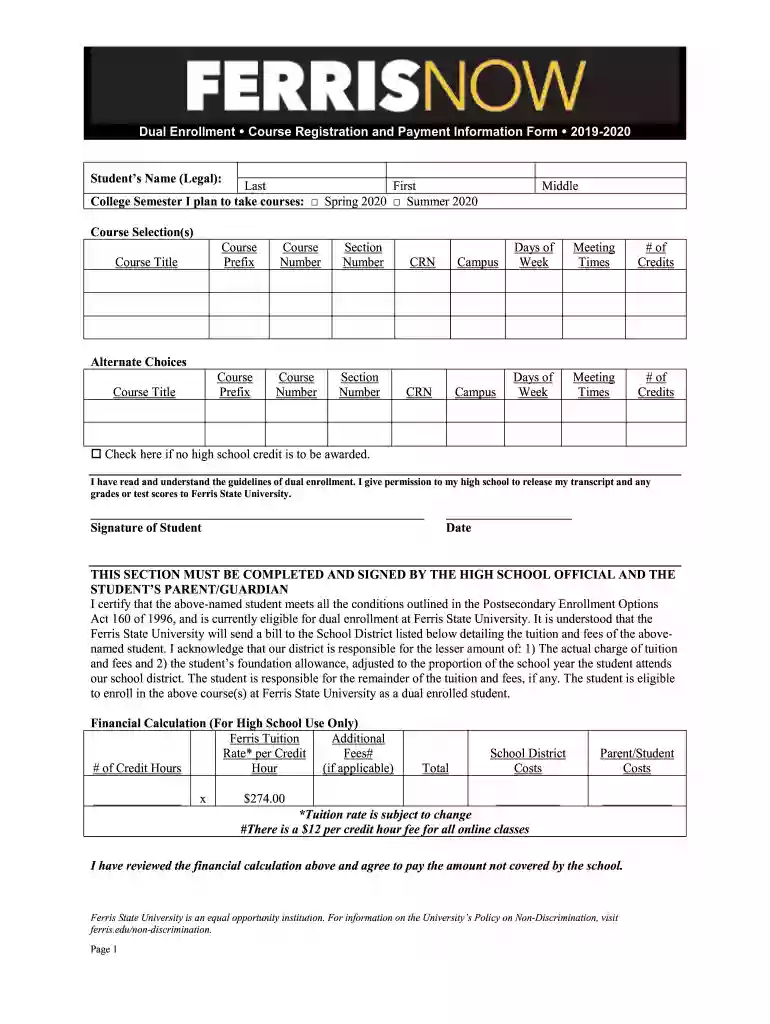
The Dual Enrollment Course Registration and Payment form is a critical document that facilitates the enrollment of high school students in college courses. This form is essential for the administrative process, ensuring that students interested in dual enrollment can officially select courses, handle payment responsibilities, and secure their positions in the program. It acts as a contractual agreement among students, their parents, and school officials, confirming their intent and understanding of the dual enrollment process.
The process of completing the Dual Enrollment Course Registration and Payment form involves several structured steps, ensuring accurate and timely submission.
Acquire the Form: Obtain the form from the participating high school's academic advisor or the college offering the dual enrollment program.
Course Selection: Carefully review the available course options. Select courses that align with the student's academic goals and future plans.
Fill Out Personal Information: Enter personal details of the student, including full name, date of birth, and contact information. Ensure all information is accurate and up-to-date.
Detail Payment Information: Specify the method of payment and acknowledge the responsibility for associated tuition and fees.
Collect Required Signatures: Obtain necessary signatures from the student, a parent or guardian, and a school official to authorize enrollment and acknowledge understanding of the terms.
Submit the Form: Depending on the institution’s requirements, the form can be submitted online, via mail, or delivered in person. Ensure submission before the deadline to secure course placement.
The dual enrollment program offers significant advantages to students, making the registration and payment form indispensable for those seeking to enhance their educational experience.
To maximize its utility, it is essential to understand the critical components of the Dual Enrollment Course Registration and Payment form.
Understanding key terminology associated with the form ensures clarity and correct completion.
While the general process is similar nationwide, specific rules and guidelines can vary by state.
Examining real-world examples can provide insight into the application of the dual enrollment form.
Completing the form may necessitate additional documents, which are essential for smooth administrative processing and ensuring eligibility for the dual enrollment program.
We've got more versions of the Dual Enrollment Course Registration and Payment form. Select the right Dual Enrollment Course Registration and Payment version from the list and start editing it straight away!
At DocHub, your data security is our priority. We follow HIPAA, SOC2, GDPR, and other standards, so you can work on your documents with confidence.
Below youll find important details about LUOAs Dual Enrollment courses including course registration deadlines, the structure of our classes, info about
The applications for the Dual Enrollment Scholarship Pilot Cycle 3 for 2024-25 is currently closed as we have received more than anticipated submissions.


