




01. Edit your form online
Type text, add images, blackout confidential details, add comments, highlights and more.

Type text, add images, blackout confidential details, add comments, highlights and more.

Draw your signature, type it, upload its image, or use your mobile device as a signature pad.

Send it via email, link, or fax. You can also download it, export it or print it out.
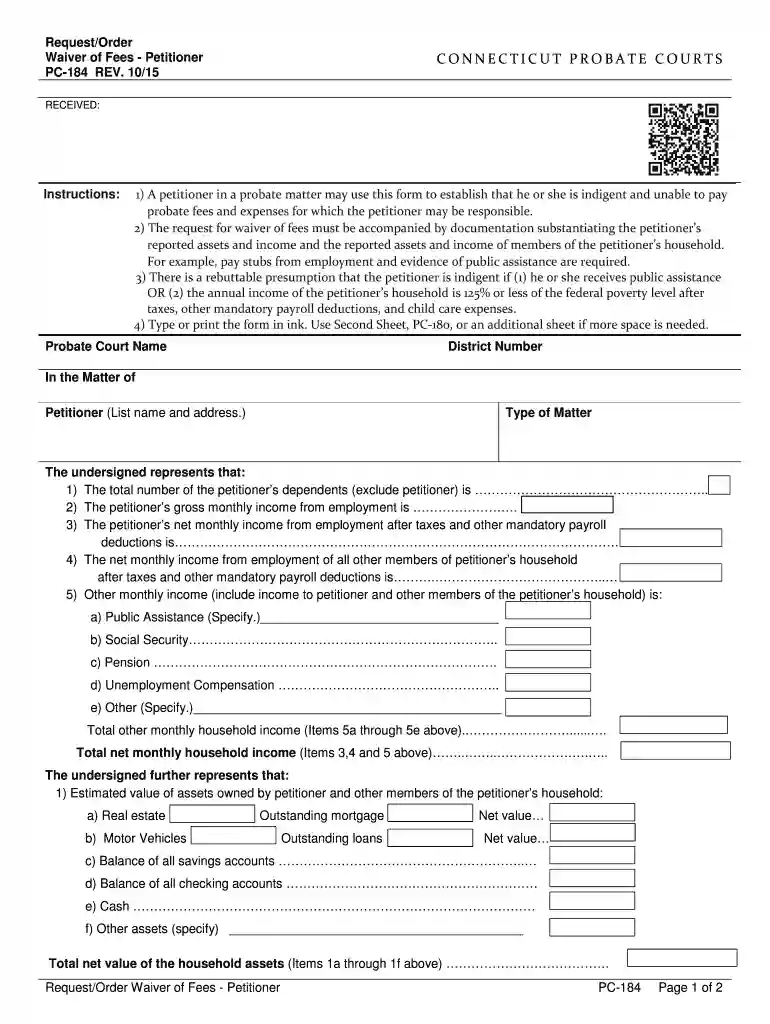
The "Connecticut Request Order Waiver of Fees - Petitioner" form is an essential document used in Connecticut Probate Courts to request the waiving of probate fees for individuals who are financially unable to pay these costs. This form is specifically designed to aid petitioners, individuals initiating a legal process in the Probate Court, who are facing financial challenges. The main purpose of the form is to outline the petitioner's financial status, detailing income, assets, liabilities, and household expenses, allowing the court to make an informed decision regarding their eligibility for a fee waiver.
To effectively use this form, petitioners must complete several critical sections that outline their financial situation. This includes accurately recording income from various sources, listing all assets, and detailing monthly expenses. The form must be filled out carefully, ensuring that all required fields are completed with precise information. Any accompanying documentation that supports the financial information provided, such as pay stubs or bank statements, should be attached to strengthen the request. Once completed, the form can be submitted to the relevant Connecticut Probate Court for review.
This form is accessible through various means to ensure convenience for users. Primarily, it can be obtained directly from the Connecticut Probate Court's website, where it is available as a downloadable PDF. Alternatively, individuals can visit any local Probate Court office to request a physical copy. Additionally, legal aid organizations in Connecticut may also provide this form, along with guidance on how to complete it effectively.
Eligibility for the waiver of probate fees is primarily based on financial need. Petitioners must demonstrate that paying these fees would cause significant financial hardship. The criteria often consider factors such as:


When filing the Connecticut Request Order Waiver of Fees - Petitioner, certain documents must accompany the form to substantiate the financial claims made. These documents may include:
In Connecticut, the rules governing fee waivers are specific and reflect the state’s commitment to accessibility to legal processes regardless of financial standing. Petitioners must be aware of Connecticut's unique requirements, such as varying criteria across different Probate Courts in the state. It is advisable for applicants to consult with court officials or legal professionals within the state to ensure thorough understanding and compliance with these rules.
The legal implications of successfully obtaining a fee waiver can be significant, offering financial relief to individuals who need to invoke the Probate Court’s services but cannot afford the associated fees. This form is particularly relevant in cases involving estate administration where the petitioner is not an heir to a significant estate and does not have the means to cover the costs. Successful applications allow petitioners to proceed with necessary legal actions without the burden of fee payments.
Practical examples of utilizing the Connecticut Request Order Waiver of Fees - Petitioner include:
Each of these scenarios highlights the form's utility in diverse legal contexts, reinforcing its role in supporting petitioners facing economic constraints.
We've got more versions of the Connecticut Request Order Waiver of Fees - Petitioner form. Select the right Connecticut Request Order Waiver of Fees - Petitioner version from the list and start editing it straight away!
At DocHub, your data security is our priority. We follow HIPAA, SOC2, GDPR, and other standards, so you can work on your documents with confidence.
The undersigned requests that the court grant a waiver of fees and expenses in the above matter for which the petitioner may be responsible because the
Feb 9, 2024 This guide may be used by law students (with supervision) and practicing attorneys to navigate the sentence.
Dec 2, 2023 However, given the high costs of this program, the Board should request HSH to report back on costs and benefits of lower cost service.


