
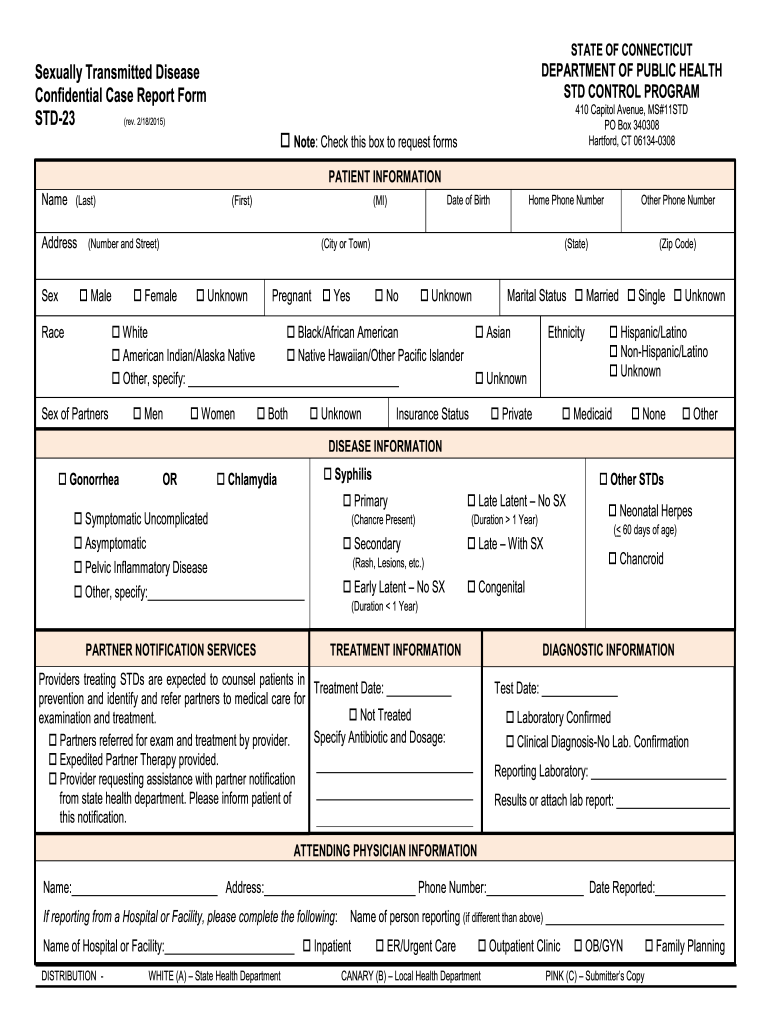







Definition and Purpose of the STD-23 - CT
The STD-23, as designated by the Connecticut Department of Public Health, serves as a Confidential Case Report Form specifically for the reporting of sexually transmitted diseases (STDs) such as Chlamydia, Gonorrhea, and Syphilis among others. The primary objective of the form is to ensure prompt and accurate documentation of STD cases, facilitating public health management and intervention efforts. Physicians, clinics, and medical laboratories utilize this form to report cases within a strictly mandated timeframe, aiding in the timely collection and analysis of public health data.
How to Use the STD-23 - CT
To accurately use the STD-23 form, health professionals must gather detailed information, which includes the patient's demographics, diagnosis details, and treatment information. The form is also designed to allow for the collection of partner notification data, thus supporting the wider public health initiative of preventing further spread of infectious diseases. It requires careful completion to ensure all relevant data is captured correctly, which is crucial for public health surveillance and intervention.
-
Complete Patient Details: Ensure that the patient's personal information, such as name, date of birth, and contact details, is filled out accurately.
-
Disease Information: Include comprehensive details about the diagnosed STD, including the date of diagnosis and the tests conducted.
-
Treatment Information: Clearly document the treatment regime prescribed, specifying both medication and dosage.
-
Partner Notification: Collect information required for notifying partners about potential exposure, ensuring necessary steps are taken to prevent further transmission.
Steps to Complete the STD-23 - CT
Completion of the STD-23 form requires adherence to a structured process to ensure accuracy and compliance:
-
Gather Required Information: Collect all necessary details concerning patient identity, diagnosis, and treatment.
-
Fill Out the Form: Start by entering patient information followed by detailed disease and treatment data.
-
Verify Data Accuracy: Review the completed form to ensure all information is correct and complete.
-
Submit Timely: Ensure the form is submitted within 12 hours of diagnosis to the appropriate health authorities to comply with legal requirements.
Why Should You Complete the STD-23 - CT
Submitting the STD-23 form is critical due to its contribution to public health safety. By reporting STD cases, healthcare professionals play a vital role in:
- Surveillance: Helping health authorities to identify trends and outbreaks.
- Prevention: Enabling initiatives to control the spread of STDs.
- Research: Providing data for epidemiological studies and public health research.
Who Typically Uses the STD-23 - CT
The primary users of the STD-23 form include:
- Healthcare Providers: Doctors, nurses, and clinic staff responsible for diagnosing and treating patients.
- Public Health Officials: Individuals involved in monitoring public health and responding to outbreaks.
- Laboratories: Facilities conducting tests that confirm STD diagnoses.


Key Elements of the STD-23 - CT
Essential components of the STD-23 form encompass:
- Patient Demographics: Information that identifies the patient while ensuring confidentiality.
- Disease Diagnosis: Detailed data about the type and scope of the diagnosed STD.
- Treatment Regimens: Specifics about prescribed treatments to facilitate public health analysis.
- Partner Notification: Data needed for contact tracing and reducing further transmission risks.
Legal Use and Compliance of the STD-23 - CT
Strict legal guidelines govern the use and submission of the STD-23 form, ensuring:
- Confidentiality: Adherence to privacy laws protecting patient information.
- Timeliness: Meeting the 12-hour submission requirement to minimize delays in public health responses.
- Accuracy: Ensuring all recorded information is correct to provide reliable data for health interventions.
Examples of Using the STD-23 - CT
Case studies demonstrating practical scenarios:
- Case of Gonorrhea: A patient diagnosed promptly submits the form to enable immediate intervention.
- Syphilis Outbreak: Rapid reporting using the STD-23 form supports outbreak management and resource allocation.
- Chlamydia Testing: Accurate use of the form helps in understanding infection patterns within a community.
State-Specific Rules for the STD-23 - CT
Connecticut state guidelines stipulate several rules:
- Submission Requirements: Submissions must reach local health authorities promptly post-diagnosis.
- Data Handling: Procedures for maintaining confidentiality during data collection and transmission.
- Reporting Standards: Specific criteria for disease classification and form completion.




