2017 MI 3966-2026

Get Form
2017 MI 3966 Preview on Page 1

Here's how it works

01. Edit your form online
Type text, add images, blackout confidential details, add comments, highlights and more.

02. Sign it in a few clicks
Draw your signature, type it, upload its image, or use your mobile device as a signature pad.

03. Share your form with others
Send it via email, link, or fax. You can also download it, export it or print it out.

Definition and Meaning of 2017 MI 3966

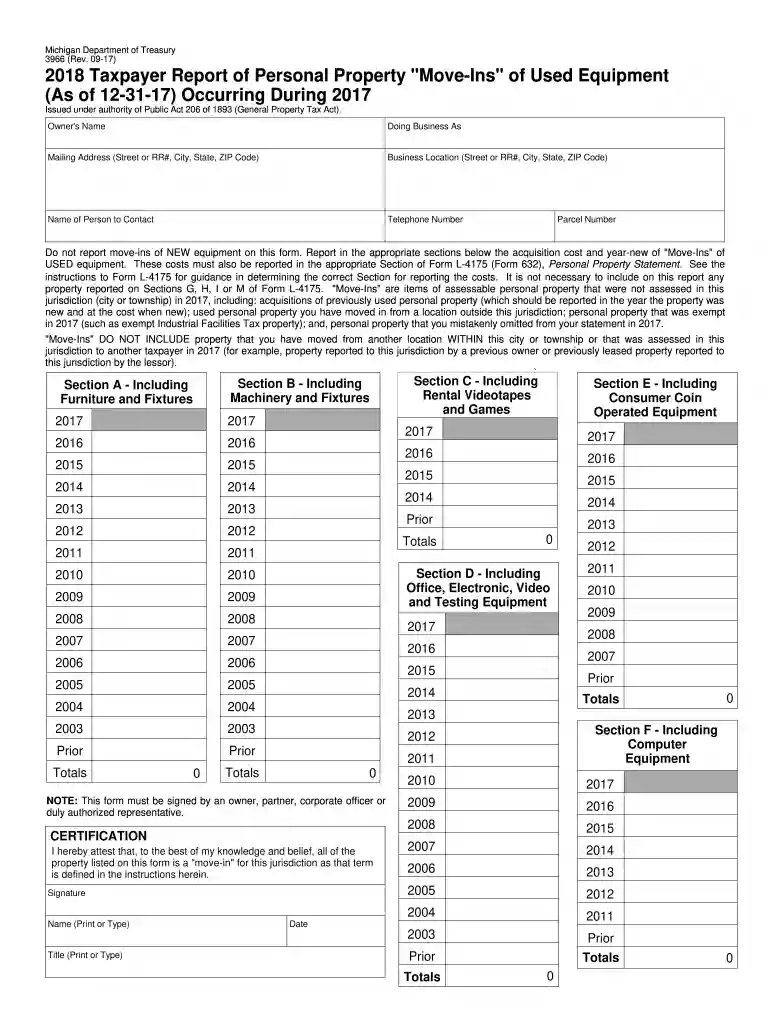
The "2017 MI 3966" form is a tax document issued by the Michigan Department of Treasury. It serves as a mechanism for reporting the 'Move-Ins' of used personal property. More specifically, it focuses on acquiring previously unassessed used equipment during the year 2017. The form is vital for ensuring tax compliance in Michigan, as it requires detailed disclosure of such equipment, thereby preventing tax evasion through unreported acquisitions.

Key Elements of the 2017 MI 3966

  • Used Equipment Reporting: It requires taxpayers to specify previously unassessed used equipment acquired during the specified year.
  • Exclusion of New Equipment: The form explicitly states that new equipment should not be reported, narrowing its focus solely to used assets.
  • Detailed Sections: The form includes specific sections accommodating different types of equipment with comprehensive guidelines for accurate completion.

How to Use the 2017 MI 3966

The 2017 MI 3966 form plays a crucial role in reporting asset acquisitions for tax purposes. Here's a structured approach to using the form effectively:

  1. Review the Instructions: Start by carefully reading the instructions provided on the form. This will give you an overview of required information and how it should be reported.
  2. Gather Required Information: Ensure you have accurate details concerning each piece of acquired used equipment, including purchase dates, values, and types.
  3. Fill Out Relevant Sections: Input details in their respective sections, ensuring specific categories of equipment are reported correctly.
  4. Certification: Certification by an authorized individual is mandatory to validate the accuracy of reported information.

Steps to Complete the 2017 MI 3966

Completing the 2017 MI 3966 form is a methodical task that requires attention to detail. Below is a guide to ensure a thorough approach:

  1. Identify Eligible Equipment: Confirm that all equipment listed fits the criteria of previously unassessed and used.
  2. Section Completion:
    • Section 1: Enter personal or business identification details.
    • Section 2: Report each item of used equipment, including purchase details and valuation.
  3. Verify Information: Double-check the inputs for accuracy.
  4. Certification: Authorize the form with an official signature.

Penalties for Non-Compliance

Failure to accurately report on the 2017 MI 3966 could lead to penalties, including fines or additional tax liabilities. It's essential to approach the form with diligence and accuracy to avoid such consequences.

Important Terms Related to the 2017 MI 3966

Familiarity with these key terms can facilitate a more accurate and efficient completion process:

  • Move-Ins: Refers to the introduction of used personal property into the jurisdiction, subject to tax assessment.
  • Unassessed Equipment: Equipment not previously evaluated for tax purposes, necessitating reporting in the given tax year.
  • Certification: A formal declaration of the form's accuracy by an authorized entity.

Legal Use of the 2017 MI 3966

The 2017 MI 3966 form is legally binding within the Michigan tax system. Its completion and submission are required for compliance with local tax laws concerning personal property acquisitions. Incomplete or inaccurate filings may breach state regulations, leading to potential audits or enforcement actions.

Who Typically Uses the 2017 MI 3966

The form is primarily utilized by individuals and businesses that have acquired used equipment within Michigan during 2017. It includes:


  • Businesses Expanding Operations: Companies introducing additional assets to their workflows.
  • Individuals Acquiring Equipment: Persons who have purchased used machinery or tools for significant usage.
decoration image ratings of Dochub

State-Specific Rules for the 2017 MI 3966

Michigan enforces specific rules to align with local tax regulations. Users must:

  • Adhere to State Guidelines: Fulfill state-specific requirements as outlined on the form.
  • Engage Local Tax Authorities: Consult with local tax professionals for guidance unique to Michigan's tax code.

Required Documents for Form 2017 MI 3966

When preparing to complete the form, ensure you have:

  • Purchase Receipts: Proof of purchase for used equipment.
  • Valuation Documents: Assessments indicating the current market value of the purchased items.
  • Previous Tax Documentation: Past filings that may provide context or clarity in compiling current year reports.

See more 2017 MI 3966 versions

We've got more versions of the 2017 MI 3966 form. Select the right 2017 MI 3966 version from the list and start editing it straight away!
Versions Form popularity Fillable & printable
2023 4.7 Satisfied (53 Votes)
2022 4.5 Satisfied (264 Votes)
2021 4.4 Satisfied (347 Votes)
2020 4.3 Satisfied (65 Votes)
2019 4.4 Satisfied (405 Votes)
2017 4.4 Satisfied (1327 Votes)
be ready to get more

Complete this form in 5 minutes or less

Get form

Got questions?

We have answers to the most popular questions from our customers. If you can't find an answer to your question, please contact us.
Contact us
For the 2024 income tax returns, the individual income tax rate for Michigan taxpayers is 4.25 percent, and the personal exemption is $5,600 for each taxpayer and dependent.
Anyone generating an income at or below that amount will pay nothing in tax; anyone making more than that amount will get a partial reduction on their taxes based on the BPA figure. Starting in 2023, the government increased the federal basic personal amount to $15,000. In 2024, the amount increases to $15,705.
401 Residential Improved Classification - this classification refers to residentially classed property that has been improved by a building being placed on that property at some point in time. The word improved does not indicate that there has been an improvement added from the previous year.
Before 2018, taxpayers could claim a personal exemption for themselves and each of their dependents. The amount would have been $4,150 for 2018, but the Tax Cuts and Jobs Act (TCJA) set the amount at zero for 2018 through 2025. TCJA increased the standard deduction and child tax credits to replace personal exemptions.
The deduction for all personal exemptions is suspended (reduced to zero), effective for tax years 2018 through 2025. For 2024, the gross income limitation for a qualifying relative is $5,050 ($350 increase). Click Next to continue.

Security and compliance

At DocHub, your data security is our priority. We follow HIPAA, SOC2, GDPR, and other standards, so you can work on your documents with confidence.

Learn more
ccpa2
pci-dss
gdpr-compliance
hipaa
soc-compliance
be ready to get more

Complete this form in 5 minutes or less

Get form

People also ask

For the 2024 income tax returns, the individual income tax rate for Michigan taxpayers is 4.25 percent, and the personal exemption is $5,600 for each taxpayer and dependent. An additional personal exemption is available if you are the parent of a stillborn child delivered in 2024.

Related links