




01. Edit your ca interdistrict attendance permit request online
Type text, add images, blackout confidential details, add comments, highlights and more.

Type text, add images, blackout confidential details, add comments, highlights and more.

Draw your signature, type it, upload its image, or use your mobile device as a signature pad.

Send school interdistrict attendance permit via email, link, or fax. You can also download it, export it or print it out.
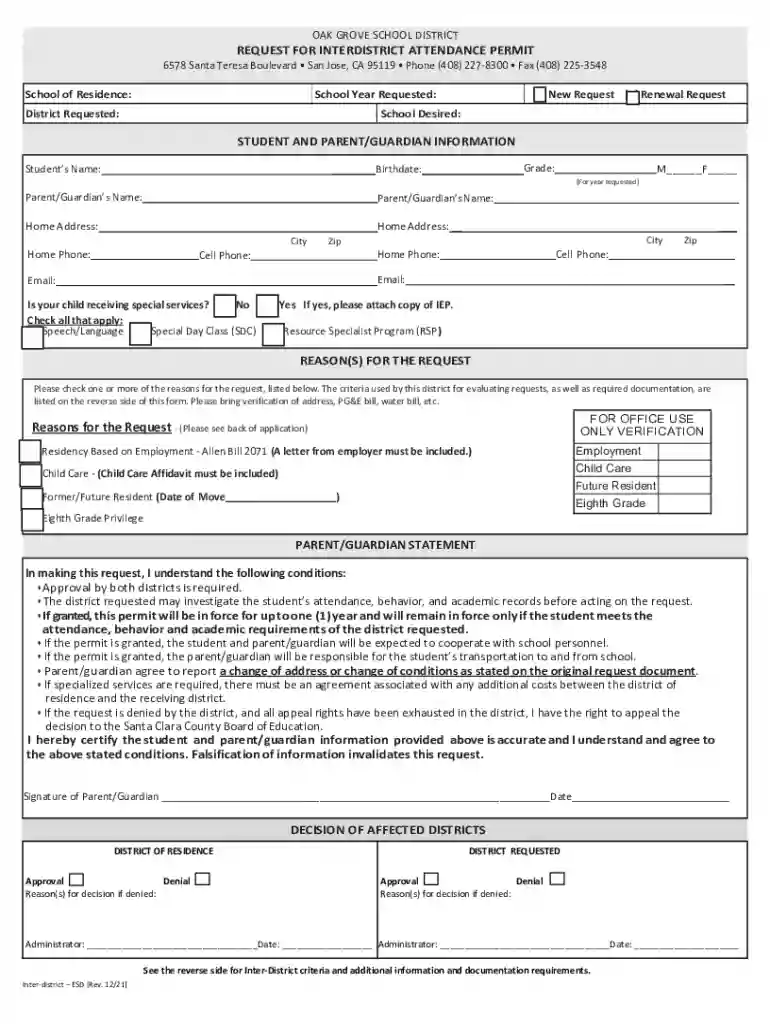
A school interdistrict attendance permit is an official document that allows a student to attend a school outside of their designated district. This permit is essential for families who wish to send their children to another district for reasons such as specialized educational programs, proximity to child care, or transportation convenience. The term "interdistrict" underscores the movement across district boundaries, highlighting the agreement that must exist between the origin and destination districts.
This permit serves as a mutual understanding between the districts involved, ensuring that all logistical and administrative requirements are met. Each school district typically outlines its own criteria for the issuance of these permits, which can include considerations like the availability of space, special educational needs, or specific programs not offered in the student's home district.
Once a school interdistrict attendance permit is obtained, it must be presented to the receiving school district during the enrollment process. Parents or guardians should include this permit with any additional required enrollment documents, such as proof of residency, immunization records, and academic transcripts. The permit should be kept accessible, as it may need to be presented during school meetings or for renewals at the end of the term.
Having the permit allows students to take advantage of educational opportunities that may be more aligned with their personal and academic needs. It facilitates participation in district-specific programs, extracurricular activities, and specialized courses that may not be available in the student's home district. Families should be aware of the conditions tied to the permit's usage, which may include maintaining satisfactory academic performance and adhering to the host district's policies.
Obtaining a school interdistrict attendance permit typically requires parents or guardians to submit an application to the student's home district. The application often involves filling out specific forms and providing supporting documentation that explains the reason for the transfer request. Common justifications include work-related relocation, distance considerations, or unique educational programs.
The process generally includes:
It is important to note that approval is not guaranteed, as it depends on factors like space availability and adherence to enrollment policies in the destination district.
Filling out the school interdistrict attendance permit involves several key steps:
Gather Required Information: Collect personal details of the student, including current school information, reasons for requesting the transfer, and any necessary documentation to support the application.
Complete the Application Form: Carefully fill out the application form, ensuring all sections are completed accurately. Clear explanations of the reasons for transfer should be provided.
Attach Supporting Documents: Include documents like family employment proof, affidavits, residency confirmations, or child care arrangements that justify the need for transfer.
Submit the Application: Deliver the completed application to the home district's administrative office. This step might require in-person submission, mailing, or online submission depending on the district's requirements.
Follow Up: Contact the district periodically to ensure the application is being processed. Be prepared to provide additional information if requested.
Receive Approval: Upon approval, the permit will be issued, and you can complete the enrollment process at the new school.
The school interdistrict attendance permit is primarily utilized by students and families residing within a district that does not offer certain programs or conveniences they seek in another district. Common users include:
Parents with Job Locations in Another District: Families may apply for a permit if a parent's place of employment is closer to the desired school, allowing the child to attend school nearer to the parent's workplace.
Families Seeking Specialized Programs: Students needing specific academic programs not available in their home district, such as advanced placement courses or language immersion programs.
Parents Seeking Superior Extracurricular Options: Families interested in a district because of its renowned athletics, arts programs, or clubs.
Guardians Handling Unique Family Situations: This could involve child custody arrangements where living circumstances require a student to attend a school outside the home district.


The interdistrict attendance permit includes several crucial elements designed to ensure a smooth transfer:
Personal Information: Details of the student, including full name, grade level, and current school.
Transfer Justification: Sections where parents or guardians must explain the reasons for the requested transfer.
Terms and Conditions: Explanation of the requirements for maintaining the permit, including behavioral expectations and possible stipulations regarding academic performance.
District Agreements: Signatures from both the home and receiving districts, indicating agreement on the transfer terms.
Expiration and Renewal Information: Indications of how long the permit remains valid and the process for renewal at the end of the term or academic year.
Eligibility for an interdistrict transfer typically involves meeting specific criteria set by both the home and destination districts. These criteria might include:
Availability of Space: The receiving school must have available space in the requested grade or program without having to hire additional teachers or alter the existing resources.
Program Needs: Justification based on specific educational or extracurricular programs offered by the destination district.
Residency-based Criteria: Proof that relocating due to employment or family circumstances justifies the transfer.
Performance and Behavior Standards: Adherence to specific academic performance or conduct benchmarks established by the receiving district.
Families should review the specific criteria established by their district to better understand what factors influence the approval process.

To better understand the practical application of an interdistrict attendance permit, consider these scenarios:
Case of Employment-Based Transfer: A family living in District A is requesting a permit for their child to attend a school in District B because the parents work in District B, which would make daily logistics more manageable. With proof of employment and a detailed application, they receive the permit.
Transfer for Specialized Academic Programs: A student excelling in math and science in their home district lacks access to advanced STEM programs. They apply for an interdistrict permit to attend another district renowned for its STEM curriculum and receive approval based on available space and program alignment.
Proximity for Child Care: A family living in one district but requiring child care services available only in a neighboring district applies for a permit to ensure their child's school attendance aligns with their child care needs. After an evaluation of the circumstances, the permit is granted.
These examples illustrate different situations where a school interdistrict attendance permit facilitates education tailored to family logistics and academic aspirations.
We've got more versions of the ca interdistrict attendance permit request form. Select the right ca interdistrict attendance permit request version from the list and start editing it straight away!
At DocHub, your data security is our priority. We follow HIPAA, SOC2, GDPR, and other standards, so you can work on your documents with confidence.
Jul 12, 2024 The interdistrict permit is required for anyone living outside of San Francisco who wishes to attend or continue attending a San Francisco public school.
This book is written for Radiomen of the United States Navy and Naval Reserve who are seeking advancement in rating to. RM 1 or RMC.
Interdistrict open enrollment policies allow students to transfer to another school outside of their resident school district. Voluntary open-enrollment


