




01. Edit your peer reporting form online
Type text, add images, blackout confidential details, add comments, highlights and more.

Type text, add images, blackout confidential details, add comments, highlights and more.

Draw your signature, type it, upload its image, or use your mobile device as a signature pad.

Send peer review reporting form via email, link, or fax. You can also download it, export it or print it out.
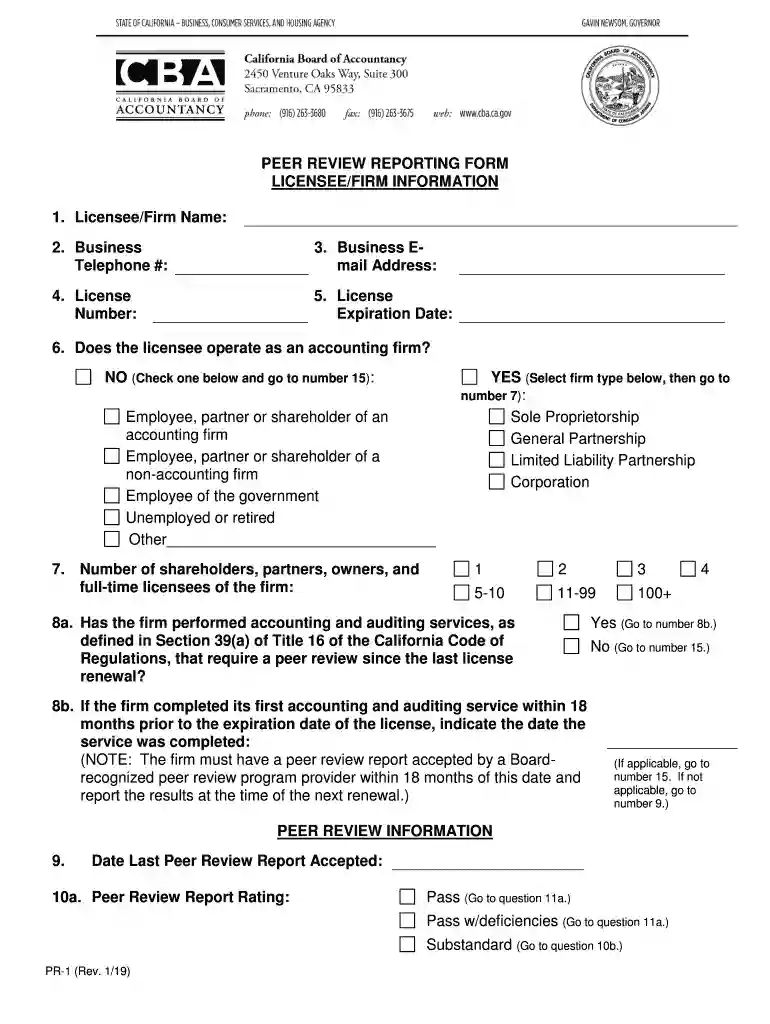
The peer review reporting form is a document mandated by the California Board of Accountancy. It serves as a critical tool for licensees and firms to report their peer review status and confirm compliance with established accounting standards. This form collects vital information about the firm's operation and professional conduct, ensuring adherence to regulatory guidelines. By submitting this form, firms demonstrate their commitment to maintaining high standards of quality in their accounting and auditing services.
The peer review reporting form encompasses several essential components:
Each element must be accurately filled to ensure compliance and avoid potential penalties.
To effectively use the peer review reporting form:
Utilizing this form correctly helps maintain compliance and up-to-date professional credentials.
Completing the peer review reporting form involves the following steps:
Proper execution of these steps ensures compliance with regulatory requirements.
The form is primarily used by firms and individuals in the accounting sector:
These users rely on the peer review reporting form to affirm their commitment to maintaining industry standards.


In California, specific rules govern the use of the peer review reporting form:
Understanding these variations is crucial for the accurate completion and submission of the form.
For the peer review reporting form, the main submission methods include:
Selecting the right submission method ensures that your form is received and processed efficiently.
Failing to submit the peer review reporting form can lead to significant penalties:
Adhering to submission guidelines and timelines helps avoid these repercussions and maintains the firm's professional reputation.
We've got more versions of the peer reporting form form. Select the right peer reporting form version from the list and start editing it straight away!
At DocHub, your data security is our priority. We follow HIPAA, SOC2, GDPR, and other standards, so you can work on your documents with confidence.
The information provided in this form will be used by the California Board of Accountancy (CBA) to determine qualifications for a Certified Public Accountant
All records from the Peer Review Teaching Observations are property of the faculty member. This form is REQUIRED in any tenure and promotion dossier for faculty


