




01. Edit your form online
Type text, add images, blackout confidential details, add comments, highlights and more.

Type text, add images, blackout confidential details, add comments, highlights and more.

Draw your signature, type it, upload its image, or use your mobile device as a signature pad.

Send it via email, link, or fax. You can also download it, export it or print it out.
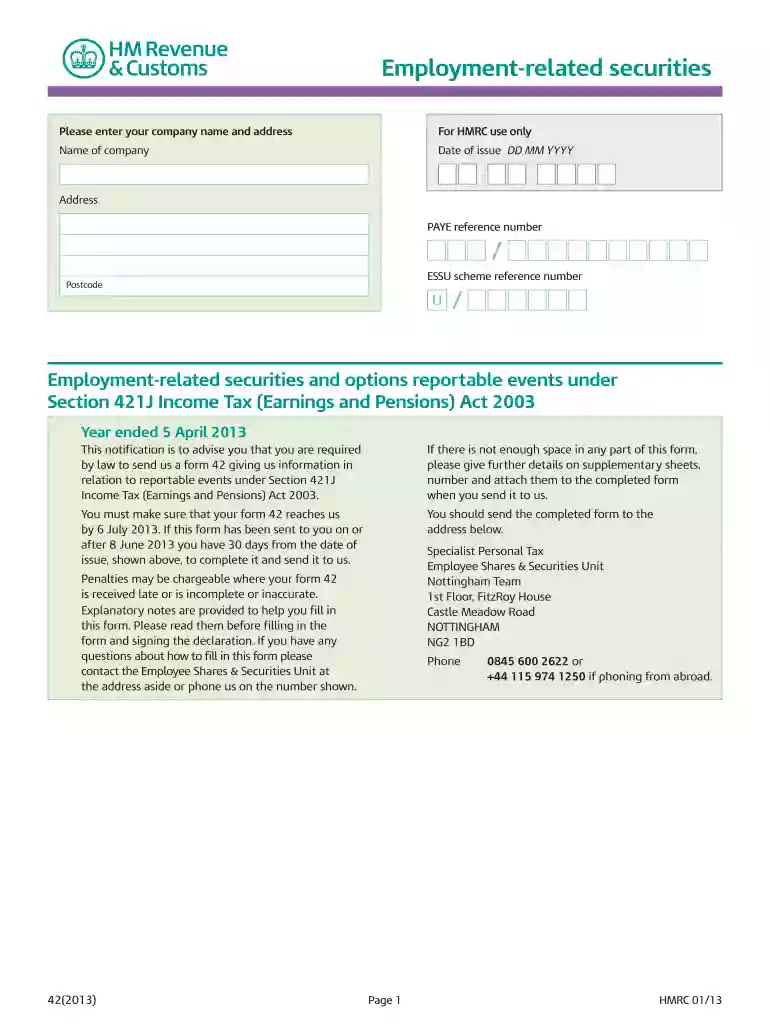
Form 42 (2013) - Share Schemes - HM Revenue and Customs is a mandatory document used in the United Kingdom for reporting employment-related securities and options. It is required under Section 421J of the Income Tax (Earnings and Pensions) Act 2003. Companies must use this form to detail any reportable events, such as the acquisition or disposal of securities, by the deadline specified—typically July 6 following the end of the tax year. The form ensures transparency and compliance in the reporting of employee share options and securities transactions.
Several critical sections form the backbone of Form 42, providing a structured way to gather necessary information:
Completing Form 42 requires accuracy and attention to detail. Here's a step-by-step process to guide you:
The deadline for submitting Form 42 is crucial. Companies must file by July 6 following the end of the tax year in which the reportable events occurred. Late submissions can result in hefty penalties, so it is advisable to prepare and verify all details well ahead of this date.
Failure to submit Form 42 by the deadline can result in significant penalties. These include fines for late filing and potential investigations by HM Revenue and Customs into non-compliance. To avoid these issues, companies should establish strict internal filing procedures and verify each submission for completeness and accuracy.
Form 42 can be downloaded directly from the HM Revenue and Customs website. Businesses can access it through the government’s online tax platform, where they can find a comprehensive guide to filling it out. Ensure you are accessing the updated version of the form applicable to the correct tax year.
Form 42 is predominantly used by companies that issue shares or employee stock options as part of their compensation packages. This includes firms across various sectors that aim to provide employees with ownership stakes, fostering motivation and loyalty.


The use of Form 42 is mandated by British tax law to ensure the proper reporting of employee share schemes. Its legal function is to document transactions that could affect the taxable income of employees, ensuring both company and employee compliance with tax regulations.
Consider the example of a tech startup that offers stock options to new employees. Each time an employee exercises their options to purchase shares, the company must document this transaction on Form 42, detailing the number of shares, the price at which they were exercised, and any other relevant financial details.
Though Form 42 is a British form used for HM Revenue and Customs, companies with dual operations in the UK and US should be aware of potential cross-border tax implications. The IRS has guidelines for reporting foreign income and assets which businesses should consult if they operate internationally.
Form 42 can typically be submitted electronically through the HM Revenue and Customs online portal, though paper submissions may also be accepted. While online submissions are faster and generate instant acknowledgment, paper submissions need to be mailed and confirmed upon receipt.
To accurately complete Form 42, businesses need several supporting documents, including employee contracts, details of share transactions, and any documents related to share options. Maintaining an organized record of these documents ensures streamlined completion and filing of the form.
Various types of business entities, such as limited companies and partnerships, may be required to file Form 42. The form is essential for any organization offering share schemes to employees, regardless of the size or sector, to ensure compliance with taxation laws.
We've got more versions of the Form 42 (2013) - Share Schemes - HM Revenue and Customs form. Select the right Form 42 (2013) - Share Schemes - HM Revenue and Customs version from the list and start editing it straight away!
At DocHub, your data security is our priority. We follow HIPAA, SOC2, GDPR, and other standards, so you can work on your documents with confidence.


