




01. Edit your form online
Type text, add images, blackout confidential details, add comments, highlights and more.

Type text, add images, blackout confidential details, add comments, highlights and more.

Draw your signature, type it, upload its image, or use your mobile device as a signature pad.

Send it via email, link, or fax. You can also download it, export it or print it out.
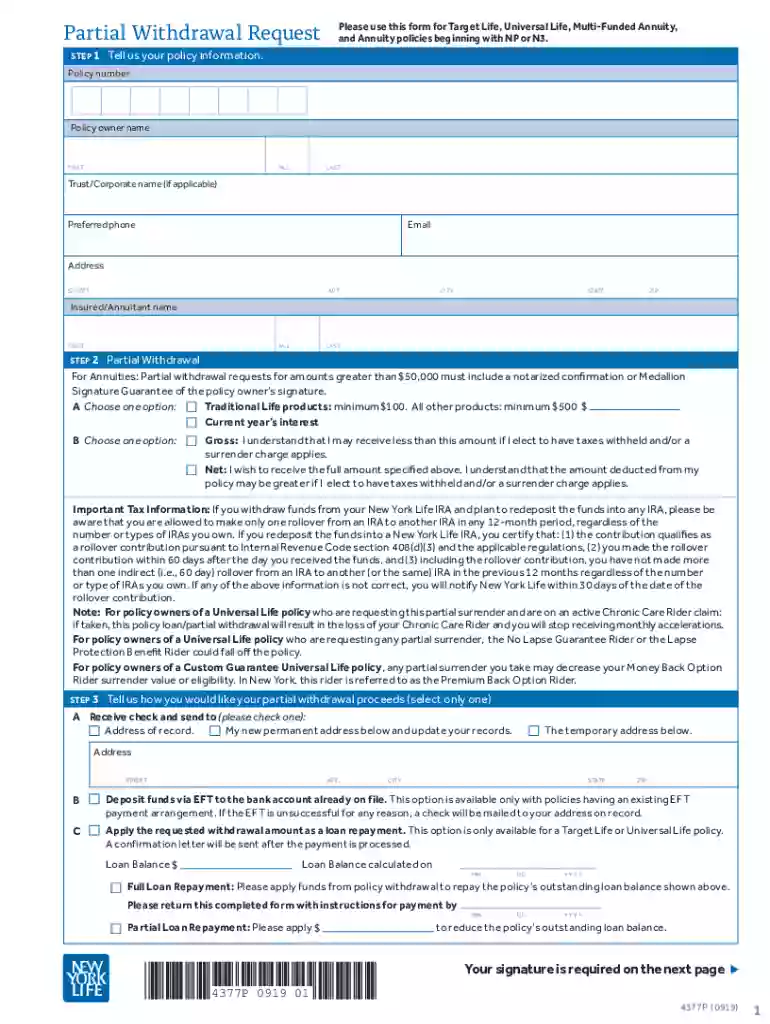
The "Partial Withdrawal Request Please use this form for Target" is a document utilized by policyholders to request a withdrawal of funds from their insurance or annuity policies. This specific form is generally used to access a portion of the accumulated benefits without terminating the policy in its entirety. Its primary purpose is to facilitate partial disbursement while maintaining the policy's active status. This kind of transaction can provide liquidity to policyholders for various financial needs, such as unforeseen expenses or investment opportunities.
Personal Information: Begin by filling in your personal details, including full name, address, and contact information. Ensure accuracy to avoid processing delays.
Policy Details: Enter the relevant policy information, such as the policy number and type. This helps to clearly identify the specific account from which funds will be withdrawn.
Withdrawal Amount: Indicate the exact amount you wish to withdraw. Be mindful to stay within the permissible withdrawal limits outlined by your policy.
Tax Withholding Options: Decide whether federal or state taxes should be withheld from the withdrawal amount. Consult with a tax advisor if you are unsure of the implications.
Signature and Date: Conclude by signing and dating the form. This certifies that the information provided is accurate and complete to the best of your knowledge.
The correct legal use of this form ensures compliance with insurance regulations and contractual obligations. By documenting the transaction, both the policyholder and the insurer maintain a transparent record, aligning with state and federal guidelines. Adherence to legal terms also minimizes potential disputes regarding miscalculated withdrawals or misunderstood benefits. This procedure is vital to safeguard both parties' interests and uphold the integrity of the contract.
Withdrawals from insurance and annuity policies have specific tax implications governed by IRS rules. Generally, partial withdrawals may be treated as taxable income, particularly if the disbursement exceeds the policy's cost basis. In some cases, an early withdrawal penalty is applicable if the policyholder is below a certain age. Consulting the IRS regulations or a tax advisor can aid in managing tax liabilities and avoiding costly penalties.
Insurance companies or financial institutions typically issue this form. It is predominantly used by policyholders seeking to liquidate a portion of their insurance or annuity assets. Common users include individuals navigating life changes such as retirement, unexpected financial needs, or investment adjustments. Businesses might also use it to realign asset management strategies without surrendering entire policy benefits.
The form can generally be submitted through various channels:
Online Portals: Many insurers provide digital submission through their websites, ensuring a quick and efficient process.
Mail: Traditional mailing remains an option, where completed forms are sent to the insurer's specified address.
In-Person: Submissions can be made at designated service centers or agent offices, which can provide additional support in filling the form accurately.
Personal Identification: Ensures the requester is the legitimate policy owner.
Policy Specifications: Details on the policy to tailor the withdrawal process correctly.
Withdrawal Details: Accurate figures and instructions on how to handle the disbursed funds tax-wise.
Authorization: Confirmed by the policyholder’s signature which serves as consent for the transaction.
Each state may impose unique regulations governing partial withdrawals, potentially affecting processing times or tax implications. For example, certain jurisdictions might require additional documentation to comply with local insurance regulations. Understanding these nuances is essential for accurate form completion and avoiding unnecessary obstacles in fund disbursement.
We've got more versions of the Partial Withdrawal Request Please use this form for Target form. Select the right Partial Withdrawal Request Please use this form for Target version from the list and start editing it straight away!
At DocHub, your data security is our priority. We follow HIPAA, SOC2, GDPR, and other standards, so you can work on your documents with confidence.
(a) In general(1) Overview. This section sets forth rules for determining a plans target normal cost and funding target under sections 430(b) and 430(d),
DOH by using a prior approval change request form. The minimum number of pre-treatment radiographic images needed to clearly show all current conditions


