




01. Edit your form online
Type text, add images, blackout confidential details, add comments, highlights and more.

Type text, add images, blackout confidential details, add comments, highlights and more.

Draw your signature, type it, upload its image, or use your mobile device as a signature pad.

Send it via email, link, or fax. You can also download it, export it or print it out.
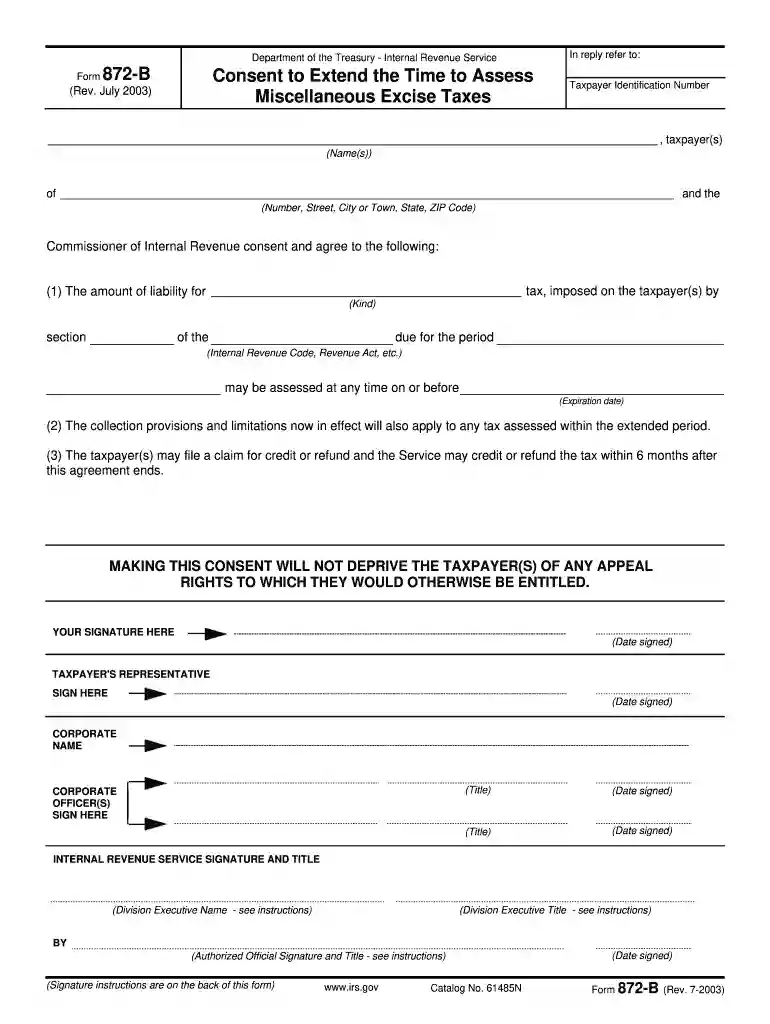
Form 872-B (Rev July 2003), also known as a consent form for extending the time to assess miscellaneous excise taxes, is issued by the Department of the Treasury - Internal Revenue Service (IRS). It serves to provide taxpayers an option to extend the timeframe within which the IRS can evaluate and assess specific excise taxes. This form is particularly crucial in ensuring that both the taxpayer and the IRS have adequate time to review and resolve any outstanding matters related to tax liabilities.
To effectively utilize Form 872-B, it's essential to understand its primary purpose, which revolves around consenting to a specified extension period for tax assessment. Taxpayers need to provide their identifying information accurately and should ensure that all sections, including the tax liability details and expiration date of assessment, are meticulously filled out. This form must be signed by both the taxpayer(s) and an authorized IRS official to be considered valid.
Identification Details: Begin by entering the taxpayer's full name, address, and taxpayer identification number (TIN).
Tax Liability Information: Specify the type of excise taxes applicable and the periods that the extension will cover.
Expiration Date: Clearly state the new expiration date for the assessment period.
Signature Lines: Ensure that the form is signed and dated by the taxpayer(s). An authorized IRS official must also provide a signature to validate the extension.
Review: Double-check all entered data for accuracy and completeness before submission.
Form 872-B is legally binding once signed by the involved parties. By signing, taxpayers extend the statute of limitations on tax assessments, allowing additional time for audits or resolution of discrepancies. This can be advantageous in complex tax situations where more time may facilitate a favorable outcome or prevent hasty assessments.
Typically, Form 872-B is used by taxpayers who are engaged in transactions that require the assessment of miscellaneous excise taxes. This can include businesses or individuals who need more time for audits or are involved in industries subject to specific excise taxes. Professionals managing complex financial scenarios, including tax attorneys and accountants, often rely on this form to negotiate extensions with the IRS.


The IRS provides clear guidelines on the conditions under which Form 872-B can be utilized. It specifies the procedures for filling out the form, acceptable methods of delivery, signing requirements, and the tax types applicable. Taxpayers are encouraged to review these guidelines to ensure compliance and to understand their rights and responsibilities under the extension agreement.
The submission of Form 872-B is contingent on reaching an agreement with the IRS before the original assessment period expires. Both parties must agree on new deadlines, and these should be explicitly documented within the form. Missing these deadlines can nullify the extension, reverting the liability to the original dates.
Failing to comply with the terms set forth in Form 872-B can lead to penalties. If the extension is not honored, or if incorrect information is provided, the IRS retains the authority to proceed with assessments based on original deadlines, which may lead to additional interest or penalties on outstanding tax liabilities.
We've got more versions of the Form 872-B (Rev July 2003), (Fill-In Capable) form. Select the right Form 872-B (Rev July 2003), (Fill-In Capable) version from the list and start editing it straight away!
At DocHub, your data security is our priority. We follow HIPAA, SOC2, GDPR, and other standards, so you can work on your documents with confidence.
Therefore, when filing the new Form 1023, you will not need to submit Form 872-C. A new Schedule E. Organizations Not. Filing Form 1023 Within 27 Months of.
by CD Bell 2013 (1). Form 870 waives your right to litigate in the Tax Court, except in rare situations when later raised issues before the statute of limitations expires


