




01. Edit your form online
Type text, add images, blackout confidential details, add comments, highlights and more.

Type text, add images, blackout confidential details, add comments, highlights and more.

Draw your signature, type it, upload its image, or use your mobile device as a signature pad.

Send it via email, link, or fax. You can also download it, export it or print it out.
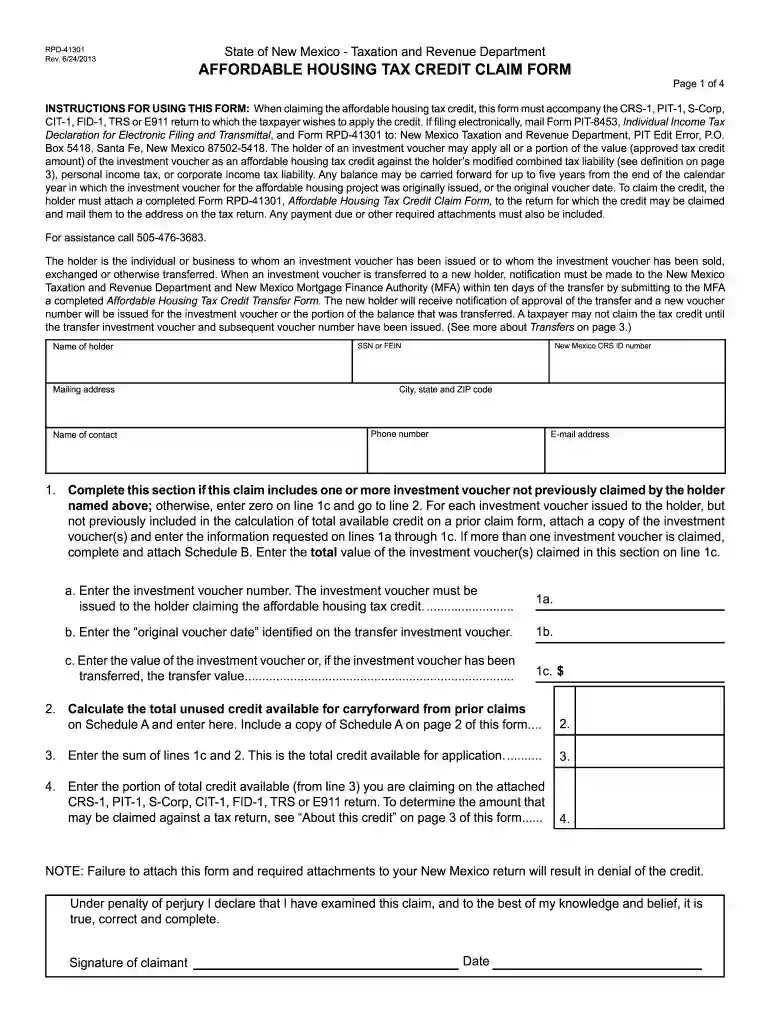
The NM Affordable Housing Credit Claim Form, known officially as RPD-41301, is a document issued by the New Mexico Taxation and Revenue Department. It allows taxpayers to claim the affordable housing tax credit, which incentivizes investment in affordable housing projects. This credit is designed to encourage contributions to eligible housing developments, thus promoting wider access to affordable living options in the state. The form details eligibility criteria, application procedures, and instructions on how to claim the tax credit. Understanding this form is crucial for individuals and organizations looking to benefit from New Mexico's affordable housing initiatives.
Gather Necessary Documents: Collect all required documentation, including investment vouchers and proof of contributions to eligible projects. Schedule A may be needed for unused credits, and Schedule B for multiple investment vouchers.
Fill in Personal and Financial Information: Accurately enter your personal details and financial information. Ensure that you match the information provided with the accompanying documents.
Complete the Credit Calculation: Follow the instructions on the form to calculate your eligible credit. Utilize the available schedules as necessary to account for different scenarios, such as carry-over credits.
Attach Required Schedules: Attach any necessary schedules to support your credit claim, ensuring all information is consistent.
Finalize and Review: Double-check the completed form for accuracy and completeness. Errors or omissions might lead to processing delays or denial of the credit.
Qualified Contributors: The credit is available to individuals or entities that have made qualifying contributions to affordable housing projects approved by the New Mexico Mortgage Finance Authority.
Project Approval: Only projects certified by the New Mexico Mortgage Finance Authority qualify for this credit. It’s important to verify that the housing project you're contributing to meets this requirement.
Contribution Documentation: Contributors must have received one or more investment vouchers issued by the project developers to claim the credit.


Credit Carryover: This refers to the unused portion of the tax credit that can be carried forward to subsequent tax years.
Investment Voucher: A document issued by qualifying projects, which verifies the contributor's investment, essential for claiming the tax credit.
Schedule A and B: These are additional forms that accompany the primary form. Schedule A details unused credits from previous years, while Schedule B covers multiple investment vouchers for the same tax year.
To avoid penalties, ensure the NM Affordable Housing Credit Claim Form is submitted by the annual tax filing deadline designated by the New Mexico Taxation and Revenue Department. It’s advisable to verify the exact date each year, as it can vary. Late submissions can result in the denial of the credit claim or penalties.
Online Submissions: You can submit the form electronically via the New Mexico Taxation and Revenue Department's website, which typically results in faster processing.
Mail-in Option: Paper forms can also be mailed to the department's address. Ensure to account for mailing time to meet the filing deadline.
In-Person: For those who prefer, forms can be submitted in-person at designated tax offices in New Mexico.
It is crucial to adhere to the legal requirements outlined in the form instructions to ensure compliance. Misrepresentation or failure to meet documented requirements may lead to penalties or legal actions. All information provided must be truthful and supported by proper documentation to validate the claim of the tax credit.
Failing to properly complete and submit the form, or attempting to fraudulently claim the tax credit, can lead to significant penalties. These penalties could include denial of the credit, fines, or further audits by the taxation authorities. It’s imperative to comply with all instructions and provide accurate information to avoid such outcomes.
We've got more versions of the nm affordable housing credit claim form help 2013 form. Select the right nm affordable housing credit claim form help 2013 version from the list and start editing it straight away!
At DocHub, your data security is our priority. We follow HIPAA, SOC2, GDPR, and other standards, so you can work on your documents with confidence.
May 23, 2023 Federal housing choice vouchers (formerly known as Section 8) are the primary form of rental assistance in New Mexico and the nation and ideally.
You are required to submit Form PIT-8453 only if you have one or more supporting documents that are not electronically submitted with the return. Individuals
Sep 16, 2013 The final regulations provide guidance on a discount rate-related specified application of the income method and a discount rate-related best


