




01. Edit your form online
Type text, add images, blackout confidential details, add comments, highlights and more.

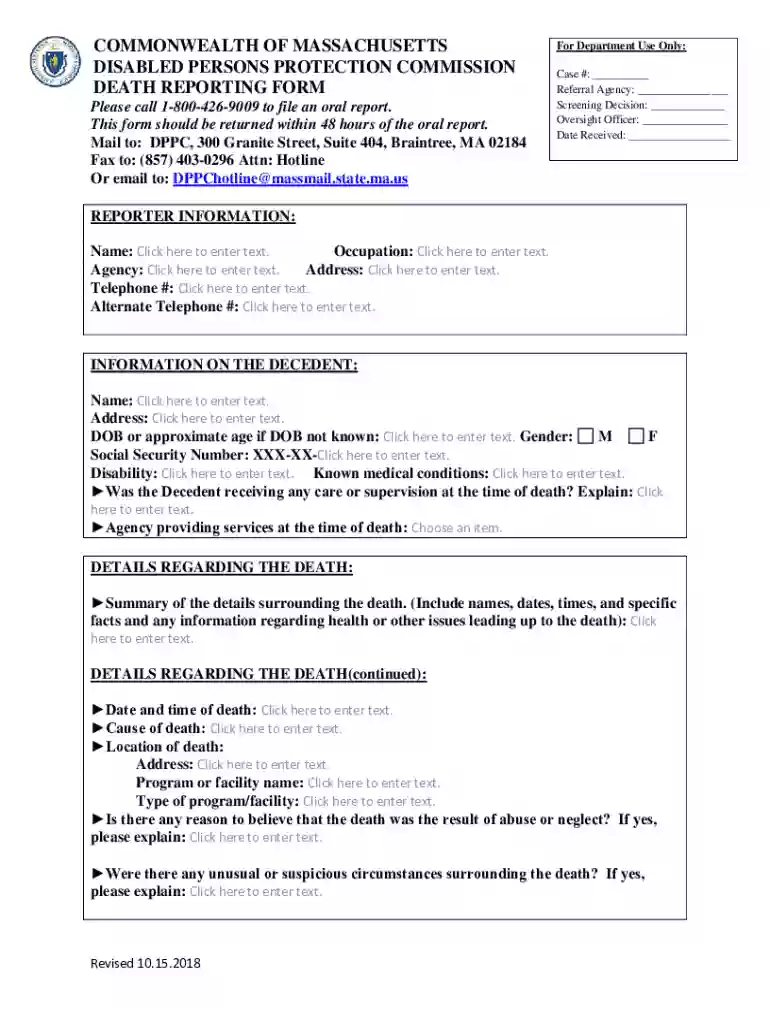
Type text, add images, blackout confidential details, add comments, highlights and more.

Draw your signature, type it, upload its image, or use your mobile device as a signature pad.

Send it via email, link, or fax. You can also download it, export it or print it out.
The DPPC (Disabled Persons Protection Commission) Reporting Form serves as a crucial tool for reporting the deaths of individuals with disabilities within Massachusetts. Required by the Commonwealth of Massachusetts, this form gathers essential information about the circumstances of the death, any indications of abuse or neglect, and pertinent details about the deceased individual. Such data is vital for ensuring appropriate investigations and safeguarding vulnerable individuals who may be at risk.
The form includes sections for the decedent's personal details, the reporter’s information, and any collateral contacts. It is designed to capture comprehensive information needed to assess whether the death requires further investigation, as well as to collect critical evidence for legal and protective measures.
Accessing the Form: Obtain the DPPC Reporting Form online, ensuring you have the fillable version available for ease of completion.
Filling the Form: Use the DocHub platform to fill in the form directly online. Input information such as the decedent’s details, the circumstances of the death, and your contact information as the reporter. The tool’s fillable feature ensures all required fields are completed accurately.
Reviewing: Before submission, review the form for completeness and accuracy. Utilize DocHub’s annotation capabilities to mark areas requiring cross-verification or additional supporting documentation.
Submitting the Form: Utilize the submission options provided by the DPPC, typically online submission through their portal or via email where applicable. Ensure submission within 48 hours if following an oral report, to remain compliant with reporting timelines.
Prepare Information: Gather all necessary information including personal details of the individual who has passed, any observed circumstances surrounding the death, and any known instances of neglect or abuse.
Enter Data: Methodically fill out each section of the form:
Validate Entries: Ensure you have entered all data accurately, cross-checking with supporting documentation when available.
Configure DPPC Submission Tools: If using DocHub, leverage tools like password protection and electronic signature features for secure submission and tracking.
Finalize and Submit: Confirm all mandatory fields are completed and submit the form through the appropriate DPPC channels.
Utilizing the DPPC Reporting Form correctly is essential for legal compliance within Massachusetts. This form serves as an official record for cases involving the death of disabled individuals. By law, it ensures prompt reporting, mandatory for legal and protective proceedings. The form also acts as a documentation tool, safeguarding all involved parties by providing a clear, legally recognized account of the death and any associated factors of neglect or abuse.
Decedent Information: Includes all available personal details of the deceased individual, critical for identifying the individual and understanding the context of their circumstances.
Reporter Section: Essential for establishing the credibility of reported information and providing contact details for follow-up inquiries.
Death Details: Captures specific observations related to the death, notably any signs of abuse or neglect.
Collateral Contacts: Lists other individuals who may have relevant information, contributing to a more comprehensive review and investigation.
Submission Details: Includes sections allowing for verified electronic submission via DocHub with options for secure, password-protected delivery.
In Massachusetts, the DPPC Reporting Form must be submitted within 48 hours of an initial oral report. This stringent guideline is designed to ensure immediate attention to potentially vulnerable situations involving disabled individuals. The state mandates comprehensive reporting to facilitate timely investigations, thereby helping to prevent further instances of neglect and abuse. Compliance with these state-specific rules is non-negotiable, ensuring that the protective mechanisms in place remain effective.
DocHub supports both the digital fillable form and paper versions of the DPPC Reporting Form. The digital version allows for immediate online editing and secure submission, featuring encryption and security best practices. This minimizes risks associated with data handling and ensures efficient processing by the DPPC. Conversely, the paper version might still be used in settings lacking digital access, but it requires manual submission processes, which could result in delays.
Failure to submit the DPPC Reporting Form within prescribed guidelines can result in legal penalties. The Massachusetts DPPC has clear protocols to ensure accountability from organizations and individuals reporting deaths. Delays or incomplete submissions can hinder protective measures and investigations, risking further abuse or neglect. Legal consequences are designed to uphold the integrity of the protective system, emphasizing the significance of timely and accurate reporting.
We've got more versions of the Dppc Reporting Form - Fill Online, Printable, Fillable form. Select the right Dppc Reporting Form - Fill Online, Printable, Fillable version from the list and start editing it straight away!
| Versions | Form popularity | Fillable & printable |
|---|---|---|
| 2018 | 4.8 Satisfied (206 Votes) |
At DocHub, your data security is our priority. We follow HIPAA, SOC2, GDPR, and other standards, so you can work on your documents with confidence.
online first am been would how were me services some d these click its like form events love old john main call hours image department title
Download DPPC reporting forms. Abuse Reporting Form (PDF) | (DOC); Death Reporting Form (PDF)


