




01. Edit your form online
Type text, add images, blackout confidential details, add comments, highlights and more.

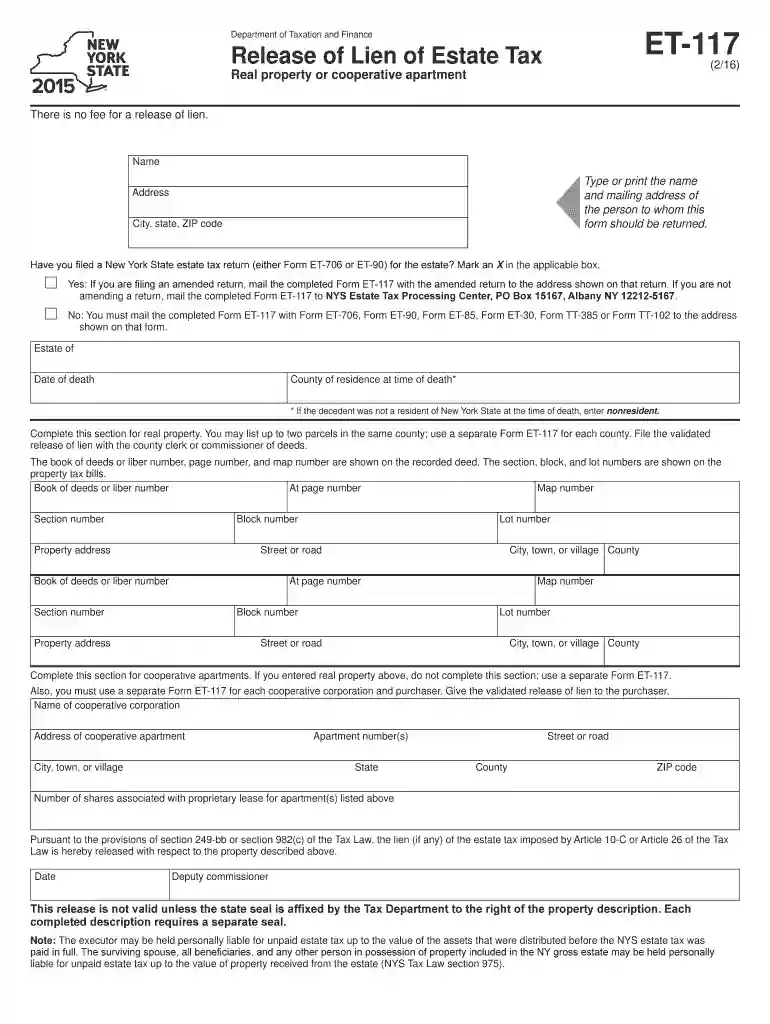
Type text, add images, blackout confidential details, add comments, highlights and more.

Draw your signature, type it, upload its image, or use your mobile device as a signature pad.

Send it via email, link, or fax. You can also download it, export it or print it out.
The ET-117 form, officially known as the "Release of Lien of Estate Tax," is a legal document issued by the New York State Department of Taxation and Finance. It is primarily used to facilitate the release of a lien associated with estate tax on real property or cooperative apartments. This form is crucial for executors, administrators, or beneficiaries involved in settling the estate of a deceased individual, as it confirms that all state estate taxes have been satisfied, allowing the property to be sold or transferred without any encumbrances.
The lien release is integral in the estate settlement process because it ensures that the New York State Department of Taxation and Finance has collected any due taxes on the estate before relinquishing its claim on the property. By doing so, the form protects both the state and the beneficiaries from future disputes over unpaid taxes.
Gather Necessary Information: Before completing the form, collect all relevant details such as the deceased's name, date of death, and estate tax identification number. You will also need information about the property in question, including its legal description and location.
Fill Out the Form Sections: Include all required personal and estate information. Provide accurate and detailed descriptions of the real property or cooperative apartments involved.
Attach Required Documentation: Submit supporting documents such as a certified copy of the death certificate, property deeds, and appraisal reports if applicable. Ensure that all documents are up-to-date and reflect the current value and status of the property.
Submit the Form: The completed form and any attachments can be submitted to the New York State Department of Taxation and Finance via mail. Ensure proper postage and address the package to the correct department to prevent delays.
Await Confirmation: Upon processing, you will receive confirmation of the lien release. Keep this document as proof of the estate's tax compliance, which may be needed for future transactions or legal purposes.
The ET-117 form can be accessed through the official website of the New York State Department of Taxation and Finance. It is available for download in PDF format, allowing for electronic or paper completion. This accessibility ensures that executors of estates or authorized representatives can easily prepare the form without needing to visit an office physically.
Additionally, you can request a physical copy by contacting the department directly. This option is helpful for individuals who might prefer handling paper forms or who lack reliable internet access for downloading.
These elements ensure that all parties have the necessary information to process and approve the release of the tax lien efficiently.
This form is specifically for use by executors, administrators, or legal representatives of an estate in New York State. Eligibility requires that the estate is subject to New York estate tax and involves real property or cooperative apartments needing lien release. Executors must prove their legal authority to act for the estate, often by providing court-issued letters testamentary or of administration.


Complying with legal requirements is essential when using the ET-117 form. It is legally binding and ensures that the decedent's estate has met its tax obligations. Incorrect or fraudulent use of this document can result in penalties or delays in the estate settlement process. The form acts as official documentation that must be maintained in estate records for future reference or potential audits.
New York State has specific guidelines for estate taxes that differ from federal regulations. For instance, estates with values below the state's taxable threshold may not require lien releases. Understanding these differences is crucial for complying with state-specific tax obligations and streamlining the estate settlement process.
Understanding these terms helps ensure accurate completion and submission of the ET-117 form, leading to a smoother estate settlement experience.
A typical scenario involves an executor managing an estate that includes a family home and a cooperative apartment in New York City. By using the ET-117 form, the executor files a lien release for both properties, ensuring they can be sold without tax-related encumbrances. This process exemplifies the form's role in facilitating the transfer of assets and highlights the importance of its proper use in estate management.
We've got more versions of the et 117 2015 form form. Select the right et 117 2015 form version from the list and start editing it straight away!
At DocHub, your data security is our priority. We follow HIPAA, SOC2, GDPR, and other standards, so you can work on your documents with confidence.
Apr 4, 2006 EDB can be degraded through three potential pathways: through hydrolytic debromination to form 2-bromoethanol; through hydrogenolysis (
Oct 24, 2025 ET-117 Instructions on form Release of Lien of Estate Tax - Real property or cooperative apartment
by J Farley 2015 Cited by 86 Ecological Economics 117 (2015) unavoidably alters ecosystem structure and emits waste, thus degrading ecosystem services, Ecosystem services and dis-services


