
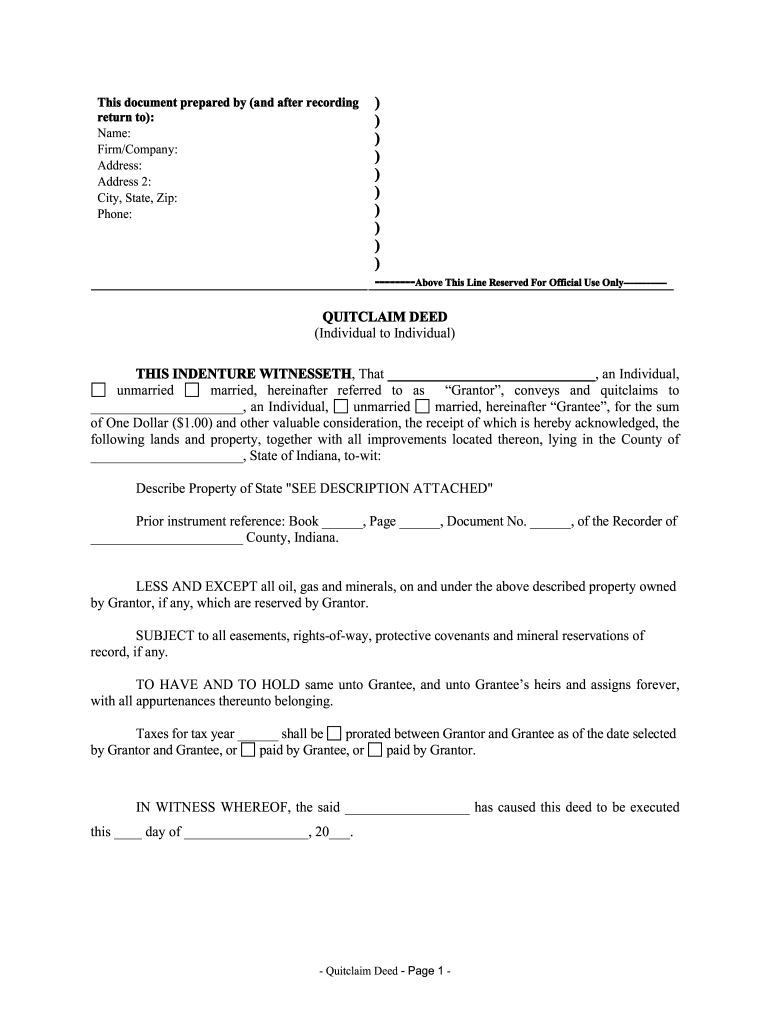







Definition and Meaning of Quitclaim Deed in Real Estate
A quitclaim deed is a legal document used in real estate to transfer a property owner's interest to another party, without guaranteeing the property's title. Unlike warranty deeds, quitclaim deeds do not offer any warranties or assurances about the property's title being free of liens or other encumbrances. This form of deed is typically used in situations involving family members or trusted parties where detailed title assurances are unnecessary. For instance, a quitclaim deed would be suitable for transferring property interest between spouses after marriage or divorce.
How to Use the Quitclaim Deed in Real Estate
To effectively use a quitclaim deed in real estate transactions, one must understand its limitations and scope. This deed is primarily employed when the transfer does not require warranty protection. Examples include:
- Family Transfers: Transferring property between relatives, such as parent to child or between siblings.
- Trust Estate Planning: Adding property into a trust as part of estate planning without needing title insurance.
- Correcting Title Issues: Resolving clerical errors in the public record by updating names or removing deceased owners' interests.
In each scenario, the parties involved should clearly understand the relinquishment of claims conveyed through this deed type.
Steps to Complete a Quitclaim Deed
Completing a quitclaim deed involves several critical steps to ensure legality and accuracy:
- Identify Parties: Clearly designate the grantor (property giver) and grantee (property receiver). Full legal names are essential to avoid discrepancies.
- Describe Property: Include a precise legal description of the property, often found on the original deed or mortgage documents. This could involve the lot number, block, and subdivision name.
- Draft the Deed: Use a template or draft the document with the necessary details. Ensure legal compliance with state-specific requirements.
- Execution: The grantor must sign the deed in the presence of a notary public to validate the transaction.
- Record the Deed: Submit the completed and notarized deed to the county recorder's office in the property's jurisdiction. This step is crucial for public record and legal recognition.
Why You Might Use a Quitclaim Deed
The use of a quitclaim deed can be advantageous in several situations due to its simplicity and efficiency:
- Cost-Effective Transfer: It's generally cheaper to use than a warranty deed because of the absence of title insurance or covenant guarantees.
- Swift Transactions: Useful in situations requiring quick property transfer without exhaustive title checks, making them ideal in emergencies or tight family agreements.
- Specific Scenarios: Handy for transferring joint ownership, removing an ex-spouse from property titles post-divorce, or adding a partner's name.
Important Terms Related to Quitclaim Deed
When dealing with quitclaim deeds, certain terminologies are crucial for clarity:
- Grantor: The property owner who is transferring their interest.
- Grantee: The individual or entity receiving the property interest.
- Legal Description: The property’s detailed location and boundaries as defined in legal documents.
- Consideration: The payment or compensation exchanged for the property transfer—often nominal in quitclaim deeds.
Understanding these terms ensures that both parties are aware of their roles and the nature of the transaction.
Legal Use of a Quitclaim Deed
The legality of using a quitclaim deed hinges on adherence to state laws, proper execution, and recording. It is vital to note:
- Transfer Limitations: Quitclaim deeds don't assure the grantee about existing liens or claims. Therefore, legal counsel may be advisable when concerns exist over title issues.
- Notarization Requirement: Most states require deeds to be notarized to be legally enforceable.
- State-Specific Laws: Variances exist in how states manage and recognize these deeds, impacting the need for additional documentation or disclosures.
State-Specific Rules for Quitclaim Deeds
Each U.S. state has unique statutes governing quitclaim deed usage, affecting legal requirements and processes:
- Illinois: Requires a specific language format for the deed and allows for shared ownership among grantees.
- California: Recognizes quitclaim deeds within community property transactions, often used in estate planning.
- Florida: Mandates precise legal descriptions and recording within sixty days to ensure validity.
Verifying each state’s regulations can prevent legal and procedural complications post-transaction.
Examples of Using a Quitclaim Deed
Real-world scenarios demonstrate the practical application of quitclaim deeds:
- Property Settlement in Divorce: Simplifies transferring property solely to one spouse post-divorce.
- Estate Planning: Parent transfers estate intent into a trust using a quitclaim to avoid probate.
- Addressing Title Defects: amicably resolves complex title situations involving multiple co-owners by transferring claims among them.
Considering specific circumstances helps ensure informed decision-making, reducing potential disputes.




