
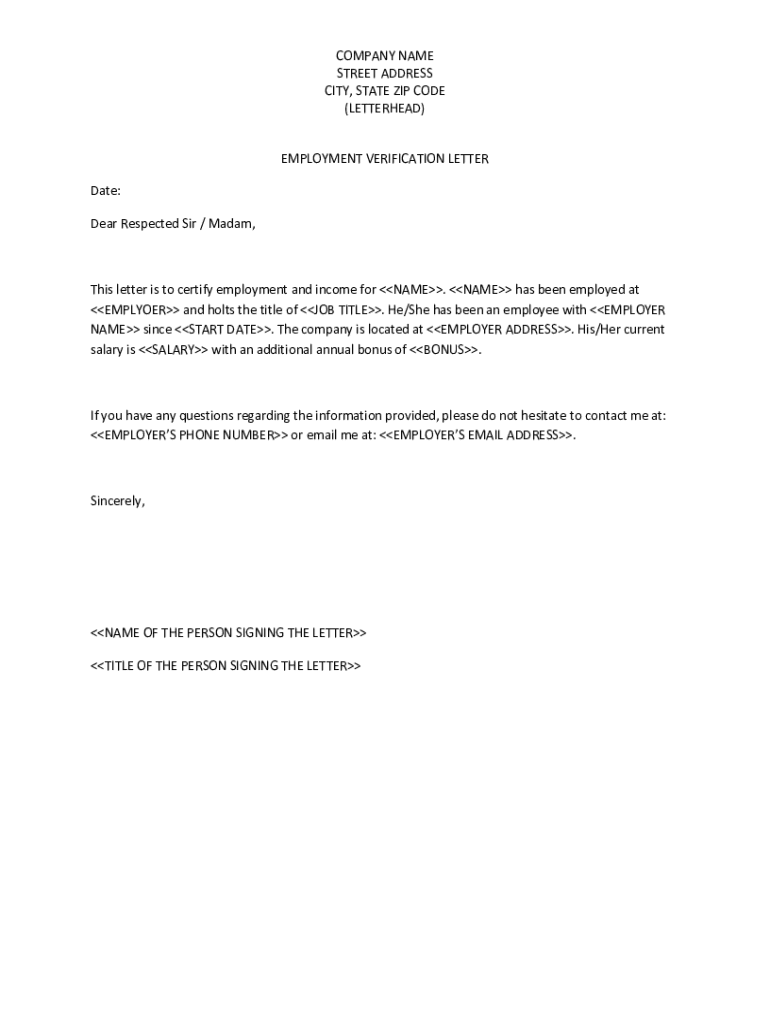







Definition and Meaning
A Letter of Employment (Sample) is a formal document that verifies an individual's employment status and details. It typically includes key information such as the employee’s position, start date, salary, and other relevant employment conditions. This letter serves multiple purposes, often required for financial verifications, renting property, or confirming employment for other official matters.
Elements commonly found in a Letter of Employment include:
- Employee Information: Full name, job title, and department.
- Employment Details: Start date, current status (full-time or part-time), and salary details.
- Employer Information: Company name, address, and contact information.
- Verification Statement: A clear declaration confirming employment and financial details.
The letter is issued on company letterhead to authenticate its legitimacy, often requiring an authorized signature from HR or a company executive.
Key Elements of the Letter of Employment (Sample)
A comprehensive Letter of Employment should include specific elements to fulfill its intended purpose effectively. Understanding these elements ensures that the letter serves as a reliable source of employment verification.
- Company Details: The letter must be on official company letterhead, displaying the organization's name, address, and official logo.
- Employee Details: Include the employee's full name, current address, job title, and department.
- Employment Confirmation: A statement verifying the employee's current employment status, job role, and essential employment terms.
- Financial Overview: Outline salary details, bonuses, and any additional compensation that the employee receives.
- Contact Information: Provide a contact point such as an HR representative or a direct supervisor for further inquiries.
- Authorized Signature: Signed by an official authority within the company, such as a Human Resources manager or company executive.
These components are crucial to ensuring the letter meets the expectations of banks, landlords, or any other entities requiring employment verification.
How to Use the Letter of Employment (Sample)
A Letter of Employment can be used in various situations where employment verification is required, such as applying for loans, renting property, or visa applications. Proper usage of this document can significantly ease these processes.
- Loan Applications: Financial institutions often request this letter to verify income and employment stability.
- Rental Agreements: Landlords use it to confirm a tenant’s ability to pay rent based on their employment status.
- Visa Processing: It can be a requirement for visa submissions to demonstrate employment ties to your home country.
- Professional Licensing: The letter might be necessary for professional certifications or licenses, confirming practical experience or roles.
Ensure the letter is recent, typically not older than a month, to ensure it provides an up-to-date verification of employment status.
Steps to Complete the Letter of Employment (Sample)
Completing a Letter of Employment requires attention to detail to ensure accuracy and completeness. Here are the steps to follow:
- Use Company Letterhead: Begin with the company's official letterhead for authenticity.
- Verify Employee Details: Include correct and updated information such as the employee's full name, position, and department.
- Include Employment Terms: Clearly state the employee’s start date, current status (full-time/part-time), and any relevant job details.
- Outline Salary Information: Provide a breakdown of the employee's salary structure, including base salary and bonuses if applicable.
- Contact for Verification: Offer details on how the verifier can contact the company or the person issuing the letter for follow-up.
- Obtain Authorized Signature: Ensure the letter is signed by someone with the authority to confirm employment, such as HR personnel.
Each step ensures the document serves its purpose effectively while maintaining credibility.
Legal Use of the Letter of Employment (Sample)
Legal compliance in crafting a Letter of Employment protects both the employer and employee. It serves as a formal acknowledgment of terms and conditions, ensuring clarity for both parties.
- Employment Verification: Provides legal documentation to verify employment for external parties.
- Income Confirmation: Legally outlines an employee's income for financial obligations.
- Contractual Obligations: Acts as a supportive document in employment-related contractual agreements.
- Data Privacy: Must comply with data protection laws, including confidentiality of employee personal information.
Ensure the letter is free of any discrepancies, which could undermine its integrity and potentially result in legal disputes.
Who Typically Uses the Letter of Employment (Sample)
Various parties require a Letter of Employment for different objectives, underscoring its multifaceted utility.
- Financial Institutions: Banks and lenders need it for loan processing as it confirms an applicant's financial status.
- Landlords and Property Managers: Uses it for tenant verification during rental applications.
- Immigration Officials: Required as a part of visa applications to confirm the applicant’s employment tie to their home country.
- Professional Bodies: May request it for verifying job credentials and work experience for professional registrations.
Anyone requiring employment verification to meet financial, legal, or professional requirements may need this document.


State-Specific Rules for the Letter of Employment (Sample)
While there are standard elements to include, certain states may have additional requirements or restrictions regarding the content or use of employment letters.
- California: Requires acknowledgment of employee consent for sharing certain employment details.
- New York: Advises that salary should only be disclosed with explicit employee permission.
- Texas: No specific format requirements, but details must be truthful and supportable.
Companies should consult with legal advisors to tailor the letter in compliance with state regulations to avoid potential legal issues.
Examples of Using the Letter of Employment (Sample)
Practical applications of the Letter of Employment vary based on customized requirements.
- Loan Approval: A bank requests this documentation as part of the applicant’s creditworthiness evaluation.
- Rental Application: A prospective tenant uses it to prove stable income to a landlord.
- Visa Filing: An employee on an international assignment submits the letter as part of their visa documentation.
- Employment Verification Calls: Businesses might use it to respond to employment verification requests while maintaining documentation compliance.
Each use scenario highlights the letter's role in supporting formal procedures in various contexts, emphasizing its value as an employment verification tool.




