
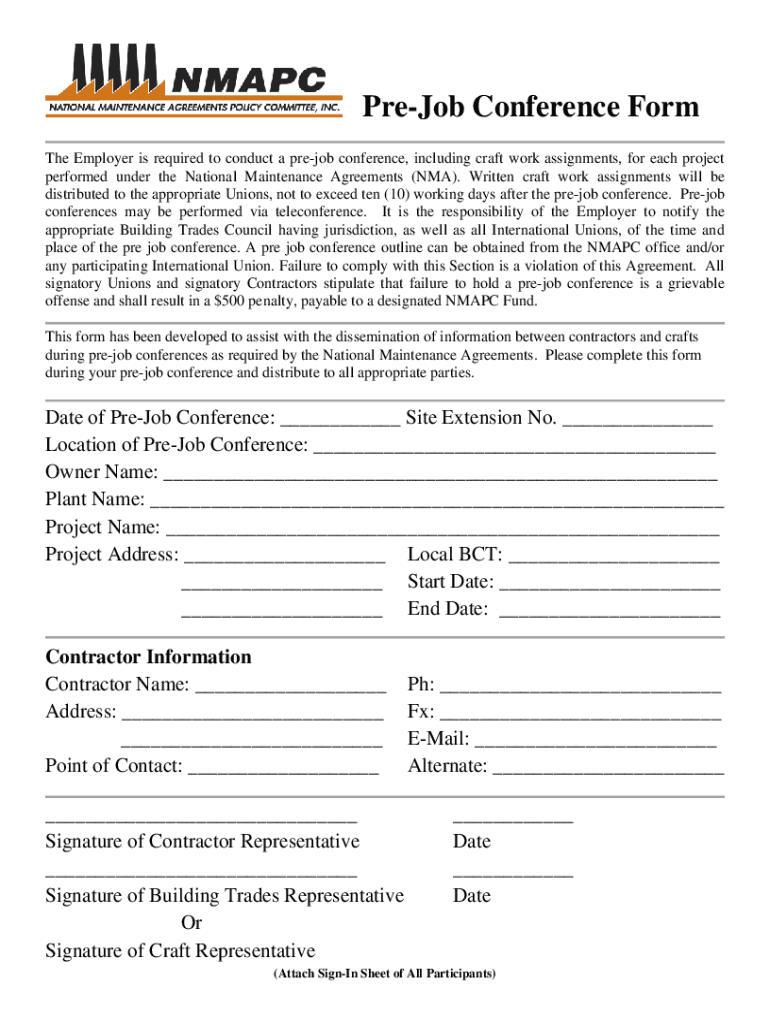







Definition and Meaning
The National Maintenance Agreement (NMA) serves as a critical contractual structure within the construction industry, notably for the maintenance sector. Originating from the National Maintenance Agreements Policy Committee, Inc. (NMAPC), this agreement aims to standardize labor relations and maintenance protocols across industries. It facilitates smooth collaboration between employers and unions, establishing clear guidelines on issues such as wages, safety regulations, and grievance procedures. By fostering uniformity, the NMA ensures that maintenance work under its scope maintains quality, safety, and productivity standards.
How to Use the National Maintenance Agreement
Organizations can utilize the National Maintenance Agreement to streamline labor negotiations and project management. Typically, companies engaged in maintenance projects in industrial sectors subscribe to the NMA to gain access to its resources and regulatory framework. By adhering to the NMA, companies can ensure compliance with agreed standards, reducing conflicts and enhancing project outcomes. Through this agreement, companies gain a roadmap for addressing labor disputes, safety concerns, and productivity goals, thereby fostering harmonious working relationships with union representatives.
Key Elements of the National Maintenance Agreement
The NMA encompasses several pivotal components that guide its application. These include recognition of unions, employer compliance responsibilities, pre-job conference requirements, and scope of work. Recognition of unions ensures that only qualified labor provides services, while employer compliance details the obligations companies must meet. Pre-job conferences allow stakeholders to align on project expectations, and the scope of work outlines specific duties covered under the agreement. By understanding these elements, parties can ensure adherence to the agreement's principles and facilitate successful project execution.
Steps to Complete the National Maintenance Agreement
Completing the National Maintenance Agreement requires careful attention to detail and communication. The primary steps involve:
- Reviewing the Agreement: Understanding the scope, terms, and obligations.
- Engaging with Stakeholders: Involving union representatives, management, and legal counsel for comprehensive insight.
- Drafting Specific Terms: Customizing sections like scope of work and project timelines to align with business needs.
- Conducting Pre-Job Conferences: Ensuring all parties are aligned on expectations and responsibilities.
- Finalizing and Signing: Agreeing on terms and acquiring signatures from authorized personnel.
Each step ensures that the agreement reflects the project needs while maintaining compliance with NMAPC standards.
Legal Use of the National Maintenance Agreement
The NMA is a legal contract emphasizing labor relations and project management within the construction and maintenance sectors. Its legal standing requires compliance with labor laws, safety regulations, and contractual obligations outlined in the agreement. By engaging with the NMA, companies and unions can avoid legal pitfalls associated with non-compliance, such as labor disputes or regulatory infractions. Legal counsel can be engaged to ensure that the application of the NMA meets both organizational needs and statutory regulations, thus protecting stakeholder interests.
Who Typically Uses the National Maintenance Agreement
The NMA is predominantly used by industrial companies involved in maintenance work that requires skilled labor. Entities such as contractors, facility management companies, and construction firms leverage this agreement to manage their workforce effectively. Unions also play a significant role as parties to the NMA, ensuring that their members' rights and obligations are upheld. This agreement becomes particularly useful for businesses that regularly engage in large-scale maintenance projects, requiring detailed planning and execution in collaboration with multiple stakeholders.


Important Terms Related to the National Maintenance Agreement
Several terms are central to understanding and applying the National Maintenance Agreement:
- Grievance Procedures: Methods for addressing disputes between workers and employers.
- Employer Compliance: Obligations for maintaining standards specified in the agreement.
- Scope of Work: Definition of tasks and responsibilities under the agreement's purview.
- Safety Regulations: Standards ensuring a safe working environment for all involved.
- Administrative Procedures: Guidelines for the organizational implementation of the agreement.
Familiarity with these terms aids all parties in navigating the agreement both effectively and efficiently.
State-Specific Rules for the National Maintenance Agreement
While the National Maintenance Agreement provides a comprehensive framework, specific state regulations may influence its application. Labor laws can vary by state, impacting elements like wage scales, safety requirements, and union interactions. Organizations must review state-specific regulations to ensure compliance with local laws while adhering to the NMA's standards. Engaging with legal advisors who understand both federal and state labor legislation can provide essential insights for appropriately applying the agreement in diverse geographical contexts.
Examples of Using the National Maintenance Agreement
Examples abound in industries utilizing the NMA for maintenance work. For instance, in a manufacturing plant, the agreement could dictate the terms for routine equipment maintenance carried out by union workers. In energy plants, it might encompass procedures for regular pipeline checks, ensuring safety and efficiency. Each application of the NMA allows businesses to engage qualified labor, maintain compliance with industry standards, and facilitate smooth operations without labor disputes, which contributes to project success and organizational growth.




