






Definition and Meaning
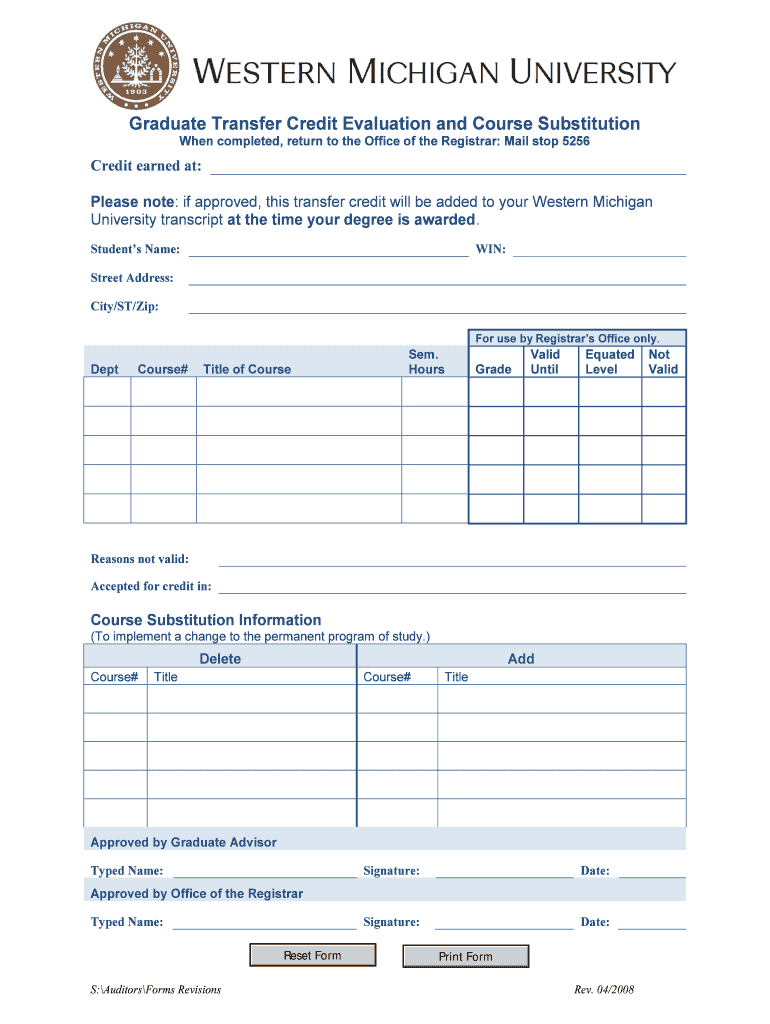
The "Graduate Transfer Credit Evaluation and Course Substitution" form is designed to assess and approve the transferability of graduate-level academic credits from other institutions or programs. This document plays a crucial role in determining whether previously completed coursework can be counted towards a student's current degree program requirements. By allowing course substitution, students can potentially fulfill specific curriculum requirements with equivalent courses taken elsewhere, thus avoiding redundancy and streamlining their academic journey. The process typically involves a detailed review by academic advisors and the registrar's office to ensure academic integrity and compliance with institutional standards.
How to Use the Graduate Transfer Credit Evaluation and Course Substitution
Using this form effectively involves a series of steps that students must follow to ensure a successful evaluation. First, students should carefully complete the form by entering their personal and contact details, along with the details of the courses they wish to transfer. It is essential to provide thorough and accurate course descriptions, including syllabi if available, to facilitate the evaluation process. After filling out the form, students must submit it to their graduate advisor, who will review the submission for initial approval.
How to Obtain the Graduate Transfer Credit Evaluation and Course Substitution
Students can obtain the "Graduate Transfer Credit Evaluation and Course Substitution" form through several methods:
-
University’s Office of the Registrar: The form is often available directly from the registrar’s office either in digital format on the institution’s website or as a physical document.
-
Graduate Advisor: Academic advisors may also provide students with this form during discussions about degree planning and transfer options.
-
Online Portal: Many institutions offer the form through their online student portal, where students can download and print it at their convenience.
Steps to Complete the Graduate Transfer Credit Evaluation and Course Substitution
Completing the form accurately is crucial for a smooth evaluation process:
-
Gather Necessary Information: Collect details about the courses you intend to transfer, including course numbers, titles, and the institution where the courses were completed.
-
Fill Out Personal Information: Enter your name, student ID, and contact information.
-
Provide Course Information: Detail each course you wish to transfer, including a description and justification for how it aligns with your current program requirements.
-
Submit Supporting Documents: Attach syllabi, transcripts, and any available course descriptions to substantiate your request.
-
Advisory Review: Submit the form to your graduate advisor for review and preliminary approval.
-
Registrar Review: Upon advisory approval, forward the form to the registrar’s office for final evaluation and processing.
Why Should You Use the Graduate Transfer Credit Evaluation and Course Substitution
Utilizing this form can significantly benefit students by reducing the time and cost required to complete a degree. It allows for recognition of prior academic efforts, potentially easing the course load and enabling students to focus on new learning opportunities relevant to their career goals. Additionally, successful course substitutions can help students maintain a steady progression towards graduation.
Important Terms Related to Graduate Transfer Credit Evaluation and Course Substitution
Understanding the terminology used in this context can help students navigate the process more effectively:
- Transfer Credits: Credits earned from a different institution that may be applicable towards a current degree program.
- Course Substitution: The process of using a transfer course to fulfill a specific requirement in a student's current program.
- Academic Advisor: A faculty member who provides guidance on course selections, degree requirements, and academic goals.
- Registrar's Office: The administrative body responsible for maintaining student records and course approvals.
Key Elements of the Graduate Transfer Credit Evaluation and Course Substitution
Several critical components make up this form, each essential to ensuring an accurate and fair assessment:
-
Student Information: Detailed personal and academic information about the student requesting the evaluation.
-
Course Details: Comprehensive information about the courses proposed for transfer, including credits, content, and outcomes.
-
Approval Signatures: Signatures from both the graduate advisor and the registrar, validating the evaluation and acceptance of transfer credits.
Examples of Using the Graduate Transfer Credit Evaluation and Course Substitution
Consider a graduate student who previously attended another university and completed courses equivalent to core requirements in their current program. By using the form, they provide detailed course descriptions and transcripts, allowing their current institution to assess equivalence and grant transfer credits, thereby reducing their current course load and accelerating their path to graduation.
Required Documents
To ensure a comprehensive and fair evaluation, students must provide specific documents along with the form:
- Official Transcripts: Demonstrate completion of the courses intended for transfer.
- Course Syllabi: Required for detailed insight into course content and outcomes.
- Supporting Letters or Documents: Additional endorsements from previous instructors or academic advisors that substantiate the relevance of the course content.