




01. Edit your form online
Type text, add images, blackout confidential details, add comments, highlights and more.

Type text, add images, blackout confidential details, add comments, highlights and more.

Draw your signature, type it, upload its image, or use your mobile device as a signature pad.

Send it via email, link, or fax. You can also download it, export it or print it out.
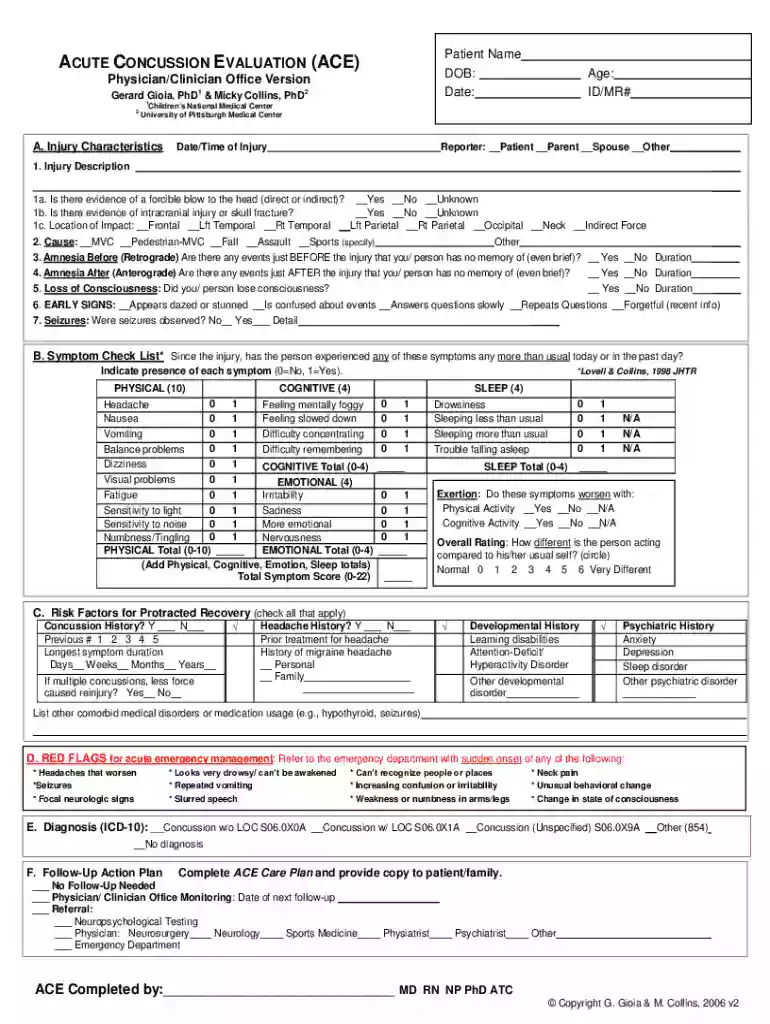
The Acute Concussion Evaluation (ACE) form, developed by the Centers for Disease Control and Prevention (CDC), serves as a comprehensive tool to assess individuals who have experienced a potential concussion. The form is deployed primarily in emergency departments to systematically capture detailed information about the injury, symptoms, and patient history to guide diagnosis and treatment strategies. By using ACE, healthcare providers can ensure a more structured assessment of concussion symptoms, helping to determine the severity and appropriate intervention measures.
Gather Patient Details: Begin with the demographic information, ensuring the patient's name, date of birth, and other personal details are accurately recorded.
Document Injury Characteristics: Record the specifics of the incident, including the date, time, and nature of the injury. Describe how the injury occurred and identify any immediate signs or symptoms observed at the scene.
Conduct Symptom Assessment: Use the form's checklist to evaluate symptoms across four domains: physical (e.g., headache, dizziness), cognitive (e.g., confusion, slowed thinking), emotional (e.g., irritability, sadness), and sleep-related issues (e.g., insomnia, fatigue).
Review Concussion History: Capture details of any prior concussions or related injuries the patient may have experienced. This historical perspective helps in understanding the potential cumulative effects of multiple concussions.
Assign Diagnosis Codes: The form allows for the documentation of specific diagnosis codes that correspond with the patient's condition. Choosing the right codes is essential for tracking the patient's diagnosis and treatment trail.
Develop a Follow-up Action Plan: Based on the evaluation, outline a management plan which may include specialist referrals, prescribed rest, and gradual return-to-activity guidelines.
Symptom Checklist: A detailed inventory of symptoms categorized into physical, cognitive, emotional, and sleep domains. This checklist provides a structured format for documenting each symptom's presence and severity.
Concussion History: A section dedicated to recording past concussion incidents, which is crucial for understanding the risk of prolonged recovery or potential brain injury.
Diagnosis and Follow-up: Practical guidance for subsequent medical evaluations and interventions, integrating diagnosis codes and action steps for continued care and monitoring.
The ACE form is primarily used by healthcare professionals in emergency departments, sports medicine practitioners, and clinicians specializing in neurology or rehabilitation. It can also be utilized by trainers and medical professionals in schools or sports teams, where concussion risks are prevalent, to ensure immediate and proper assessment and subsequent action.


Consider a high school football player who sustains a head injury during a game. Using the ACE form, the athletic trainer or on-site medical staff would systematically document the injury details, record the player's symptoms, and consult previous concussion history. This methodical approach aids in determining whether the player requires urgent medical attention or can be closely monitored and gradually return to play under medical guidance.
The ACE form aids compliance with legal mandates regarding the management of concussions, particularly in educational and athletic settings. Following a concussion policy that includes the use of standardized evaluation tools like the ACE is critical in legal situations where mismanagement of head injuries could result in liability.
While the ACE form provides a standardized approach, some states might have unique mandates about concussion protocols in schools and sports. States like California and Texas have specific laws requiring educational institutions to have concussion management policies in place, which often include the systematic use of evaluation forms like the ACE.
Healthcare providers may choose between digital and paper versions of the ACE form based on their infrastructure. Digital forms facilitate easier data storage, sharing, and retrieval, while paper versions can be particularly useful in settings without reliable digital access, ensuring all environments have access to critical evaluation tools.
Incorporating a detailed approach through these sections allows practitioners to fully leverage the ACE form, ensuring they are equipped to handle concussions effectively and align with established medical and legal frameworks in the U.S.
We've got more versions of the ACUTE CONCUSSION EVALUATION ACE ACE-ED Completed by - cdc form. Select the right ACUTE CONCUSSION EVALUATION ACE ACE-ED Completed by - cdc version from the list and start editing it straight away!
| Versions | Form popularity | Fillable & printable |
|---|---|---|
| 2006 | 4.6 Satisfied (49 Votes) |
At DocHub, your data security is our priority. We follow HIPAA, SOC2, GDPR, and other standards, so you can work on your documents with confidence.
Serial evaluation of the concussion is critical as symptoms may resolve, worsen, or ebb and flow depending upon many factors
CDC HEADS UP is the go-to resource for concussion prevention and education. Resources for Medical Professionals.Read more


