






Definition & Meaning
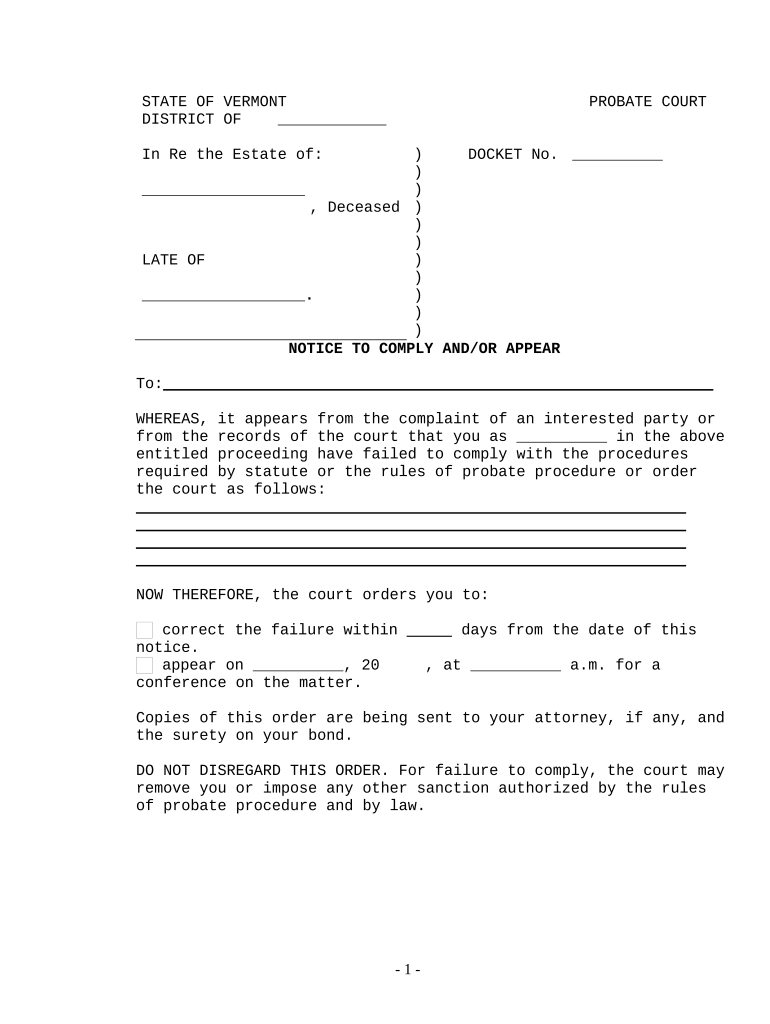
The "Notice to Comply and or Appear - Vermont" is a legal document utilized by the Probate Court of Vermont. It serves as a formal notification to an individual involved in estate proceedings, indicating non-compliance with court orders or statutory procedures. The document requires the recipient to either rectify the compliance failure within a specified timeframe or appear at a scheduled conference. The notice underscores the critical importance of adherence to legal mandates and warns of potential sanctions for non-compliance.
Purpose and Use
The primary purpose of the Notice to Comply and or Appear is to ensure that individuals involved in estate proceedings address any lapses in adherence to legal requirements set forth by the court. It acts as a reminder and a directive to take corrective actions, thereby maintaining the integrity of legal processes. This notice plays a pivotal role in facilitating efficient and orderly estate management, preventing unnecessary delays, and safeguarding the interests of parties involved.
How to Use the Notice to Comply and or Appear - Vermont
Steps to Follow
-
Review the Document: Carefully read the notice to understand the specific compliance failures highlighted by the court. Pay attention to the sections detailing the actions required to rectify these issues.
-
Identify Deadlines: Take note of the deadlines specified in the notice for compliance or appearance. Timeliness is crucial to avoid potential sanctions or negative outcomes.
-
Consult Legal Counsel: Engage with a legal advisor to interpret the notice content comprehensively and obtain guidance on appropriate measures to ensure compliance.
-
Prepare Required Documentation: Gather and organize any documents or evidence needed to address the compliance issues or prepare for the court appearance as detailed in the notice.
-
Execute Compliance Actions: Undertake the necessary steps to correct the compliance failures, such as filing overdue documents or making required submissions to the court.
-
Attend Scheduled Hearings or Meetings: If the notice mandates an appearance, ensure attendance at the designated time and location, prepared to present any required documentation or arguments.
Examples
- If the notice indicates failure to submit a required inventory of estate assets, promptly collect the necessary asset details and submit them to the court.
- For missed deadlines involving tax filings related to the estate, consult with an accountant or tax advisor to prepare outstanding submissions swiftly.
Key Elements of the Notice to Comply and or Appear - Vermont
Core Components
- Date and Reference Number: Confirm the date on the notice and any reference numbers for tracking and communication purposes.
- Recipient Details: Ensure accuracy of the recipient's name and contact information; discrepancies should be rectified immediately.
- Compliance Issues: The section outlining specific compliance failures is crucial; it details what actions are required from the recipient.
- Remedial Actions: Instructions on required steps to address non-compliance, including document submissions, attendances, or corrections.
- Deadlines and Timetables: Clearly established deadlines for compliance or appearances to maintain court schedules and obligations.
- Legal Consequences: Warnings or notes on potential legal sanctions or penalties for continued non-compliance.
Illustration
Consider a scenario where the notice cites a failure to submit a final accounting of an estate within the imposed deadline. The core components would then highlight this issue, outline the necessary documentation required, and provide a clear deadline for its resolution.
State-Specific Rules for the Notice to Comply and or Appear - Vermont
Vermont Probate Law
Vermont's probate law governs the procedures and requirements for notices to comply or appear in the state's legal system. It includes specific statutes that outline the responsibilities and duties of individuals involved in estate proceedings. Compliance with these rules ensures that estates are settled in accordance with Vermont's legal standards, promoting fairness and legal integrity.
Unique Considerations
- Local Court Procedures: Familiarize yourself with the Vermont probate court's procedural rules, as they may influence the notice's requirements.
- Jurisdictional Variations: Be aware that practices and expectations can vary slightly across different court precincts within Vermont, necessitating local legal consultation.
Legal Use of the Notice to Comply and or Appear - Vermont
Court Authority
The notice exemplifies the authority of the probate court to enforce compliance with legal and procedural requirements. It serves as a legal mechanism for ensuring that all parties involved in estate proceedings adhere to their obligations. Non-adherence could lead to court-imposed sanctions, including fines, contempt of court orders, or other legal remedies.
Enforcement Actions
When recipients fail to comply, the court may enforce the notice through several actions, such as:
- Issuing contempt orders to prompt compliance.
- Imposing fines or other financial penalties to emphasize the seriousness of compliance failures.
- Ordering additional hearings to resolve non-compliance issues, potentially delaying estate settlement.
Penalties for Non-Compliance
Possible Sanctions
Failure to comply with the notice can result in significant legal repercussions, including but not limited to:
- Monetary fines that accrue daily until compliance is achieved.
- Attachment of property or assets as collateral for unresolved obligations.
- In extreme cases, imprisonment for contempt of court, highlighting the severity of non-compliance.
Avoidance Strategies
Recipients should prioritize compliance by:
- Maintaining clear lines of communication with legal counsel.
- Promptly responding to court notices with organized, accurate documentation.
- Seeking extensions or clarifications from the court if compliance within the set timeframe is not feasible.
Important Terms Related to Notice to Comply and or Appear - Vermont
Glossary of Terms
- Probate Court: A specialized legal body that handles matters of estate settlement and related disputes.
- Compliance: Adherence to statutory, procedural, or court-imposed requirements.
- Summons: A legal document mandating an individual's appearance in court or compliance with specific directives.
- Sanctions: Penalties imposed for failing to comply with legal or procedural requirements.
- Statute: A formal written enactment of legislative authority defining legal obligations and principles.
Contextual Usage
Understanding these terms is crucial for effectively navigating the requirements of the "Notice to Comply and or Appear - Vermont." For instance, recognizing the role of the probate court can provide insight into the legal processes and expectations involved in estate administration, while awareness of potential sanctions underscores the importance of timely and accurate compliance.