







Definition & Purpose
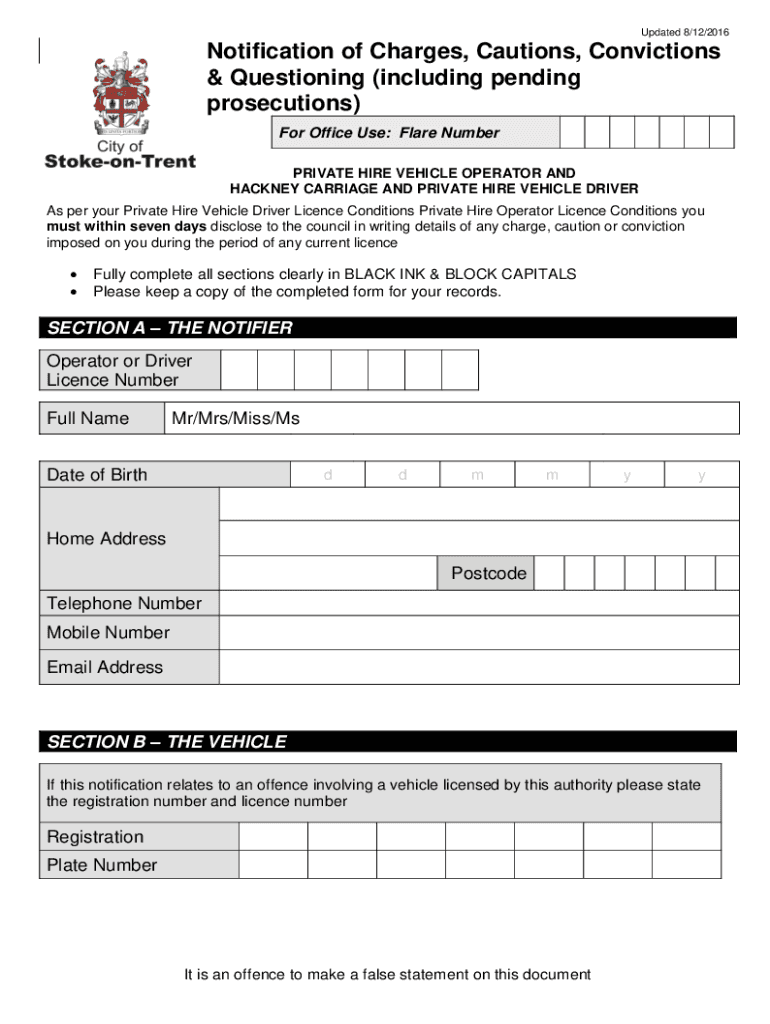
The "Webapps Stoke UK Uploaded Files: Taxi Charges Notification of Charges, Cautions, Convictions, and Questioning" form is integral for taxi operators and drivers in Stoke, UK, to formally inform the local council of any charges, cautions, or convictions. This form ensures compliance with regulatory requirements and helps maintain public safety by ensuring that individuals with certain legal issues are appropriately monitored.
The notification must be submitted within seven days of any relevant legal issue. This requirement illustrates the form's role in promoting transparency between vehicle operators and regulatory bodies. It underscores the importance of maintaining an honest and open communication channel regarding a driver's legal status.
How to Use the Form
Using this form involves several steps. First, obtain the form from the relevant local council’s website or office. The driver or operator must fill in the necessary personal and vehicle information accurately. It's essential to pinpoint the specific type of notification being reported, such as a charge or a conviction.
- Start by reading the entire form: It is crucial to understand all requirements before beginning.
- Fill in personal details: This includes your name, address, and contact information.
- Vehicle details section: Provide information about the taxi operated, such as make, model, registration number, etc.
- Detail the legal issue: Clearly state the charge, caution, or conviction, including dates and legal references.
- Submit the form: Once completed, submit the form as per the specified method by the local council, often via mail or online.
How to Obtain the Form
The form can be acquired through the Stoke council's website or by visiting a local government office. It is often housed under sections related to public transport or vehicle licensing.
- Online Access: Navigate the council’s website, typically in the public services or transportation section, to download the form.
- In-person: Visit the local council office and request a physical copy.
- Request via email or phone: Contact the council’s department responsible for public transport or licensing for direct assistance.
Steps to Complete the Form
- Gather Required Information: Before starting, ensure you have all necessary personal, vehicle, and legal documentation.
- Fill out Personal Information: Include your name, address, and license details.
- Complete Vehicle Information: Provide details of the taxi, such as vehicle registration and the operating license number.
- Detail Legal Matters: Clearly outline the specific charge, caution, or conviction, and any questioning related to the legal matter.
- Declare Honesty and Accuracy: Sign the form to confirm that the provided information is accurate.
- Submit the Form: Follow instructions for submitting the form, whether by mail, online, or in person.
Each of these steps is designed to facilitate seamless communication with regulatory bodies and adherence to legal obligations.
Legal Use and Implications
The major legal implication of this form is compliance with local regulations for taxi operators and drivers. Non-compliance could result in penalties, fines, or even revocation of the operating license. Thus, it is imperative to adhere to all guidelines while filling out the form.
- Ensure Timeliness: Submissions must be within the mandated seven-day period to avoid penalties.
- Accuracy: Verify all details to prevent legal repercussions due to incorrect information.
Important Terms Related to the Form
Understanding key terms related to this form enhances accurate completion:
- Charge: A formal accusation that someone has committed a crime.
- Caution: A formal warning given by police in place of prosecution for minor offences.
- Conviction: A formal declaration that someone is guilty of a criminal offence.
- Questioning: Inquiries conducted by authorities regarding potential involvement in illegal activities.
These terms underline the form's purpose in maintaining transparency and ensuring that all participants in the transport sector are lawfully compliant.
Submission Methods
Submitting the form involves choosing the most convenient method as authorized by the local council.
- Online Submission: Most councils offer an online portal for digital submissions.
- Mail Submission: Complete the form and mail it to the address provided by the council.
- In-Person Submission: Deliver the form directly to the relevant council office.
Each submission method requires confirming receipt or requesting a confirmation to ensure that the compliance process is officially recognized.
Key Elements of the Form
The form is divided into several critical sections:
- Personal Information: Collects details about the individual notifying the council.
- Vehicle Information: Documents specific vehicle details used for public transport.
- Legal Notification Details: Provides detailed information on the charges, cautions, or convictions.
- Declaration and Signature: Certifies that the information provided is accurate and true.
Each section’s completion is instrumental in maintaining transparency and ensuring that the reporting process fulfills legal adequacy requirements.
Penalties for Non-Compliance
Failure to comply with the requirements of this form could lead to significant penalties:
- Fines: Monetary penalties imposed for delayed or non-submission.
- License Suspension: Temporary removal of the rights to operate a vehicle.
- Revocation of License: Permanent removal of the operating rights for repeated non-compliance.
Understanding these penalties highlights the importance of timely and accurate submissions to avoid severe repercussions.
Practical Examples
Real-world scenarios illuminate the practical use of this form:
- Example 1: A taxi driver receives a speeding ticket. Within seven days, they must notify the council of this charge using the form.
- Example 2: An operator's court conviction for an unrelated crime requires immediate submission of the form to illustrate compliance.
- Example 3: A caution received after a minor altercation needs documenting to reassure the council of continued suitability for operating services.
These examples demonstrate the form’s role in maintaining accountability among drivers and vehicle operators in the community.




