
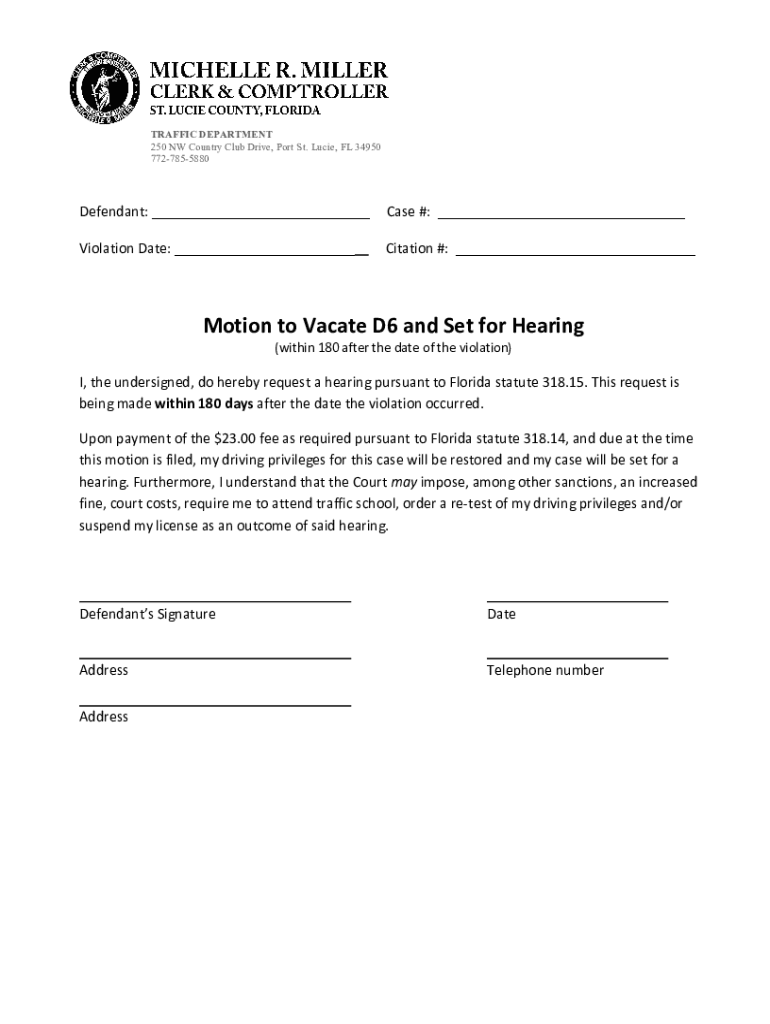







Definition and Meaning
The "Motion to Vacate D6 Less than 180" form is a legal document used primarily in the state of Florida. It allows a defendant to request the court vacate, or set aside, a traffic violation judgment within 180 days of the original violation date. This motion is typically filed as part of a process to contest or re-evaluate the conditions under which the violation was issued. Key elements include the defendant's personal information and details of the traffic violation being contested.
How to Use the Motion to Vacate D6 Less than 180
To utilize the Motion to Vacate D6 Less than 180 effectively:
- Review the Violation: Understand the specifics of the traffic violation you wish to contest.
- Complete the Form: Fill out the necessary sections, including personal details and specifics about the violation.
- Attach Supporting Documents: Include any relevant evidence, such as photographs or witness statements, that supports your case.
- Submit the Motion: File the completed form with the court, either in person or via designated submission methods.
- Attend the Hearing: If granted, attend the scheduled court hearing to present your case.
Steps to Complete the Motion to Vacate D6 Less than 180
-
Gather Information:
- Personal identification details: name, contact information, and driver's license number.
- Details of the traffic violation: date, time, location, and nature of the offense.
-
Fill Out the Form:
- Enter your personal information accurately.
- Clearly state your reasons for requesting the motion to vacate the judgment.
-
Collect Supporting Documents:
- Evidence that may support your claim or offer an explanation for the violation.
- Any correspondence related to the violation, such as notification letters or emails.
-
File the Motion:
- Submit the form at the appropriate traffic court, adhering to local guidelines.
- Pay any required filing fees.
-
Await Response and Attend Hearing:
- Monitor communications from the court regarding your motion.
- Prepare to present your case at a scheduled hearing if applicable.
Required Documents
When filing the Motion to Vacate D6 Less than 180, ensure you have the following documents ready:
- Completed Motion Form: Fully filled with no sections left incomplete.
- Identification: A government-issued ID or driver's license.
- Proof of Violation Details: Copies of traffic tickets or court documents related to the violation.
- Evidence and Supporting Documents: Photographic evidence, witness affidavits, or other documentary support for your motion.
Legal Use of the Motion to Vacate D6 Less than 180
The legal purpose of this motion is to allow defendants a fair opportunity to challenge a traffic violation ruling. It ensures that any judgments passed align with lawful procedure and justice, particularly when new evidence or changed circumstances warrant reconsideration. Legally, this motion must be filed within the specified 180 days from the date of the violation to be considered valid by the court.
Key Elements of the Motion to Vacate D6 Less than 180
- Defendant Information: Accurate identification and contact details.
- Case Description: Clear outline of the violation and grounds for the motion.
- Supporting Evidence: Documentation to uphold your request to vacate the ruling.
- Signatures: Legal acknowledgment of the filing with dates and necessary attestations.
Filing Deadlines and Important Dates
The central rule with this motion is the 180-day filing deadline post-violation. Late filings are typically dismissed unless exceptional circumstances are demonstrated. Recipients must:
- Track File Date: Know the exact offense and filing deadline dates.
- Meet Court Schedules: Adhere to any additional court-issued deadlines post-filing.
- Respond Promptly: Ensure all correspondence with the court or responding parties adheres to given timelines.
State-Specific Rules for the Motion to Vacate D6 Less than 180
Given that this is a Florida-specific form, users should be aware that rules may differ significantly from other states. Understand the following:
- Court Procedures: Each Florida circuit may have unique procedures for responding to these motions.
- Fee Structures: The cost associated with filing can vary, so checking specific regional rates is prudent.
- Documentation Requirements: Some jurisdictions may request additional documentation for evidence or validation purposes.




