







Definition & Meaning
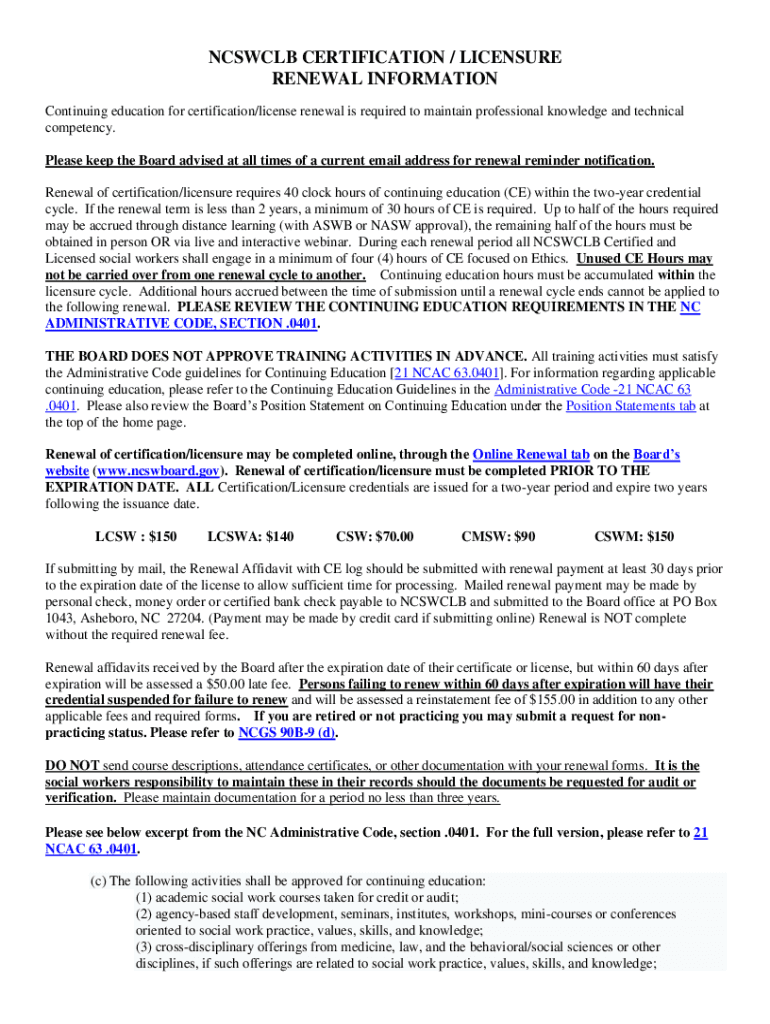
The "North Carolina Social Work Certification and Licensure" is a regulatory framework designed to ensure that social workers in North Carolina meet certain professional standards. It provides guidelines for obtaining and maintaining credentials as social workers in the state. These credentials demonstrate that a social worker has met educational and clinical competency requirements, ensuring that they are equipped to offer professional services to individuals and communities. The licensure process is supervised by the North Carolina Social Work Certification and Licensure Board (NCSWCLB), which sets the standards for entry into the profession and monitors ongoing compliance with ethical and practical standards.
How to Obtain the North Carolina Social Work Certification and Licensure
To become certified or licensed as a social worker in North Carolina, applicants must follow a multi-step process:
-
Educational Requirements: A bachelor’s or master’s degree in social work from a program accredited by the Council on Social Work Education (CSWE) is typically required.
-
Examination: Applicants must pass the appropriate examination administered by the Association of Social Work Boards (ASWB). There are several levels of exams based on the type of licensure being sought, such as the Bachelor, Master, or Clinical level.
-
Application Submission: After passing the exam, candidates must submit an application to the NCSWCLB, including all required documentation and fees.
-
Background Check: A criminal background check is mandatory, ensuring that all applicants are in good standing and do not pose a risk to clients.
-
Clinical Social Work Experience: For certain licensure types, like the Licensed Clinical Social Worker (LCSW), applicants must complete a specified amount of supervised clinical experience.
Steps to Complete the North Carolina Social Work Certification and Licensure
Detailed steps are necessary to successfully complete the licensure process:
- Complete Educational Prerequisites: Obtain a CSWE-accredited degree in social work.
- Gather Required Documentation: Ensure all academic transcripts, exam scores, and references are ready.
- Apply for Licensure: Submit an application to the NCSWCLB with supporting documents and application fees.
- Schedule and Pass the Examination: Register and take the relevant ASWB exam.
- Complete Supervised Practice (if required): Work under supervision for a certain period, meeting the criteria for clinical hours if aiming for clinical licensure.
- Await Approval: Once all materials are submitted, wait for the Board’s decision on the application.
Important Terms Related to Certification and Licensure
Understanding key terminology is crucial to navigating the certification and licensure process:
- ASWB Examination: A standardized test crucial for licensure that evaluates a candidate's knowledge in social work practices.
- NCSWCLB: The North Carolina Social Work Certification and Licensure Board, which oversees and regulates social work practice in the state.
- CSWE: The Council on Social Work Education, which accredits social work education programs in the U.S.
- Supervised Clinical Hours: A period of practical, supervised experience required for certain types of licenses, crucial for demonstrating practical expertise.
- Continuing Education (CE): Ongoing professional learning required to renew certifications and ensure best practices.
Eligibility Criteria
To be eligible for licensure, applicants must meet several criteria:
- Educational Background: Hold a degree in social work from a CSWE-accredited program.
- Citizenship or Legal Residency: Be a U.S. citizen or legal resident, to work legally within North Carolina.
- Legal and Professional Good Standing: No prior criminal convictions that would affect professional practice.

Required Documents
Applicants must prepare and submit several key documents:
- Official Transcripts: Directly from your educational institution verifying degree completion.
- Exam Scores: Proof of passing the appropriate ASWB examination level.
- Completed Application Form: Accurately filled out with personal and professional information.
- Background Check Report: Conducted by the state or authorized agencies to ensure compliance with legal requirements.
Application Process & Approval Time
The application process involves submitting all necessary forms and fees to the NCSWCLB. After submission, the review process typically takes several weeks. Applicants must account for the time required to conduct background checks and verify credentials. Upon successful review, applicants will be notified of their licensure status and any additional steps or documentation needed to finalize the process.
Penalties for Non-Compliance
Non-compliance with certification and licensure requirements can result in severe penalties, including:
- Revocation of License: Professional licenses can be revoked for not adhering to CE requirements or ethical violations.
- Fines and Penalties: Failing to renew on time or misrepresenting qualifications may incur financial penalties.
- Restrictions on Practice: Incomplete or incorrect submissions might delay the ability to practice legally.




