







Definition & Meaning
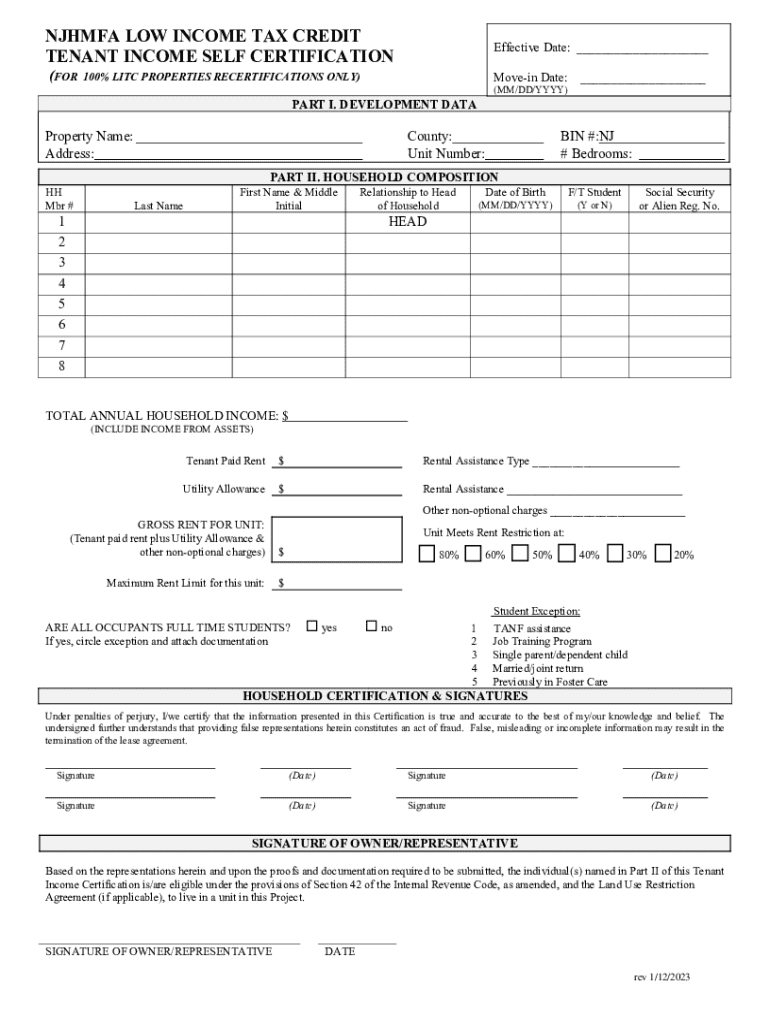
The Tenant Income Self-Certification form is a crucial component of the NJHMFA Low Income Tax Credit program. This form is specifically designed to verify the income levels of tenants residing in 100% LITC properties to ensure compliance with program eligibility requirements. By accurately capturing household compositions, income sources, and rental agreements, tenants can confirm their qualification for low-income housing benefits.
Key Elements of the Form
- Household Composition: Identify all household members living in the rental unit, along with their respective relationships to the primary tenant.
- Income Details: Collect detailed information about income sources for each household member, covering wages, public assistance, and any other financial contributions.
- Rental Information: Confirm the rental terms and agreements, including monthly rent and lease conditions.
Steps to Complete the NJHMFA Low Income Tax Credit Tenant Income Self-Certification
- Gather Necessary Information: Before beginning, gather all pertinent details regarding household members, income sources, and rental agreements.
- Fill Out Household Composition: Start by listing each member living in the residence, including their full name, date of birth, and relationship to the primary tenant.
- Report Income Sources: Accurately record all sources of income for the household, ensuring to include both earned and unearned income, such as wages, social security benefits, and alimony.
- Document Rental Terms: Note down the specific terms of your rental agreement, including the monthly rent amount and lease period.
- Review and Sign: Double-check all entries for accuracy before providing signatures from the tenant and property owner to affirm the validity of the information.
Eligibility Criteria
To qualify for the NJHMFA Low Income Tax Credit, tenants must meet specific income thresholds that align with program standards. The form helps determine eligibility by verifying household income relative to state and federal guidelines.

Prerequisites for Eligibility
- Income Limits: Must fall within prescribed income limits, often set as a percentage of the area's median income.
- Household Size: Adjustments for different household sizes ensure fair assessment under program norms.
Legal Use of the NJHMFA Low Income Tax Credit Tenant Income Self-Certification
The form serves as a legal document that verifies a tenant's eligibility for involvement in the NJHMFA Low Income Tax Credit program. By signing, both the tenant and property owner agree to the truthfulness and accuracy of the information provided, which can be used for legal and compliance checks.
Legal Implications
- Misrepresentation Penalties: Providing false information may lead to penalties or disqualification from the program.
- Compliance Assurance: Regular audits and checks ensure that the certifications remain accurate over time, protecting both tenants and landlords from potential legal challenges.
How to Obtain the NJHMFA Low Income Tax Credit Tenant Income Self-Certification
Methods of Acquisition
- Direct Download: Access the form online from the official website of the NJHMFA or through authorized housing agencies.
- Property Manager: Obtain a copy directly from the property management office where you reside.
- Community Housing Resources: Visit community centers or housing assistance forums that offer these forms.
Important Terms Related to the NJHMFA Low Income Tax Credit Tenant Income Self-Certification
Understanding pertinent terms can aid in accurately completing and understanding the form.
- LITC Properties: Properties that qualify under the Low Income Tax Credit program.
- Self-Certification: The process by which a tenant verifies personal and financial information as accurate.
- Household Income: The sum of all income sources for individuals living under one roof, crucial for determining eligibility.
State-Specific Rules for the NJHMFA Low Income Tax Credit Tenant Income Self-Certification
While the form is standardized, some state-specific rules may influence how income and household composition are reported. This can affect eligibility and benefit distribution.
Different States, Different Rules
- Income Thresholds: These may vary based on cost of living and economic conditions in different states.
- Documentation Requirements: States might have varying requirements regarding the supplementary documents needed alongside the form.
Digital vs. Paper Version
The form is accessible in both digital and paper formats, offering flexibility in how it can be filled and submitted.
Pros and Cons
-
Digital Version:
- Pros: Offers convenience through electronic submission, easier access to modify and correct.
- Cons: Requires internet access and basic digital literacy.
-
Paper Version:
- Pros: Offers a tangible record that some may find easier to complete.
- Cons: Slower submission process, riskier in terms of document preservation.




