




01. Edit your form online
Type text, add images, blackout confidential details, add comments, highlights and more.

Type text, add images, blackout confidential details, add comments, highlights and more.

Draw your signature, type it, upload its image, or use your mobile device as a signature pad.

Send it via email, link, or fax. You can also download it, export it or print it out.
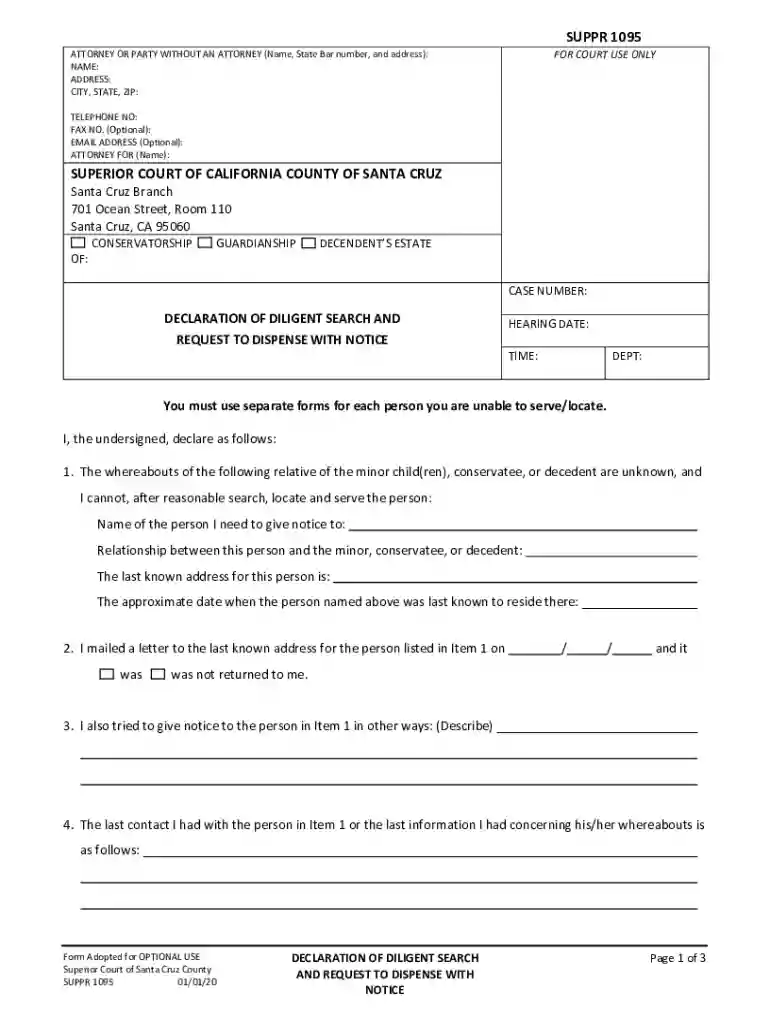
The "Superior Court of California, County of Santa Cruz" (SCCCSC) operates as a trial court for the county, conducting judicial proceedings for civil, criminal, family, and probate cases. It is part of California's judicial system, addressing legal matters within the geographical jurisdiction of Santa Cruz County. This court also handles specific functions such as juvenile law and traffic violations, serving its civil obligation to maintain justice.
When engaging with the SCCCSC, individuals need to follow proper legal procedures. This involves filing the appropriate legal forms or petitions, attending court hearings, and complying with court orders. The use of the court involves understanding its schedule, the availability of judges, and the procedural details required for various types of cases like probate or small claims. Utilizing the court often includes navigating its administrative offices to file paperwork or request information.
Forms for the SCCCSC can be accessed through various means. The most straightforward approach is visiting the official court website, where forms can be downloaded in PDF format. Alternatively, physical forms can be obtained by visiting the court's self-help center or customer service windows. For more complex cases, legal advice from a lawyer or court facilitator may be needed to ensure the correct forms are sourced and completed.
Identify the Correct Form: Determine which form is required for your specific legal issue. Refer to the court's official site or a legal advisor for guidance.
Fill Out Personal Information: Enter the necessary personal details such as name, address, and contact information, ensuring accuracy to avoid delays.
Detail the Legal Issue: Clearly and concisely outline the facts of your case or request, providing all required information as indicated on the form.
Attach Relevant Documents: Compile and include any supporting documentation that substantiates your claims or requests, such as evidence or prior judgments.
Review and Sign: Carefully review all entered information for accuracy and comprehensiveness. Sign the form as required, possibly in the presence of a notary.
Submit the Form: Deliver the completed form either online through the court’s e-filing system, by mail, or in person at the court’s office.
Typical users of the SCCCSC include residents of Santa Cruz County with legal disputes or needs, such as marriage dissolution, criminal charges, estate and probate inquiries, or civil litigation. Additionally, nonprofits, businesses, and legal professionals frequently interact with the court, whether for corporate litigation, mediation proceedings, or handling legal affairs for clients.


Documents submitted to the SCCCSC must adhere to legal standards and practices. Legal use involves compiling accurate records for case hearings, maintaining privacy and confidentiality of sensitive information, and ensuring compliance with California state laws. Understanding the legal framework within which the SCCCSC operates ensures that any legal proceedings are conducted efficiently and justly.
Key elements in the operation of the SCCCSC include accessibility to justice, availability of legal resources, a diverse array of case types managed by the court, and transparency in judicial proceedings. The court’s infrastructure supports equitable access to its services, offering interpreters and assistance for those with disabilities, ensuring that justice is meted out fairly across different social and economic groups.
We've got more versions of the SUPERIOR COURT OF CALIFORNIA COUNTY OF SANTA CRUZ form. Select the right SUPERIOR COURT OF CALIFORNIA COUNTY OF SANTA CRUZ version from the list and start editing it straight away!
At DocHub, your data security is our priority. We follow HIPAA, SOC2, GDPR, and other standards, so you can work on your documents with confidence.


