




01. Edit your meal count online
Type text, add images, blackout confidential details, add comments, highlights and more.

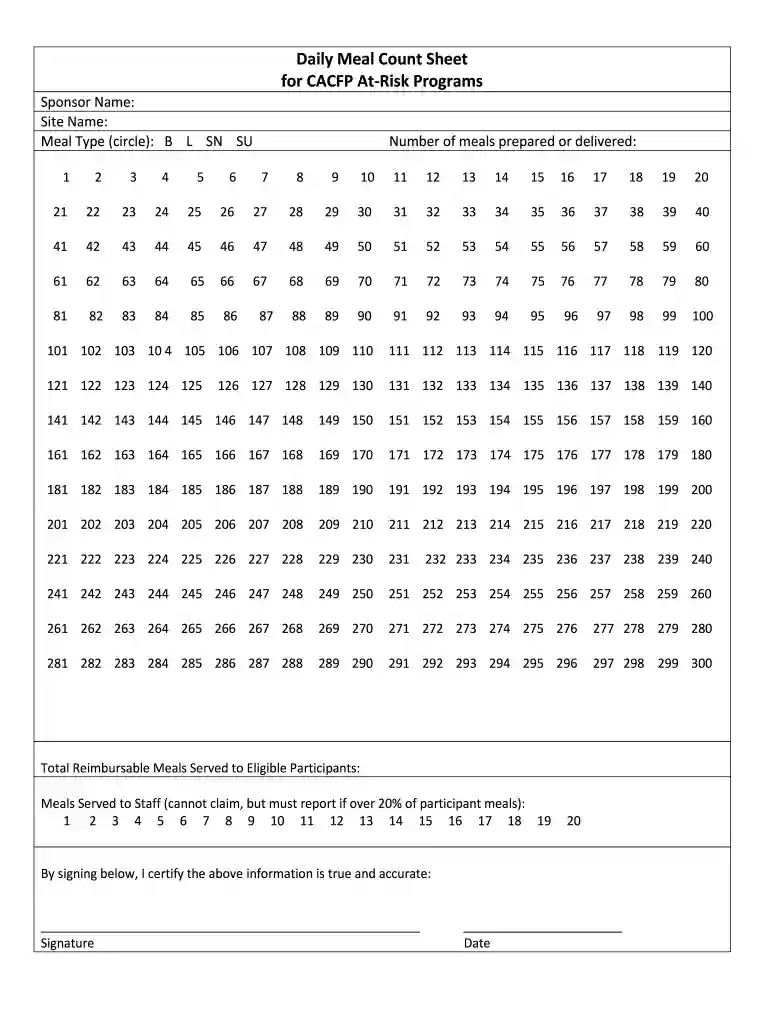
Type text, add images, blackout confidential details, add comments, highlights and more.

Draw your signature, type it, upload its image, or use your mobile device as a signature pad.

Send meal count sheet via email, link, or fax. You can also download it, export it or print it out.
The daily meal count sheet is a vital document for organizations participating in the Child and Adult Care Food Program (CACFP) and similar initiatives. It serves as a centralized tool for tracking the number of meals served to eligible participants and ensuring compliance with program requirements.
The primary purpose of the daily meal count sheet is to provide accurate records of meals prepared and delivered at a specific site. This consistency helps organizations:
Using this sheet enhances accountability and transparency, particularly in federally funded programs where accurate reporting is crucial.
The daily meal count sheet typically includes several sections designed to capture specific data:
This clear and organized structure allows for straightforward data entry and review.
Filling out the daily meal count sheet involves several steps to ensure all necessary information is accurately recorded:
Following these steps ensures that meal counts are thorough and reliable, supporting smoother audits and reviews.
Organizations may encounter several challenges when managing daily meal count sheets:
Addressing these challenges involves staff training, implementing digital solutions, or regular audits to improve data integrity.
Compliance with federal and state guidelines is essential when utilizing the daily meal count sheet. Organizations should take note of the following:
Legal compliance not only safeguards funding but also enhances the organization’s reputation within the community.
In practice, daily meal count sheets are employed by various organizations, including:
Such utilization demonstrates the versatility and importance of daily meal count sheets across different contexts, all aimed at promoting food security and nutritional health.
To enhance the efficacy of daily meal count sheets, organizations can implement several best practices:
By adopting these practices, organizations can enhance their meal tracking process and ensure compliance with necessary regulations.
You need to use only trustworthy software solutions with strong data protection compliance to sign your paperwork electronically. DocHub is just the type of service you need! It stores data on Amazon Web Servers and complies with all necessary security criteria and eSignature laws, so it’s a reliable way to eSign your meal count form or other forms using this tool.
Using a swift editing system like DocHub, you do not need anything but a web browser and connection to the internet to edit your daily meal count form on the internet quickly. Add your document or get the appropriate form in DocHub’s catalog, open our editor with a single click, and finish it digitally. To edit your forms at any time, sign up a free profile with DocHub.
At DocHub, your data security is our priority. We follow HIPAA, SOC2, GDPR, and other standards, so you can work on your documents with confidence.
Meal Count Forms for Schools. Meal Count Worksheet (DOC) Used to compare the daily free, reduced-price, and paid actual meal counts. Meal Count WorksheetRead more
Use the Healthy Eating Plate as a guide for creating healthy, balanced mealswhether served at the table or packed in a lunch box. Click on each section of.


