




01. Edit your fire drill report template online
Type text, add images, blackout confidential details, add comments, highlights and more.

Type text, add images, blackout confidential details, add comments, highlights and more.

Draw your signature, type it, upload its image, or use your mobile device as a signature pad.

Send fire drill report form via email, link, or fax. You can also download it, export it or print it out.
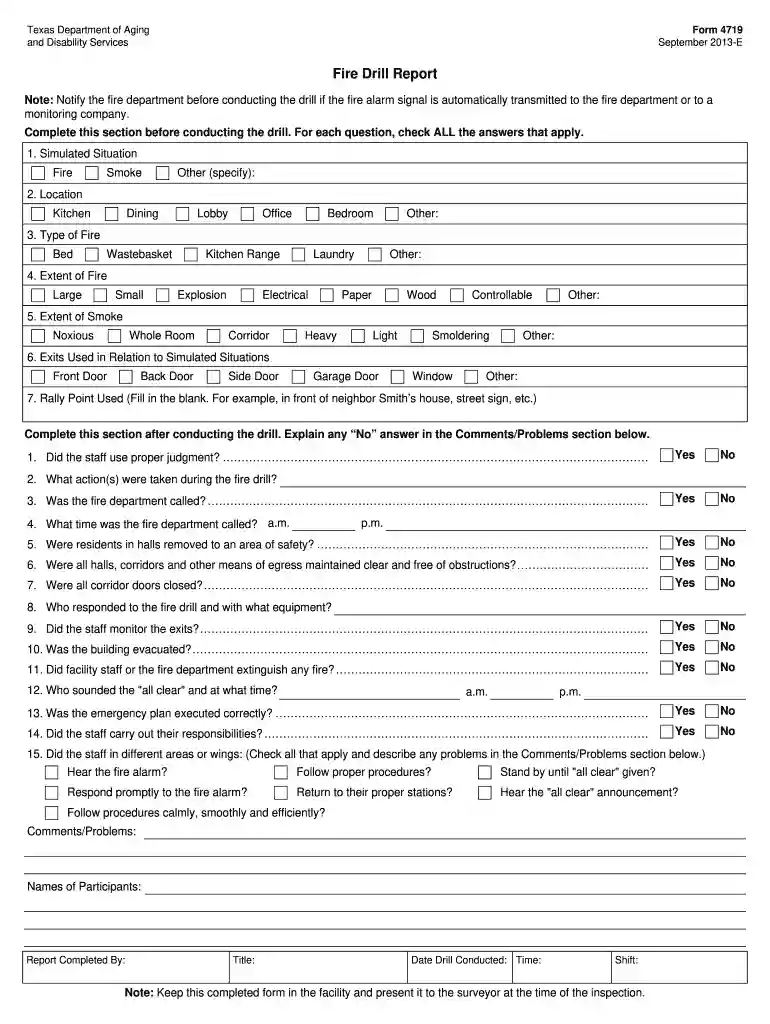
The fire drill report form serves as an essential document used in various facilities to record the details of fire drills conducted for safety compliance and preparedness training. It captures a comprehensive assessment of participant actions, execution of safety protocols, and evaluation of performance during simulated fire situations. The form is primarily utilized by educational institutions, healthcare facilities, and organizations governed by safety regulations.
This reporting document typically includes information such as the date and time of the drill, the nature of the drill (e.g., full evacuation or shelter-in-place), the designated safety officer, and a log of participant attendance. It also highlights any issues encountered during the drill, such as evacuation delays or communication failures, which are critical for future training and safety improvements.
Using the fire drill report form requires a methodical approach to ensure thorough documentation. It can be employed to articulate the drill process effectively and provide a valuable resource for improving safety protocols.
Completing a fire drill report form necessitates a structured approach to capture all vital information effectively. Follow these steps to ensure comprehensive coverage:
Understanding the terminology associated with the fire drill report form helps facilitate clear communication and enhances compliance with safety regulations. Key terms include:
The fire drill report form is utilized by a diverse range of professionals and organizations concerned with safety and compliance. Typical users include:


The legal implications surrounding the fire drill report form highlight the importance of maintaining safety standards within various facilities. In many states, documentation of fire drills is required to demonstrate compliance with local fire codes and regulations.
Real-world scenarios illustrate the practical application of the fire drill report form in enhancing safety preparedness.
A school district implements a fire drill at all schools. Each facility uses the report to document attendance, drill timing, and any issues encountered, ensuring compliance with state-mandated safety drills. The compiled reports serve as evidence of their commitment to safety during inspections.
A nursing home conducts quarterly fire drills to ensure both staff and residents can evacuate safely. Post-drill evaluations using the report form reveal that some staff members struggled with the evacuation route. These insights lead to targeted training sessions and updates to the evacuation plan.
A corporation includes annual fire drills in their workplace safety strategy. The report forms are critical for tracking participant responses and identifying training deficiencies, allowing them to refine their safety measures regularly.
By experiencing these situations firsthand, organizations can better appreciate the value of the fire drill report form in enhancing safety protocols and ensuring compliance with legal and regional requirements.
At DocHub, your data security is our priority. We follow HIPAA, SOC2, GDPR, and other standards, so you can work on your documents with confidence.
Fire Drill Response Form. Section 1: General Information. Section 2: Alarm Information. Did all alarm devices on your floor activate? Section 3: EvacuationRead more
While moving, Shadow Pinion spawns projectiles in the form of drills that spawn behind the character, which slowly accelerate backwards and deal damage toRead more
FIRE/EMERGENCY EVACUATION DRILL RECORD Monthly emergency evacuation drills are required under ORS 479.041(1). The first drill of each school year shall beRead more


