
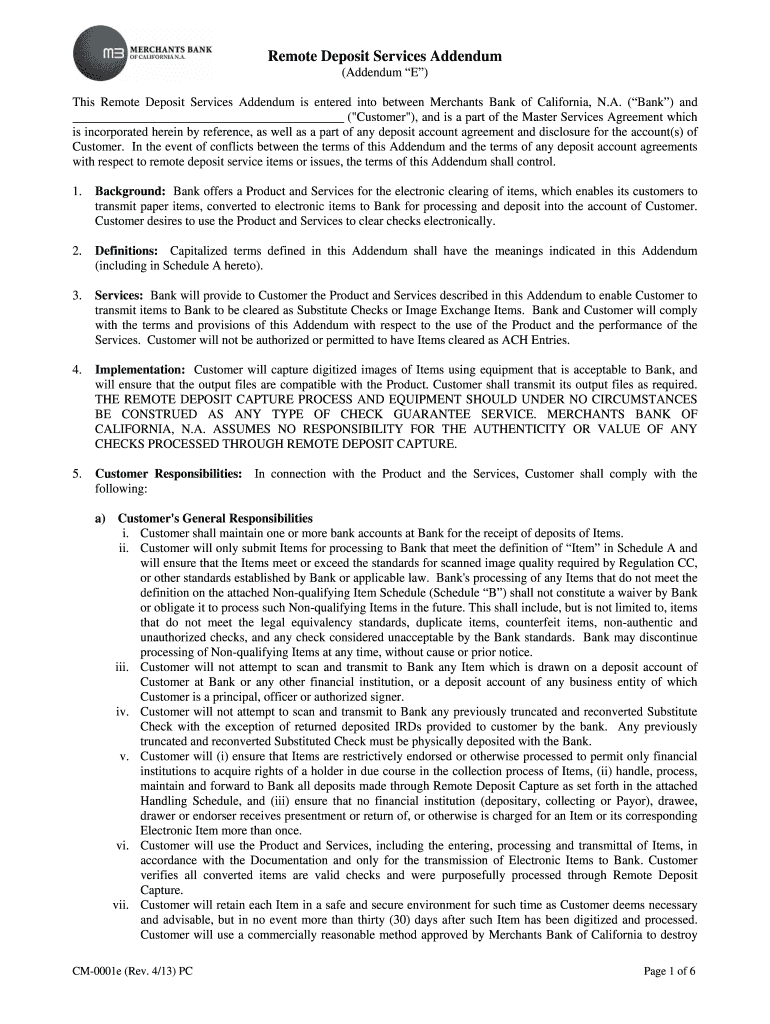







Definition & Meaning
The Remote Deposit Services Addendum is an agreement established between Merchants Bank of California and its customers which defines the terms for the electronic processing and deposit of checks. This document outlines the mutual responsibilities of the bank and its customers, including terms and protocols for capturing, transmitting, and safeguarding check images. Key aspects include compliance with relevant legal regulations, ensuring a clear understanding of the services offered, and detailing the proper implementation of procedures.
How to Use the Remote Deposit Services Addendum
To effectively utilize the Remote Deposit Services Addendum, customers must familiarize themselves with the outlined steps for capturing and transmitting check images. Key actions include:
- Setting Up Equipment: Ensure that your scanning equipment is compatible with the system requirements as specified in the addendum.
- Image Transmission: Follow the transmission protocols detailed in the document for uploading check images to the bank's system securely.
- Security Compliance: Adhere to the security measures outlined, including password protections and encryption, to safeguard sensitive financial data.
Steps to Complete the Remote Deposit Services Addendum
Completing the addendum requires a thorough understanding of each section. Here are the main steps:
- Read the Agreement: Carefully review definitions, terms, and conditions to understand the bank's and customer's responsibilities.
- Personal Information: Accurately enter your business details and any relevant personal information required by the bank.
- Acknowledgement and Compliance: Sign and acknowledge compliance with all security protocols and user responsibilities.
- Submit to Bank: Once completed, submit the document to the bank via the specified channels, ensuring all required signature fields are properly filled.
Key Elements of the Remote Deposit Services Addendum
The addendum includes several critical components that define its scope:
- Service Description: Detailed explanation of the services being provided by the bank, including technological requirements and limitations.
- Responsibilities: Outline of customer duties, including adhering to the processes for secure image capture and transmission.
- Bank Rights: States the bank's rights in terms of suspending or terminating services if compliance is not maintained.
- Fees and Charges: Specification of any applicable fees associated with the use of remote deposit services.
Who Typically Uses the Remote Deposit Services Addendum
Primarily catered to businesses, the addendum serves individuals or companies frequently depositing checks. Typical users include:
- Small to Medium Enterprises: Especially those without immediate access to bank branches.
- Retail Businesses: Companies needing quick access to check processing for cash flow management.
- Remote Workers: Individuals or freelancers who receive major payments via checks and require a seamless deposit process.


Important Terms Related to the Addendum
Grasping the terminology used in the addendum is essential. Important terms include:
- Check Image: A digital representation of the physical check that needs to be transmitted.
- Encryption: The method used to protect sensitive data during transmission.
- Transmission Protocol: The system used to securely upload check images to the bank.
Legal Use of the Remote Deposit Services Addendum
Legal compliance is crucial in the use of this addendum. It ensures both parties understand the legal ramifications of their activities:
- Adherence to Electronic Funds Transfer Act (EFTA): Ensures compliance with federal regulations related to electronic deposits.
- Liability Clause: Limits bank liability concerning the authenticity of checks and imposes accountability on customers for verifying validity before deposit.
State-Specific Rules
While this addendum applies broadly, some nuances may vary by state due to differing state laws:
- State Regulations: Compliance with local statutes regarding electronic transactions is necessary, as these can affect implementation.
- Banking Guidelines: State-specific banking laws may dictate additional requirements to be followed.
Examples of Using the Remote Deposit Services Addendum
Practical examples illustrate the utility of this addendum:
- Retail Application: A retailer can utilize the addendum by capturing daily sales receipts and transmitting them for immediate deposit.
- Freelance Services: A freelancer receives a large client payment by check and deposits it remotely, reducing wait times for payment clearance.
Application Process & Approval Time
Understanding the timeline and steps involved provides clarity on the operational setup:
- Application Submission: Complete and submit the necessary application documents as outlined by the bank.
- Evaluation Period: The bank reviews the submission for compliance and accuracy, typically within a set timeframe.
- Approval Notification: Customers receive notification once the application is approved and services are active.
Penalties for Non-Compliance
Non-compliance with the addendum can result in penalties. These may include:
- Service Termination: The bank reserves the right to suspend remote deposit privileges for breaches.
- Financial Penalties: Monetary penalties may be imposed for repeated non-compliance with security protocols or service misuse.
Eligibility Criteria
Certain criteria must be met to qualify for these services:
- Business Legitimacy: Proof of business legitimacy and operational transparency.
- Financial Stability: Demonstrated financial stability and history of successful check processing.

Digital vs. Paper Version
The addendum is typically presented in digital format but may also be available in paper for record-keeping:
- Efficient Processing: The digital version allows quicker submission and processing, while the paper version provides a tangible record.
- Accessibility: Digital formats are accessible from remote locations, catering to users without immediate access to banking facilities.




