




01. Edit your msp onboarding questionnaire online
Type text, add images, blackout confidential details, add comments, highlights and more.

Type text, add images, blackout confidential details, add comments, highlights and more.

Draw your signature, type it, upload its image, or use your mobile device as a signature pad.

Send it via email, link, or fax. You can also download it, export it or print it out.
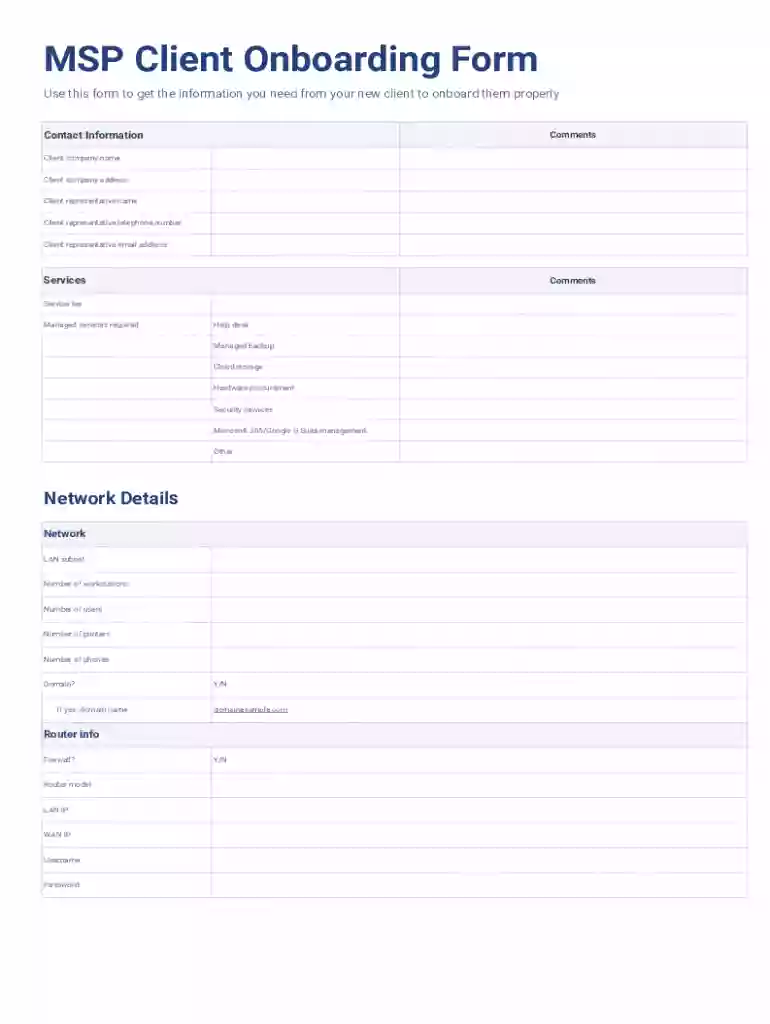
The MSP Client Onboarding Form is a crucial instrument utilized by Managed Service Providers (MSPs) to gather essential information from new clients during the onboarding process. This form plays a vital role in understanding the specific needs and configurations of a client’s IT infrastructure. By capturing detailed information such as contact details, services required, network setups, software applications, and emergency protocols, the form helps MSPs tailor their services effectively to meet client requirements.
Understanding the significance of this form allows both the MSP and the client to establish clear expectations and ensure a smooth transition and ongoing service.
The MSP Client Onboarding Form is structured to capture various critical data points, ensuring comprehensive client profile creation. Key elements typically include:
Each section ensures that the MSP has a complete understanding of the client's environment, enabling tailored service delivery.
Using the MSP Client Onboarding Form effectively involves several steps to ensure accurate data collection and a smooth onboarding process. Here’s how it typically works:
Initiation of the Onboarding Process: The onboarding process generally begins after a client consents to engage the services of an MSP. At this stage, the form is introduced as a critical component for collecting pertinent client information.
Client Data Collection: The client is asked to fill out the form, entering all relevant information regarding their technological landscape and preferences for services.
Review and Verification: Once the form is completed, the MSP reviews the information provided, ensuring that there are no omissions or inaccuracies. This may involve follow-up communications with the client for clarification.
Form Submission: The finalized form is submitted and securely stored. Depending on the platform utilized by the MSP, this can be a digital submission through forms integrated into service management software.
The form acts as a foundation for creating a service agreement, ensuring both parties are aligned with the scope of work.
Completing the MSP Client Onboarding Form is a critical step-to-step process for ensuring all necessary information is captured. Here’s a detailed breakdown of the steps:
Provide Contact Information: Begin with entering detailed contact data of individuals involved in IT decisions.
Specify Required Services: Clearly indicate which managed services are being sought. This could include a wide range of IT services like network management or data protection.
Describe Network Specifications: Detail the existing network configurations, including network hardware and software in use.
List Software Applications: Provide a comprehensive list of all major software applications used, including proprietary and third-party tools.
Enter Emergency Contact Information: Identify emergency contacts to facilitate communication in critical situations.
These steps ensure the form is completed accurately and that the MSP receives all needed information to support the client effectively.
The primary users of the MSP Client Onboarding Form are Managed Service Providers and their clients. Here's a closer look at who benefits from this form:
This form streamlines the onboarding process for all parties by providing a structured way to document and communicate technology service needs.


Understanding certain technical terms related to the MSP Client Onboarding Form can aid in its effective use. Here are a few:
These terms are foundational to the discussions and collaboration between an MSP and its clients.
The legal use of the MSP Client Onboarding Form revolves around the compliance with data protection and privacy laws. Here's what to consider:
These legal considerations help in maintaining trust and transparency between service providers and their clients.
Specific types of businesses particularly benefit from using the MSP Client Onboarding Form due to their reliance on IT infrastructure. These include:
Each business type benefits from the structured data collection and service personalization facilitated by the onboarding form.
At DocHub, your data security is our priority. We follow HIPAA, SOC2, GDPR, and other standards, so you can work on your documents with confidence.


